Is your high-end optic one bumpy van ride away from becoming an expensive paperweight? It's a question every serious player should ask before tossing their kit into the boot. You've spent hundreds on your AEG or gas blowback rifle, so selecting a high-quality airsoft gun case isn't just about aesthetics; it's about operational readiness. We all know the anxiety of transporting gear through public spaces or the frustration of finding your mags scattered and scratched because of poor organisation.
Protecting your investment requires more than a basic padded sleeve. This expert guide helps you master the art of gear protection by choosing the right kit for your specific loadout. We'll show you how to customise foam inserts for a professional look while ensuring your setup provides complete protection from knocks and moisture. You'll also get a clear brief on UK transport laws to keep your travel legal and stress-free. From organising batteries to securing delicate sights, we're covering the technical nuances that keep you field-ready and your equipment in peak condition.
Key Takeaways
- Compare the protection-to-weight ratio of soft bags versus hard cases to determine the best fit for your storage and transit needs.
- Understand how IP67 seals and specialised foam types prevent moisture damage and keep your optics perfectly zeroed during rough handling.
- Stay compliant with UK law by mastering the requirements for discreetly transporting your airsoft gun case under the VCRA 2006.
- Learn how to use the 'trace and flip' customisation method to organise your RIFs and sidearms into a professional, field-ready layout.
Choosing Between Soft Gun Bags and Hard Rifle Cases
Soft Padded Bags: The Lightweight Skirmisher’s Choice
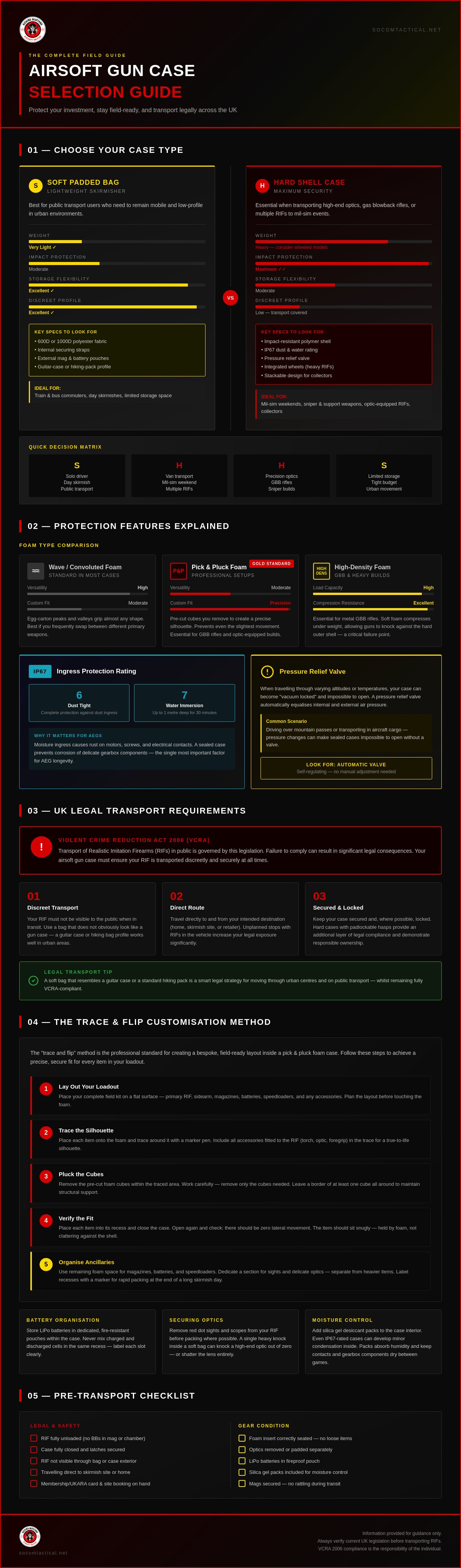
Soft bags are the go-to for players who rely on public transport. If you are travelling by train or bus, every kilogram counts. You don't want to be lugging a heavy plastic box across a station platform. Instead, look for bags made from high-denier fabrics like 600D or 1000D polyester. These materials are rugged enough to resist tears and prevent barrel poke-through. Most quality soft bags feature internal straps to stop your gear from shifting. A major advantage here is the external storage. You can easily fit your airsoft gun magazines, batteries, and speedloaders into dedicated pouches, keeping your entire loadout in one place. Just remember that under the Violent Crime Reduction Act 2006, your transport must be discreet. A soft bag that looks like a guitar case or a standard hiking pack can be a smart way to avoid unwanted attention whilst moving through urban centres.
Hard Shell Cases: Maximum Security for High-End RIFs
When you've invested in precision optical sights and red dots, a hard airsoft gun case is the only way to ensure your zero stays true. One heavy knock in a soft bag can knock a high-end optic out of alignment or, worse, shatter the lens. Hard cases use impact-resistant polymers to create a protective cocoon. If you're running a heavy support weapon or a long-range sniper rifle, look for models with integrated wheels. They'll save your back during the long walk from the car park to the safe zone. For collectors, hard cases offer the benefit of stackability. You can pile them high in a cupboard without worrying about the bottom rifle being crushed. It's about operational readiness; when you flip those latches at the site, you need to know your kit is exactly as you left it.
Essential Features for Maximum Protection: Foam, Seals, and Valves
Choosing the right airsoft gun case is only half the battle. To achieve true field-readiness, you need to look under the hood at the technical specs that actually keep your gear safe. A high-quality case acts as a survival cell for your RIF, protecting it from the mechanical stress of transport and the environmental hazards of a wet UK skirmish site. From the density of the foam to the integrity of the seals, these features determine whether your kit arrives in peak condition or requires a mid-morning repair in the safe zone.
Wave Foam vs. Pick and Pluck: Which is Better?
Foam isn't just padding; it's a shock absorber. Wave foam, often called convoluted foam, is the egg-carton style material you'll find in many standard cases. It's incredibly versatile because the peaks and valleys can grip almost any shape, making it perfect if you frequently swap between different primary weapons. However, for a truly professional setup, pick and pluck foam is the gold standard. It consists of pre-cut cubes that you remove to create a precise silhouette of your rifle. This tailored fit prevents even the slightest movement during transit. If you're running a heavy gas blowback rifle, high-density foam is essential. Lower-quality, soft foam will compress under the weight of a metal GBB, allowing the gun to knock against the hard outer shell.
IP67 Ratings and Pressure Relief Valves Explained
If you've ever opened your case to find a fine layer of orange rust on your motor or screws, you've experienced moisture ingress. An IP67 rating means the case is dust-tight and can handle immersion in water up to one metre deep for 30 minutes. This seal doesn't just stop rain; it blocks out humidity. Maintaining a bone-dry internal environment is the single most important factor for AEG longevity as it prevents the corrosion of delicate electrical contacts and gearbox components.
When you're travelling through varying altitudes or temperatures, you might find your case "vacuum locked" and impossible to open. This is where an automatic pressure relief valve comes in. It allows air to equalise whilst keeping water molecules out. It's a vital feature for anyone taking their gear on a flight or driving through the Highlands for a weekend event. Finally, never overlook security. Reinforced padlock points are a legal and practical necessity. Following the UK government guidance on firearms measures, keeping your RIF in a secure, lockable airsoft gun case is the best way to demonstrate responsible ownership. To ensure your case is fully loaded with the right spares, check out our latest airsoft RIF accessories to fill those custom foam cut-outs.
Legal Requirements for Transporting Airsoft Guns in the UK
Owning a high-performance RIF is a massive part of the hobby, but it comes with serious legal responsibilities. In the UK, the primary legislation you must respect is the Violent Crime Reduction Act 2006. This act dictates how we handle and move Realistic Imitation Firearms (RIFs) and two-tone Imitation Firearms (IFs). While you have a "reasonable excuse" to carry these items when travelling to and from a legitimate airsoft site, the way you pack your airsoft gun case can be the difference between a smooth journey and a police intervention. It is not just about protecting the kit; it's about protecting yourself from legal complications.
Safety protocols should be your first priority before you even leave the house. Never transport a RIF with a magazine inserted or a battery connected. This is a fundamental rule of the community. Disconnecting your LiPo or NiMH batteries prevents accidental discharges and demonstrates that you aren't carrying a weapon in a "ready-to-use" state. If you are stopped, being able to show that the gun is completely inert goes a long way in proving you are a responsible hobbyist. These small steps ensure that your gear remains a tool for sport rather than a cause for concern.
Discreet Transport: Avoiding Public Alarm
Discreet transport is non-negotiable. You must never "telegraph" the contents of your luggage to the general public. Brandishing an imitation firearm in a public space is a serious offence, and even a partially visible barrel or stock can cause significant alarm. According to the UK Crown Prosecution Service guidance on firearms, the police take incidents involving imitation weapons extremely seriously. A professional, non-descript airsoft gun case acts as your first line of legal defence. It ensures that your hobby remains private whilst you move through urban centres or use public transport. Whether your gun is a RIF or a bright two-tone IF, it must remain completely out of sight until you are inside the site boundaries.
Securing Your Gear: Padlocks and TSA Compliance
Security is about more than just preventing theft; it's about demonstrating total control over your equipment. You should always use padlocks on your case latches to prevent unauthorised access, especially if you are travelling with others. Whilst TSA-approved locks are specifically designed for international air travel, they are a solid investment for UK domestic travel if you use courier services like Parcelforce. These locks allow security professionals to inspect the contents without damaging your case. For more specific details on UKARA registration and the finer points of imitation firearm law, visit our FAQ page. Keeping your kit locked down shows you take the "operational" side of the hobby as seriously as the skirmish itself.
How to Customise and Organise Your Airsoft Gun Case
Customising your airsoft gun case is about more than just looking like a Tier 1 operator. It's about efficiency and protecting your internal components from unnecessary vibration. A well-organised case ensures you aren't digging through a pile of loose kit when you should be prepping for the next engagement. By creating dedicated slots for your primary RIF, sidearm, and accessories, you turn a simple transport box into a mobile armoury. It's a hallmark of a seasoned veteran who values operational readiness.
This meticulous approach to gear protection is common across many technical pastimes. For example, those who enjoy building intricate models from Narrow Minded Railworks often apply the same principles of secure, custom-fitted storage to ensure their delicate kits remain undamaged during transit.
Planning Your Layout for Rifles and Magazines
Before you touch a blade, lay everything out on the foam surface. You need to leave at least 2cm of foam between each item. If the walls are too thin, the foam will tear or lose its structural integrity over time. Always place the heaviest part of the RIF, usually the receiver and motor, closest to the handle side of the case. This prevents the weight from shifting downwards when you're carrying it. Don't forget to account for protruding parts like charging handles, oversized optics, or extended flash hiders. They need extra clearance to avoid being crushed against the case walls during rough transit.
The Art of Cutting Foam for a Professional Finish
A professional finish requires the right tools. Whilst a sharp craft blade works for small details, an electric carving knife is the secret weapon for deep, clean cuts through thick foam layers. Follow these steps for a perfect result:
- Place your kit on the foam and trace the outline with a white chalk marker or silver pen.
- Use the 'trace and flip' method: trace on the back of the foam layer, cut it out, and then flip it over so the marker lines are hidden at the bottom.
- Cut vertically. Any angle in your blade will result in a sloppy, uneven fit.
- Create 'bottoming' by adding a thin base layer of foam to keep items flush with the top.
You should always cut your slots slightly smaller than the actual item to ensure a tight friction fit that prevents any movement during transit.
For those who want the ultimate setup, 'Shadow Foam' uses high-contrast colours in the base layer. This makes it instantly obvious if a tool or a spare magazine is missing. It's a great way to track your consumables, ensuring you never turn up to a game without your speedloaders or green gas. A tidy case is a tidy mind. It reflects the grit and precision expected of an experienced practitioner. To finish your pro-level layout, browse our latest airsoft RIF accessories to fill those custom slots.
Finding the Perfect Fit amongst the Socom Tactical Inventory
Since 2009, Socom Tactical has been at the heart of the UK airsoft community. We don't just shift boxes; we provide the gear we'd trust in our own loadouts during a high-stakes weekend mil-sim. Selecting the right airsoft gun case is about precision and ensuring your specific setup fits perfectly with all its attachments. Our inventory is built on field-tested reliability. Whether you're running a compact PDW or a full-length sniper rifle, we have the storage solution to match your operational needs.
One of the best ways to get your setup right is by visiting our Fleet showroom. You can bring your kit and perform a 'test fit' to see exactly how much room remains for mags, batteries, and optics. It takes the guesswork out of the process and ensures your weight balance is spot on before you commit to cutting any foam. If you can't make it to the shop, our new products section is constantly updated with the latest in hard-case technology and impact-resistant polymers to keep you ahead of the curve.
Specialist Brands and Quality Assurance
We stock heavyweights like Nuprol and Tokyo Marui because these brands understand the grit of the hobby. Every item in our inventory is vetted for durability and field performance. We know that a case latch failing in a muddy car park is more than an inconvenience; it's a threat to your gear. If you're building a new loadout from scratch, our UK Tactical Gear Guide offers a deep dive into the essential equipment needed for modern skirmishers. It's about creating a cohesive, reliable system that stands up to the rigours of the field.
Expert Advice from the Socom Tactical Team
Our team isn't just a group of retail specialists. We are technical experts with years of repair experience. We've seen first-hand what happens when a RIF isn't stored correctly. From bent outer barrels to crushed hop-up units, poor storage causes avoidable damage that puts you out of the game. If you're unsure which airsoft gun case suits your airsoft guns, don't hesitate to contact us for bespoke advice. We can help you navigate dimensions and foam densities to get the best protection possible. Keep an eye on our back-in-stock section for the latest arrivals in protection gear. We ensure you stay field-ready and operational at all times.
Lock Down Your Loadout for Field Success
Choosing the right airsoft gun case is the final step in ensuring your kit performs exactly when you need it. Whether you've opted for the lightweight mobility of a soft bag or the crush-proof security of a hard shell, you now have the technical knowledge to organise your gear for maximum stability. By staying compliant with UK transport laws and mastering the custom foam cutting methods discussed, you've moved from being a casual player to a prepared practitioner. Your optics will stay zeroed, your internals will remain dry, and your transport will stay discreet.
Socom Tactical has been providing skirmish-ready gear since 2009, and our team is always on hand with expert UK-based technical support to help you choose the right fit. We stock a comprehensive range of Nuprol and specialist cases designed to withstand the grit of the local scene. Secure your gear today; browse our full range of airsoft gun cases at Socom Tactical and ensure your RIF is ready for the next high-stakes engagement. See you on the field.
Frequently Asked Questions
Is it illegal to carry an airsoft gun in a public place in the UK?
It is illegal to carry an imitation firearm in a public place without a "reasonable excuse," such as travelling to or from a legitimate skirmish site. Under the Violent Crime Reduction Act 2006, you must ensure your kit is transported in a secure, non-transparent airsoft gun case. This prevents causing public alarm and ensures you are acting within the law whilst moving between your home and the game centre.
Do I need a hard case for my airsoft gun if I travel by car?
You aren't legally required to use a hard case for car travel, as a padded soft bag is sufficient for discreet transport. However, a hard shell is highly recommended if you're stacking heavy plate carriers or multiple RIFs in your boot. It provides a structural buffer that prevents your expensive optical sights from being crushed or knocked out of zero during the drive to the site.
What is the difference between wave foam and pick and pluck foam?
Wave foam uses a convoluted "egg-carton" texture to press down on your gear, making it versatile enough to hold different rifles on different days. Pick and pluck foam consists of small, pre-cut cubes that you remove to create a precise, permanent silhouette of your specific loadout. Whilst wave foam is better for those who swap kit often, pick and pluck offers the most professional, movement-free fit.
Can I use a real firearm case for my airsoft RIF?
You can certainly use a real firearm case, and many veterans prefer them for their superior impact resistance and high-quality seals. These cases are built to the same rugged standards as tactical gear used in the field, so they'll easily handle the weight of a gas blowback rifle. Just double-check that the internal depth is sufficient for airsoft-specific accessories like wide high-cap magazines or bulky battery boxes.
How do I stop my airsoft gun from rusting inside its case?
The best way to prevent rust is to ensure your kit is completely dry before you lock it away. If you've played a wet game, wipe down the metal surfaces and let the gun reach room temperature before storage. Using an airsoft gun case with an IP67 waterproof seal and adding a few silica gel desiccant packs will help manage internal humidity and protect your motor and gearbox components.
Are wheeled airsoft cases worth the extra money?
Wheeled cases are worth every penny if you run a heavy support weapon or carry a large amount of secondary kit. Many UK sites have long walks from the car park to the safe zone, and lugging a 10kg loadout can be exhausting before the game even starts. Integrated wheels turn a cumbersome haul into an easy transit, keeping you fresh for the opening engagement.
Will my airsoft gun fit in a standard 120cm rifle case?
A 120cm case will fit the majority of standard AEGs, including M4 variants with extended suppressors or AKs with fixed stocks. However, long-range spring sniper rifles often exceed this length, sometimes reaching 130cm or more. Always measure your RIF with the stock fully extended and any muzzle devices attached to ensure you don't end up with a case that won't shut properly on game day.