If you're heading to any of the premier airsoft sites in the UK what to wear becomes the most critical decision you'll make before even loading your first magazine. Most players think their biggest threat on the field is a well-placed BB, but the real enemy is often a poorly planned loadout. We've all experienced that moment when a sudden downpour turns the woodland into a bog or when your eye protection fogs up right as you're clearing a tight corner. It's frustrating when you're more focused on stinging welts or wet feet than the mission objective.
We're here to ensure your kit is an asset, not a liability. You're going to learn exactly how to master your loadout with our expert guide to the essential clothing, safety gear, and footwear required for the unique challenges of British skirmishing. We'll dive into the technical details of ballistic ratings like EN166B, compare MTP for the woods against CQB-ready setups, and reveal the secrets to staying dry and fog-free. From high-traction tactical boots to impact-rated protection, this is your roadmap to total operational readiness on the field.
Key Takeaways
- Decode critical safety ratings to ensure your ballistic eye protection meets the rigorous EN 166B standard required for high-velocity impacts on the field.
- Secure your mobility on unpredictable terrain by selecting professional tactical boots that offer superior ankle support to prevent common injuries during high-intensity manoeuvres.
- Understand how to adapt to the unpredictable British climate using a tactical three-layer system, as for most airsoft sites in the UK what to wear depends on balancing thermal regulation with effective MTP or DPM camouflage.
- Streamline your operational efficiency by choosing between lightweight chest rigs and high-speed plate carriers to keep your magazines and equipment organised for rapid access.
- Implement a professional post-game routine, from safe zone etiquette to using a dedicated dry bag, to keep your gear and vehicle in peak condition after a muddy skirmish.
The Non-Negotiable Essentials: Ballistic Eye and Face Protection
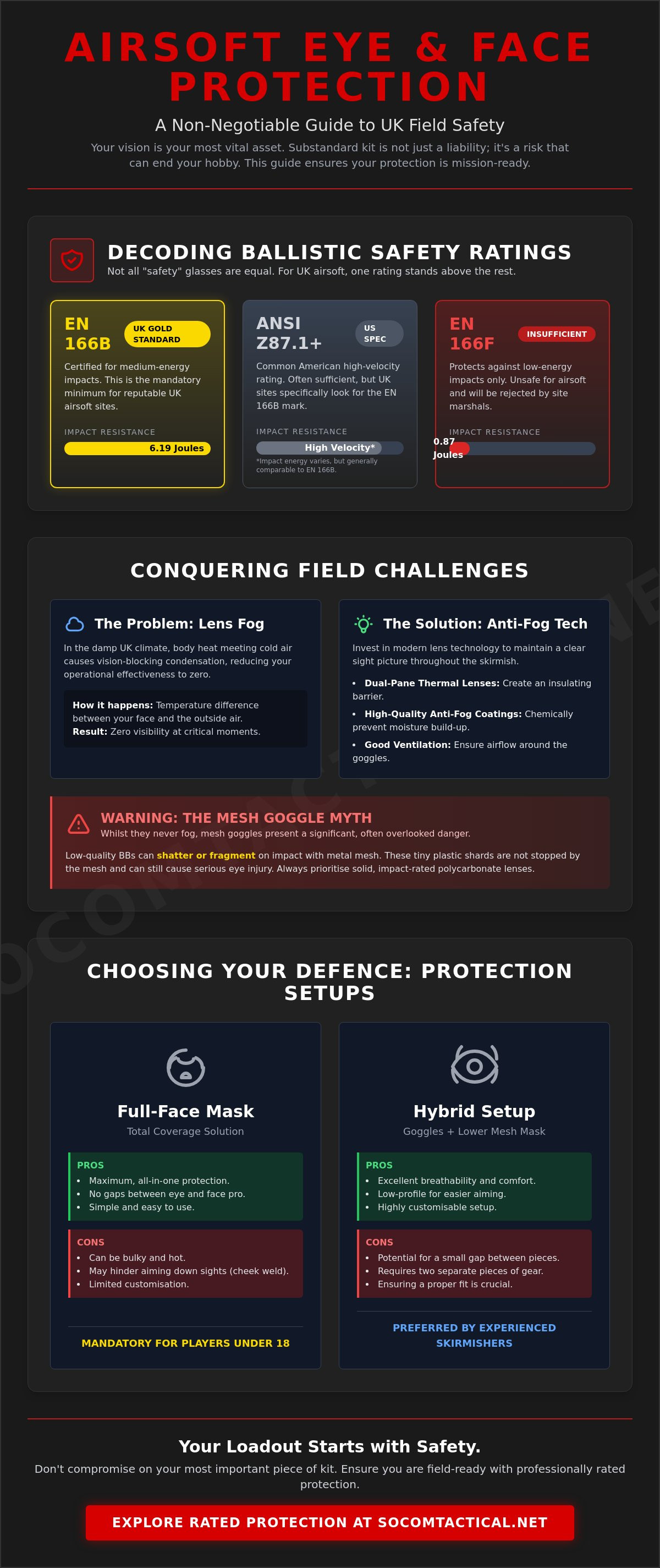
When you're prepping for a day at any of the premier airsoft sites in the UK what to wear begins with your most vital asset: your vision. This isn't just about following site rules; it's about operational longevity. A single high-velocity BB can end your hobby in a split second if you're sporting substandard kit. Whilst tactical aesthetics matter, your primary investment must always be in impact-rated ballistic eye protection. Understanding the essentials of airsoft gear starts with recognising that not all "safety" glasses are created equal.
The UK scene is notorious for its damp, unpredictable climate, which presents a unique challenge: the dreaded lens fog. When your body heat meets the cold woodland air, your visibility can drop to zero in minutes. To combat this, we recommend high-quality polycarbonate lenses with dual-pane thermal technology or dedicated anti-fog coatings. Avoid mesh goggles if you can. Whilst they never fog, they don't protect against BB fragments or 'shatter' which can occur when a low-quality BB hits a metal mesh at high speed.
Decoding Safety Ratings for UK Skirmishers
EN 166B is the gold standard for UK airsoft because it certifies that the eyewear can withstand a medium energy impact of approximately 6.19 Joules. Most American-spec gear carries the ANSI Z87.1 rating, which is often sufficient, but European sites specifically look for the 'B' rating on the frame or lens. A 'low energy' rating (marked with an 'F') only protects against 0.87 Joules, which is significantly lower than the output of a standard AEG or sniper rifle. Don't risk it with unrated fashion goggles or cheap sunglasses; marshals will rightly spot these during the morning briefing and send you back to the car park.
Full-Face vs. Lower Mesh Protection
Choosing your face protection is a balance between comfort and dental bills. For players under 18, full-face protection is a mandatory requirement at all reputable UK airsoft sites. These masks offer total coverage but can be bulkier when trying to get a clear sight picture through your optical sights. Experienced skirmishers often opt for a 'hybrid' setup: low-profile ballistic goggles paired with a lower mesh mask. This protects your teeth whilst allowing for better breathability and easier integration with tactical helmets. When deciding between the various airsoft sites in the UK what to wear for face protection often comes down to whether you're tackling tight indoor CQB corridors or vast woodland environments.
Footwear and Mobility: Conquering Muddy UK Terrains
Your movement on the field is only as reliable as your connection to the ground. When considering the various airsoft sites in the UK what to wear on your feet often determines whether you'll be leading the charge or limping back to the safe zone by midday. British skirmish environments are notoriously unforgiving, featuring a mix of slick clay, hidden tree roots, and deep puddles that can swallow a low-profile shoe. High-intensity manoeuvres require a foundation that offers both traction and structural integrity, especially when you're carrying the extra weight of a plate carrier and a primary RIF.
Wearing standard trainers is perhaps the most common mistake made by new players. Whilst they might feel light, they offer zero lateral support. Ankle inversion, essentially a severe roll or sprain, remains the most frequent injury reported at woodland sites. When you're sprinting through undergrowth to avoid incoming fire, a hidden rabbit hole or a moss-covered log can end your day instantly if your footwear lacks a high-cut collar. Professional tactical boots are designed to lock the ankle in place, providing a rigid frame that absorbs the shock of uneven terrain.
Waterproofing is another non-negotiable factor for the UK climate. Wet feet lead to softened skin, which leads to blisters, which eventually leads to a complete loss of mobility. Look for boots with a breathable waterproof membrane like Gore-Tex or similar technical linings. These allow sweat to escape whilst preventing bog water from seeping in. Always remember to break in your boots at least two weeks before an eight-hour skirmish. Wearing brand-new, stiff leather for the first time on game day is a guaranteed recipe for agony.
Combat Boots vs. Hiking Boots: The Verdict
Military-style combat boots are built for durability and often feature reinforced toe caps and oil-resistant soles, making them ideal for gritty CQB environments. However, many veteran players prefer lightweight hiking boots for woodland sites because they offer superior flexibility and aggressive lug patterns designed for mud. High-cut designs are essential regardless of the style you choose. If you value speed in the safe zone, consider side-zip models; they allow for rapid transitions during lunch breaks without the hassle of unlacing muddy boots.
The Role of Tactical Socks
Never underestimate the power of a high-quality pair of socks. Cotton is your enemy here because it retains moisture and causes friction. Opt for moisture-wicking synthetic blends or Merino wool to keep your feet dry and cushioned. We always recommend the 'two-pair' rule: keep a fresh set in your kit bag. Changing into dry socks during the midday break is a massive morale booster that can give you the second wind needed for the final afternoon mission. The thickness of your socks will also affect your boot fit, so ensure you test your footwear with the same pair you intend to wear on the field.
Field-Ready Clothing: Layering for the British Climate
The British climate is a fickle adversary. Mastering your loadout for airsoft sites in the UK what to wear depends heavily on your ability to regulate body temperature whilst under fire. A standard skirmish day involves periods of high-intensity sprinting followed by static defensive positions. This cycle makes the 'Three-Layer System' essential. Your base layer must be moisture-wicking synthetic or Merino wool. Never wear cotton against your skin. In the airsoft community, we say 'Cotton is Rotten' because it absorbs sweat and rain, staying heavy and cold for hours. This leads to rapid cooling during breaks and significantly increases the risk of chills in the damp British woods.
A mid-layer should be a removable thermal, like a lightweight fleece, which you can shed as the action heats up. Your outer layer needs to balance durability with camouflage. Traditional tunics provide decent protection but often become sweltering under a plate carrier. This is why Under Body Armour Combat Shirts (UBACS) have become the standard. They feature a moisture-wicking torso for ventilation and rugged sleeves to protect against abrasions. Selecting professional clothing and gear ensures you stay focused on the objective rather than your discomfort.
Camouflage Patterns for the UK Landscape
Multi-Terrain Pattern (MTP) is the undisputed king of the UK landscape. It's designed to blend into the varied greens, browns, and tans found in British woodland and scrubland. Whilst the older Disruptive Pattern Material (DPM) still has a loyal following amongst veterans for its deep green hues, MTP offers better versatility across different seasons. For indoor CQB sites, darker tones like Olive Drab or Black are often preferred. They excel in low-light corridors where breaking up your silhouette is more important than matching the foliage.
Trousers and Kneepads: Protecting Your Joints
Your trousers are your first line of defence against the terrain. Look for ripstop fabric. It's a reinforced weave that prevents small snags from brambles or sharp branches from turning into massive tears. Kneepads are equally critical. Integrated kneepads, which slot directly into the trouser fabric, are superior to external strap-on versions. They don't slip down your shins during a sprint or cut off circulation behind the knee. When you're kneeling in the mud to take a shot, you'll be glad for that extra layer of impact protection. This setup is a staple for many regulars at various airsoft sites in the UK what to wear experts recommend for maximum mobility.
Tactical Load-Bearing Gear: Carrying Your Kit
Staying operational for a full eight-hour skirmish requires more than just a reliable AEG. When you're assessing airsoft sites in the UK what to wear for load-bearing gear is a choice between maximum protection and high-speed mobility. Your kit needs to be accessible under pressure whilst distributing weight evenly to prevent fatigue. A poorly balanced loadout leads to sore shoulders and slow reloads; these are issues that will definitely get you sent back to the respawn point during an intense engagement.
Chest Rigs vs. Plate Carriers
Plate carriers are the go-to for many players because they offer a realistic aesthetic and plenty of MOLLE real estate for customisation. They provide excellent protection against close-range hits in CQB environments, but they can become heat traps during summer woodland games. If you're tackling long patrols, a lightweight chest rig might be the better option. It keeps your back clear for ventilation and allows for faster movement through thick brush. For a deeper dive into specific setups, check out our UK Tactical Gear Guide.
| Feature | Chest Rig | Plate Carrier |
|---|---|---|
| Mobility | Superior | Moderate |
| Protection | Minimal | High (Impact) |
| Customisation | Moderate | High |
Offloading weight from your shoulders is a pro-level move. A dedicated tactical belt acts as your 'First Line' of gear, carrying your sidearm, a few spare magazines, and a dump pouch. By shifting some of the load to your hips, you'll find you can stay on the frontline much longer without discomfort. Hydration is another critical factor. Whilst a water bottle in a pouch works, a hydration bladder integrated into your back panel is far more efficient. It allows you to sip water whilst keeping your eyes on the treeline, ensuring you stay hydrated during those intense summer heatwaves.
Essential Pouches and Accessories
Organising your 'Second Line', which is your chest rig or plate carrier, is about building muscle memory. Your primary magazine pouches should be front and centre for fast reloads. We always recommend adding a dump pouch to your belt; it's a game-changer for stowing empty magazines without fumbling with small pouch flaps. A small admin pouch is also useful for keeping site maps, dead rags, and spare batteries secure. When considering airsoft sites in the UK what to wear for your tactical setup, remember that accessibility and weight distribution are your top priorities. If you're ready to upgrade your loadout, explore our full range of Plate Carriers and Chest Rigs to find the perfect fit for your playstyle.
The Safe Zone Checklist and Post-Game Maintenance
The final whistle doesn't mark the end of your operational responsibilities. Professionalism extends beyond the treeline and into the safe zone; where discipline is just as vital as it is on the frontline. When you're packing up at various airsoft sites in the UK what to wear for the journey home is a logistical detail that separates the veterans from the novices. A successful skirmish day concludes with proper kit maintenance and a respect for the shared space of the staging area. It's about ensuring your gear is ready for the next deployment whilst maintaining the standards the community expects.
Safe zone etiquette is the cornerstone of community trust. Before you even think about unmasking, your RIF must be cleared. This means removing the magazine and firing two clear shots into a designated clearing zone to ensure no BB remains in the hop-up chamber. Your sidearm should be holstered and your primary weapon set to safe. These aren't just suggestions; they are non-negotiable safety protocols that protect everyone in the vicinity. Part of this communication involves the use of a 'Dead Rag' on the field. Carrying a bright red cloth to signal you're out of play prevents unnecessary 'overkill' and keeps the game flowing smoothly for everyone involved.
The Logistics of a Full Skirmish Day
One of the most overlooked aspects of field prep is the post-game transition. We highly recommend keeping a 'Dry Bag' in your vehicle containing a full change of clothes and a fresh pair of shoes. After a day of crawling through damp British woodland, sitting in a car with mud-caked trousers is a recipe for post-game chills and a ruined interior. A clean set of joggers and a hoodie will keep your core temperature stable during the drive back. Nutrition is equally important. Ensure you've packed high-energy snacks and plenty of water to supplement the 45-minute lunch break. Most sites have specific rules regarding rubbish and safety, so check the FAQ page for site-specific guidelines before you arrive.
Caring for Your Tactical Clothing
Your tactical gear is an investment that requires proper upkeep to maintain its camouflage integrity. When washing MTP or DPM fabrics, always turn them inside out and use a cool, non-biological detergent to prevent premature fading. Never use fabric softeners; they can break down the technical fibres and affect the breathability of your UBACS. Drying your tactical boots is a process that shouldn't be rushed. Avoid placing them directly on a radiator, as intense heat can cause the leather to crack or the sole adhesive to fail. Instead, stuff them with newspaper and let them dry naturally. Finally, perform a rigorous inspection of your eye protection. Check for any hairline cracks or pits from impacts. If the structural integrity is compromised, replace it immediately to stay field-ready for your next engagement at any of the airsoft sites in the UK what to wear experts recommend.
Ready for the Frontline: Finalising Your Tactical Loadout
You've now got the tactical blueprint to dominate the field from the first whistle to the final extraction. By prioritising EN 166B ballistic protection and locking in your mobility with high-cut tactical boots, you've already mitigated the most common risks found on British sites. Success in the woodland or the warehouse depends on your ability to adapt; use the three-layer system to manage the unpredictable weather and keep your gear organised for rapid reloads. Mastering the logistics of airsoft sites in the UK what to wear is the difference between a frustrating day and a tactical victory.
At Socom Tactical Airsoft, we've been providing expert UK-based advice since 2009. We understand the grit and precision required for a high-stakes engagement. Whether you need ballistic-rated eye protection from top industry brands or want to browse our huge range of MTP and tactical clothing in stock, we have the field-ready solutions you need. Don't leave your performance to chance when you can rely on gear tested by the community. Gear up for your next skirmish at Socom Tactical Airsoft and lead your team to the win. See you on the field.
Frequently Asked Questions
Do I need to wear camouflage to play at UK airsoft sites?
You don't need to wear full camouflage to participate at most venues, but it provides a significant tactical advantage in woodland settings. Many new players start in dark, durable clothing like work trousers or olive drab hoodies. However, as you progress, you'll find that matching your surroundings with MTP or DPM is the best way to avoid early detection during long-range engagements and remain hidden amongst the dense British undergrowth.
Can I wear a hoodie for my first airsoft game?
A thick hoodie is an excellent choice for your first skirmish because the heavy fabric helps dampen the sting of incoming BBs. It's a staple for rental players who haven't invested in a full combat shirt or tunic yet. Just ensure you have a moisture-wicking base layer underneath, as you'll quickly discover that running in heavy cotton leads to overheating and excessive sweating during high-intensity firefights.
What is the best footwear for indoor CQB sites in the UK?
Mid-cut tactical boots with non-slip, oil-resistant rubber soles are the superior choice for indoor CQB environments. Unlike woodland sites where mud is the main concern, urban sites often have slick concrete floors or dusty surfaces that require maximum grip. These boots provide the necessary ankle support for rapid pivoting and room clearing whilst remaining light enough for high-speed, aggressive play in tight corridors.
Is it better to wear a full-face mask or goggles and a mesh mask?
Choosing between these setups depends on your priority: total protection or ease of aiming. Full-face masks are the safest option, especially for younger players or high-intensity CQB where face hits are frequent. However, pairing ballistic goggles with a lower mesh mask is the preferred setup for many veterans. This hybrid approach allows for a closer cheek weld on your rifle's stock, making it much easier to use optical sights effectively.
How do I stop my airsoft goggles from fogging up in the rain?
Preventing fogging in the damp British climate requires a combination of high-quality gear and proper maintenance. Start with dual-pane thermal lenses which create a buffer against temperature changes. Applying a dedicated anti-fog spray before the morning briefing is essential. Additionally, ensure there is enough airflow between your goggles and face mask; even a small gap can help heat escape and keep your vision clear when the rain starts.
Should I wear gloves for airsoft, and what type is best?
Protective gloves are a vital part of your kit because knuckle hits are notoriously painful and can take you out of the game. Look for tactical gloves with reinforced padding or hard-shell protection on the joints. When deciding at various airsoft sites in the UK what to wear, ensure your gloves offer enough dexterity to operate your trigger and manipulate small fire selectors or magazine releases without feeling cumbersome.
What should I bring to the safe zone for a full day of play?
Your safe zone kit should include a speedloader, high-quality BBs, and spare LiPo batteries to keep your AEG running. Don't forget a basic tool kit for minor field repairs and plenty of hydration. Since most games last all day, having a dedicated area to organise your consumables ensures you can quickly reload and re-arm between rounds without missing the next mission briefing or tactical deployment.
How many layers should I wear for a winter airsoft game?
Stick to a three-layer system to balance warmth with the high physical exertion of the hobby. A synthetic base layer wicks away sweat, a lightweight fleece mid-layer provides insulation, and a rugged outer shell protects against wind and BBs. This setup allows you to shed the mid-layer if you're playing aggressively, ensuring you stay comfortable whilst navigating the diverse challenges found at various airsoft sites in the UK what to wear experts recommend.