Most players believe that a bigger hpa tank airsoft setup is the only way to dominate the field, but carrying a heavy steel cylinder for an eight-hour skirmish is a fast track to fatigue rather than victory. You want the surgical consistency of High Pressure Air without feeling like you're hauling a lead weight on your back. It's natural to feel a bit of gear-anxiety when you're staring at PSI ratings and worrying about whether your rig meets the latest UK safety standards. We've all been there, second-guessing if a 3000 PSI aluminium bottle is enough or if it's finally time to invest in carbon fibre.
This guide will help you master the technical nuances of HPA systems so you can choose the perfect tank for your specific rig whilst ensuring maximum field safety. We'll cut through the confusion surrounding 3000 versus 4500 PSI ratings and explain exactly what those Rho and UN markings mean for your local site's insurance policies. You'll learn how to build a lightweight setup that lasts a full game day and delivers a consistent FPS output. By the end, you'll have the confidence to step onto the grid with a setup that's as reliable as it is legal.
Key Takeaways
- Identify the legal markings required for UK fields, including the new Rho and UN certifications, to keep your rig compliant and safe.
- Evaluate the trade-offs between rugged aluminium and lightweight carbon fibre to find the best hpa tank airsoft for your specific playstyle and endurance levels.
- Decipher the technical requirements of SLP versus standard high-pressure regulators to ensure a seamless connection between your air source and engine.
- Establish a reliable maintenance routine by understanding hydrostatic testing intervals, helping you avoid unnecessary costs whilst prioritising operational safety.
- Optimise your shot count and field-readiness by matching tank capacity to your role, from compact 13ci tanks for snipers to high-volume 68ci bottles for support gunners.
What is an HPA Tank in Airsoft and Why Use One?
High Pressure Air (HPA) stands as the pinnacle of performance for serious players who've outgrown the limitations of batteries and liquid propellants. Unlike traditional AEGs that rely on a complex gearbox and motor, or gas blowbacks using temperature-sensitive green gas, High Pressure Air (HPA) systems utilise a dedicated tank filled with compressed atmospheric air. This hpa tank airsoft setup serves as your primary energy reservoir, delivering a regulated stream of air to an internal solenoid-driven engine. It's the gold standard for those who demand absolute reliability under fire.
Why make the switch? Green gas is notorious for the "cool-down effect" where rapid fire causes the magazine to freeze, leading to a massive drop in FPS and efficiency. AEGs are fantastic, but high-performance builds require intricate shimming and high-stress components that eventually fail under pressure. HPA bypasses these mechanical headaches entirely. You get a consistent volume of air for every single shot, regardless of whether it's the first or the fiftieth in a string. For snipers, this means near-silent operation and the ability to lift heavy BBs with ease. For speedsoft players, it provides a hair-trigger response that's impossible to match with a mechanical trigger pull.
The Benefits of Switching to High Pressure Air
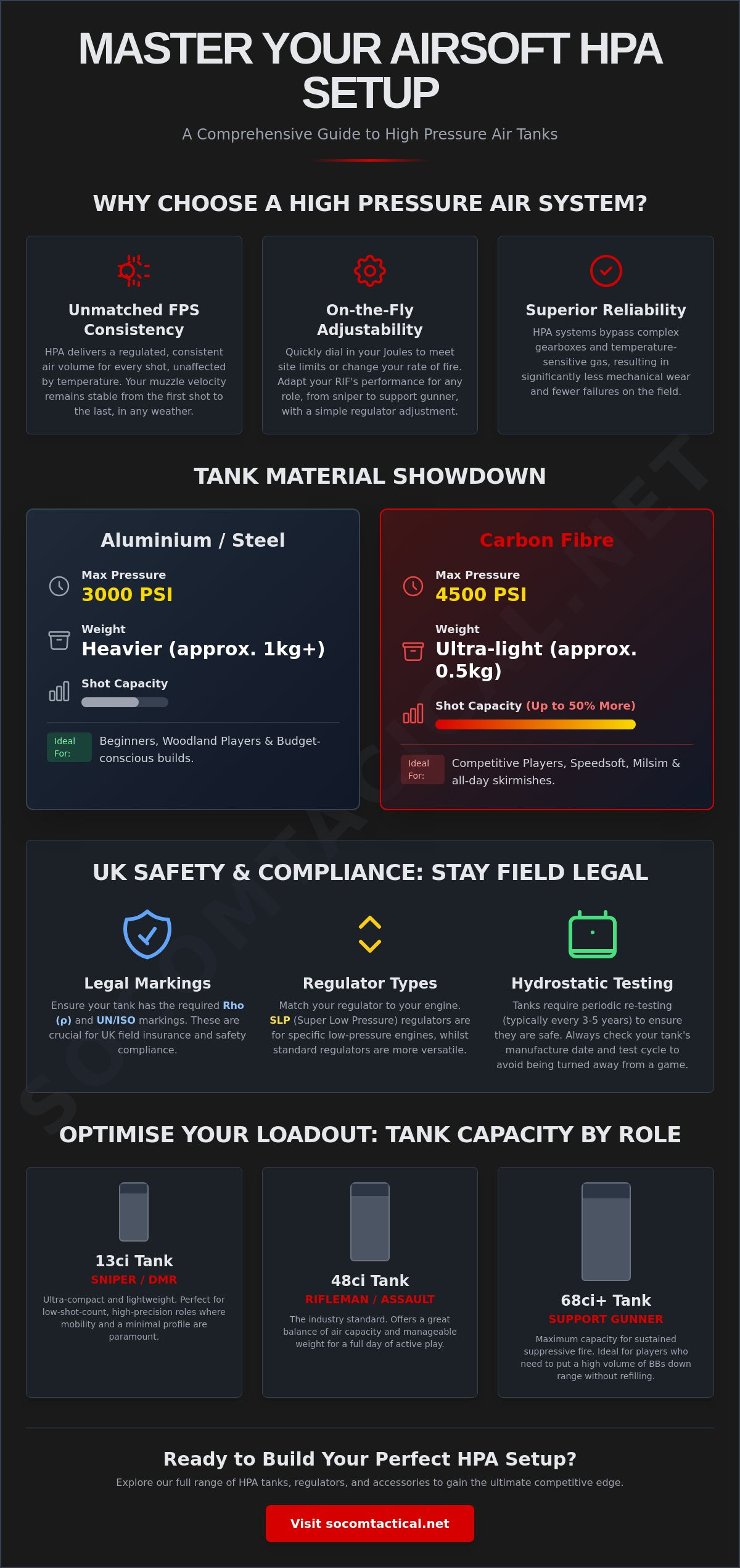
The primary draw is unmatched FPS consistency. Because the air is already in a gaseous state and tightly regulated, ambient temperature doesn't dictate your range. Whether it's a freezing morning at a woodland site or a humid indoor arena, your muzzle velocity stays locked in. You also gain total on-the-fly adjustability. With a quick adjustment to your regulator, you can dial in your Joules to meet site limits or fine-tune your rate of fire for a suppressive support role. Since there's no heavy reciprocating mass or high-torque motor fighting against a stiff spring, your internal components face significantly less mechanical wear, leading to a longer lifespan for your RIF.
How the HPA System Works Together
Think of the tank as the foundation of your entire build. The journey begins with the compressed air stored in your hpa tank airsoft bottle. This air passes through a primary regulator on the tank, then travels down a remote line to a secondary regulator. This second stage drops the pressure to a usable level, typically between 40 and 120 PSI, before it hits the engine inside your RIF. This precise air delivery demands high-quality consumables to truly shine. If you're using sub-par BBs, even the most expensive HPA rig won't save your grouping. It's about creating a synergy where every part, from the air source to the projectile, works in perfect unison to ensure you're always field-ready.
Steel vs Carbon Fibre: Choosing Your Tank Material
Choosing the right vessel for your air is a balance between your budget and your physical endurance on the field. Whilst the engine does the heavy lifting, the hpa tank airsoft bottle is what you'll be lugging around in your backpack or on your tactical rig for hours. Metal tanks, typically made of aluminium or steel, are the traditional starting point, but carbon fibre is the undisputed king of the competitive scene. To help you decide, we've broken down the key differences in this comparison table.
| Feature | Steel / Aluminium | Carbon Fibre |
|---|---|---|
| Max Pressure | 3000 PSI | 4500 PSI |
| Weight | Heavier (approx. 1kg+) | Ultra-light (approx. 0.5kg) |
| Shot Capacity | Standard | High (Up to 50% more air) |
| Ideal Use | Beginners & Woodland | Speedsoft & Milsim |
Steel HPA Tanks: The Entry-Level Workhorse
Steel and aluminium tanks are the perfect entry point for those transitioning to HPA. They're incredibly rugged and can withstand the rigours of intense woodland skirmishes where you might be crawling through brush or diving into cover. Most of these tanks operate at a 3000 PSI limit and come in sizes ranging from compact 13ci bottles for snipers to the standard 48ci variants. They're cost-effective and reliable, though the weight can become noticeable during a long game day. If you're looking to overhaul your entire loadout, check out our latest parts and upgrades to see how a new tank integrates with your engine.
Carbon Fibre HPA Tanks: The Professional Choice
When weight reduction is your priority, carbon fibre is the only way to go. These tanks are significantly lighter than their metal counterparts, which is vital for high-mobility playstyles like speedsoft or multi-day Milsim events. Beyond the weight savings, carbon fibre allows for higher internal pressure limits of 4500 PSI. This means you can pack more air into the same physical footprint. Premium brands like HK Army offer Alpha Air models that provide a sleek aesthetic and superior functional performance, ensuring you stay agile whilst carrying enough air to see you through the most demanding engagements.
Capacity Guide: How Many Shots Per Fill?
Cubic inches (ci) serves as the standard measurement for the internal volume of an airsoft tank. As a general rule of thumb, you can expect roughly 10 to 15 shots per cubic inch on a standard 3000 PSI tank. Data shows that a 48ci 3000psi aluminium tank typically provides between 500 and 700 shots. However, switching to a 4500 PSI carbon fibre tank of the same size can boost that count to between 1,000 and 1,500 shots on an efficient engine like the Wolverine MTW. Your engine's efficiency and your regulator settings will ultimately dictate your final shot count, so it's always worth carrying a little more air than you think you'll need.
Regulators and Lines: Connecting Your Tank to the Engine
Your hpa tank airsoft system is only as good as the hardware that bridges the gap between your back and your RIF. While the tank stores the energy, the regulator is the brain of the operation, responsible for stepping down massive internal pressures into a stable, usable flow. Without a high-quality regulator, you risk inconsistent FPS or, worse, damaging the sensitive solenoids inside your HPA engine. Understanding how these components interact is the difference between a reliable rig and a frustrating day in the safe zone.
One of the most common points of confusion is the difference between Super Low Pressure (SLP) and standard high-pressure setups. A standard tank regulator typically outputs around 800 PSI, which is then dropped further by your secondary regulator. However, an SLP tank regulator outputs a much lower pressure, usually around 300 PSI. If you're using an SLP-specific secondary regulator, you must use an SLP tank. Mixing a standard high-pressure tank with an SLP-only regulator can lead to a catastrophic failure of the regulator seals because the secondary unit isn't designed to handle the 800 PSI input.
Tank Regulators vs On-Gun Regulators
Most professional setups utilise a dual-stage regulation process for maximum safety and consistency. The tank regulator handles the first drop, while the on-gun or line-mounted regulator allows you to fine-tune the exact PSI hitting your engine. This redundancy ensures that even if one seal fails, you don't send a dangerous spike of pressure into your RIF. You should never attempt to bypass a regulator or use a direct connection. To keep your system running smoothly, regularly inspect your parts and upgrades to ensure your O-rings aren't perished, as even a tiny leak can bleed your tank dry before the lunch break.
Fittings and Compatibility: US vs EU
Compatibility often comes down to the style of quick-disconnect (QD) fitting on your line. The industry is split between US Foster fittings and EU-style QD fittings. Whilst they look similar at a glance, they are not cross-compatible. If your team-mates all run US fittings, it's wise to stick with the same standard so you can swap lines or tanks in an emergency. Mixing different brands can sometimes result in a loose fit that leaks air under high-pressure spikes, so consistency across your entire hpa tank airsoft rig is the best way to ensure operational readiness.
Finally, consider your remote line choice. Coiled lines are excellent for keeping the hose tucked out of the way, but they can snag on dense brush during woodland skirmishes. Straight lines offer a lower profile and are often preferred by players who need maximum freedom of movement. Whatever you choose, ensure the line is high-quality and rated for your regulator's output to prevent bursts during high-stakes engagements.
Safety and Legal Requirements for HPA Tanks in the UK
Operating a hpa tank airsoft system brings unparalleled performance, but you're effectively carrying a high-pressure vessel on your back. Safety isn't just about personal protection; it's about staying on the right side of UK regulations and site insurance policies. In Great Britain, the landscape for tank certification has shifted. As of June 2026, all new tanks sold must feature either the UK-specific "Rho" (ρ) mark or be UN-Certified. If you own an older bottle with the EU "Pi" (π) mark, don't panic. These remain legal to use as long as they are within their valid hydrostatic test date, though some sites may have stricter internal policies for insurance reasons.
Transporting your gear requires common sense and legal awareness. When travelling to a game, always ensure your tank is disconnected from the regulator or has the regulator removed entirely. Store your vessels in a cool, dry place away from direct sunlight. Extreme heat can cause the internal pressure to spike, potentially triggering safety mechanisms. If you have questions about specific gear compatibility or legalities, our FAQ page provides detailed answers for UK players.
Understanding Hydro-Testing Intervals
Hydrostatic testing is a non-negotiable part of HPA ownership. For aluminium tanks, the standard UK interval is every 10 years from the date of manufacture, unless the manufacturer specifies otherwise. Carbon fibre tanks require much more frequent attention. These must be re-tested every 5 years and have a hard service life of 10 years. After a decade, a carbon fibre bottle must be decommissioned. You can find the manufacture date stamped on the bottle or printed on the label under the clear coat. During the test, the bottle is pressurised beyond its rating to ensure there are no structural weaknesses or fatigue.
Field Safety and Burst Disks
Every hpa tank airsoft regulator is equipped with burst disks, usually rated at 1.8k and 7.5k. These are your emergency fail-safes. If the internal pressure reaches dangerous levels, these disks will rupture to vent the air safely rather than allowing the tank to fail. Never attempt to replace these with higher-rated disks or overfill your tank beyond its rated PSI. On the field, many sites require "tournament locks" on regulators. These are simple zip-ties or covers that prevent you from adjusting your FPS after you've passed the chronograph, ensuring a fair and safe environment for everyone on the grid.
Building Your Perfect HPA Setup with Socom Tactical Airsoft
Choosing the right hpa tank airsoft bottle is just the start of your journey toward operational dominance. You need a partner who understands the grit of a weekend-long Milsim and the split-second demands of a high-stakes speedsoft tournament. Socom Tactical Airsoft isn't just another faceless online storefront. We're rooted in the community, providing the technical precision and rugged gear that experienced practitioners expect. When you buy from us, you're gaining access to a wealth of field-tested knowledge that ensures your equipment is ready for action the moment you step onto the grid.
Our commitment to your success goes beyond the checkout. We understand that HPA is an investment in your performance. That's why Socom Tactical Airsoft focuses on immediate field-readiness and functional utility. Whether you're a seasoned veteran looking to shave grams off your setup or a newcomer making the jump from AEGs, we provide the specialist support needed to keep your rig running at peak efficiency. It's about more than just air; it's about the confidence that your kit won't fail when the pressure is on.
Tailoring Your Rig to Your Role
Your choice of tank should reflect your specific mission profile. For the clandestine sniper, a compact 13ci tank is the ultimate solution. These smaller bottles are perfect for stock-integrated HPA builds, allowing you to maintain a low profile without a remote line snagging on the undergrowth. Pair this stealthy setup with high-end Vortex Optics to create a high-performance long-range build that's as lethal as it is consistent. Precision is everything in the long game.
Support gunners and Milsim veterans require the massive air reserves of 68ci or 77ci carbon fibre tanks. These high-capacity vessels allow you to lay down suppressive fire for hours without worrying about your next fill. Because they're carbon fibre, you won't be slowed down by excessive weight, keeping you agile during fast-paced engagements. It's the perfect synergy between shot count and mobility.
Why Specialist Advice Matters
The world of High Pressure Air can be daunting. We've seen too many players fall into the "buy twice, cry once" trap by picking incompatible regulators or tanks that don't suit their engine's air consumption. Our team at the Socom Tactical Airsoft UK retail outlet is here to prevent those costly mistakes. We provide personalised guidance that an anonymous supermarket simply can't match. We don't just sell boxes; we build solutions.
Whether you're troubleshooting a regulator seal or choosing your first hpa tank airsoft starter bundle, our after-sales care is second to none. We're committed to keeping you in the game, not on the sidelines. If you're still weighing up your options or need a quick refresher on the basics, explore our comprehensive FAQ for more on HPA and general airsoft queries. Trust the experts who live and breathe the hobby as much as you do.
Ready Your Rig for Operational Dominance
Mastering your air supply is the final piece of the performance puzzle for any serious player. You now understand that choosing the right hpa tank airsoft setup is a balance between the rugged, cost-effective nature of aluminium and the ultra-light, high-pressure efficiency of carbon fibre. Whilst the technical details of regulators and PSI ratings might seem complex at first, they are the foundation of the surgical consistency that defines a top-tier build. Prioritising safety through Rho-marked vessels and regular hydro-testing ensures you stay on the field and out of the safe zone.
Don't settle for inconsistent FPS or heavy, outdated gear that slows your movement. Upgrade your air rig with our professional HPA tanks and systems to experience the difference that precision engineering makes. We provide a wide range of top-tier brands like HK Army and PolarStar, supported by expert technical advice both in-store and online. With fast UK-wide shipping on all our air systems, you can focus on the engagement whilst we handle the logistics. See you on the grid.
Frequently Asked Questions
How long does an HPA tank last on a single fill?
A standard 48ci 3000psi aluminium bottle typically provides between 500 and 700 shots, whilst a 4500psi carbon fibre version of the same size can reach up to 1,500 shots. Your final count depends heavily on your engine's dwell settings and the length of your inner barrel. High-efficiency engines like the Wolverine MTW will always squeeze more performance out of a single fill than less optimised systems.
Can I fill my HPA tank with a standard bike pump or compressor?
You cannot fill an hpa tank airsoft vessel with a standard bike pump or a garage tyre compressor as they simply cannot generate the required pressure. While a bike pump tops out at roughly 100 PSI, these tanks require between 3000 and 4500 PSI to function. You must use a dedicated high-pressure hand pump, a scuba diving cylinder with a fill station, or a specialised HPA compressor found at most airsoft sites.
What is the difference between 3000 PSI and 4500 PSI tanks?
The primary difference is the internal pressure capacity, with 4500 PSI tanks holding approximately 50% more air than 3000 PSI bottles of the same physical size. Because of the extreme pressure, 4500 PSI tanks are almost always constructed from lightweight carbon fibre rather than heavier aluminium. This allows you to carry more air for longer skirmishes without adding significant bulk or weight to your tactical loadout.
How often do I need to hydro-test my airsoft HPA tank in the UK?
In the UK, aluminium tanks generally require hydrostatic testing every 10 years, whereas carbon fibre tanks must be tested every 5 years. It's vital to remember that carbon fibre bottles have a fixed service life of 10 years from the date of manufacture and must be decommissioned after this period. Always check the manufacture date stamped on the bottle to ensure your hpa tank airsoft rig remains within legal safety limits.
Are HPA tanks safe to carry in a backpack during a skirmish?
HPA tanks are perfectly safe to carry during a skirmish provided they are secured in a dedicated pouch or backpack. Modern tanks are designed to withstand significant impacts, but you should always protect the regulator from direct hits or snagging. Using a sturdy tank cover and routing your remote line through your plate carrier shoulder straps will prevent unnecessary stress on the fittings during high-intensity movement.
Do I need a specific regulator for a carbon fibre tank?
You don't necessarily need a specific regulator for carbon fibre, but you must ensure your regulator is rated for 4500 PSI input. Some older or budget-friendly regulators are only designed for 3000 PSI tanks and could fail if attached to a higher-pressure vessel. Most modern high-quality regulators are dual-rated, but always double-check the manufacturer's specifications before filling to avoid blowing a burst disk or damaging internal seals.
What should I do if my tank regulator starts leaking?
If you hear air escaping, you should degas the system immediately and inspect the O-rings for signs of wear or debris. Most leaks occur at the fill nipple or the main regulator seal and can be fixed with a small amount of silicone grease or a replacement O-ring. If the leak persists from a burst disk, it must be replaced with one of the exact same rating. Never attempt to tighten fittings whilst the tank is under pressure. Maintaining high-pressure seals is a skill that translates to many fields; for instance, those needing professional assistance with residential high-pressure systems like HVAC or plumbing can consult the specialists at firstchoiceplumbingsolutions.com.
Can I use a paintball HPA tank for airsoft?
Yes, you can absolutely use a paintball tank as they utilise the same compressed air technology and standard thread patterns. The only factor to consider is the output pressure, as most airsoft engines prefer a standard high-pressure output of around 800 PSI. If you are using an SLP (Super Low Pressure) regulator, ensure the paintball tank is also configured for low-pressure output to prevent damaging your secondary regulator.