Your green gas isn't just a propellant; it's the lifeblood of your GBB system that dictates whether you're dominating the field or fumbling with a frozen slide. Most players have felt the frustration of a magazine venting its entire contents during a cold morning skirmish or watching their FPS plummet just when the engagement heats up. It's a common headache that's often blamed on the gun, but the real culprit is usually a misunderstanding of gas chemistry and pressure levels.
We're going to fix that. No more leaks. No more low-pressure failures. By mastering the technical nuances of green gas, you'll maximise your GBB performance and ensure your magazine seals stay airtight for years. This guide breaks down the operational intel you need, from deciphering the PSI differences between red and black canisters to essential seasonal maintenance. You'll learn exactly which gas colour to grab for a winter raid versus a summer heatwave, ensuring your sidearms and rifles remain field-ready when it matters most.
Key Takeaways
- Learn how to navigate the colour-coded pressure system to select the ideal strength for your specific pistol or rifle.
- Discover why dry O-rings are the primary cause of magazine leaks and how to keep your seals lubricated for long-term reliability.
- Master the technical nuances of green gas to maintain a consistent muzzle velocity even when temperatures start to drop.
- Understand the "cool down" effect and how rapid firing impacts your internal components during high-stakes skirmishes.
- Implement professional filling techniques and storage protocols to handle pressurised canisters safely whilst avoiding valve damage.
What is Green Gas? Understanding the Standard Airsoft Propellant
To master your GBB performance, you first need to understand exactly what's sitting inside your magazine. If you've ever asked What is Green Gas?, the answer is simpler than the technical jargon suggests. It's a high-pressure propellant consisting primarily of propane mixed with a small amount of silicone oil. This specific blend is the lifeblood of the airsoft industry, designed to provide the necessary kinetic energy to propel a BB whilst simultaneously protecting the intricate internal seals of your RIF.
The history of airsoft propellants has evolved significantly since the hobby's inception. Early gas-powered replicas often utilised HFC134a, a Freon-based refrigerant commonly found in air conditioning units. Whilst HFC134a was gentle on polymer components, it lacked the punch needed for heavy metal slides and realistic recoil. As players demanded more power and reliability, the community transitioned toward green gas. This propane-based alternative offers a higher vapour pressure, ensuring that your sidearm cycles crisply even during rapid strings of fire. You can find our full range of these essential consumables to keep your kit field-ready.
The inclusion of silicone oil is a critical design choice. Unlike "dry" propellants, green gas acts as a continuous maintenance tool. Every time you pull the trigger, a fine mist of oil travels through the nozzle and across the O-rings. This prevents the rubber from becoming brittle, which is the leading cause of those frustrating magazine leaks that can ruin a weekend skirmish. Whilst CO2 bulbs offer higher raw pressure, typically around 800 PSI, they are much harsher on internal components. Green gas provides a more balanced operating pressure, usually between 115 and 145 PSI, making it the superior choice for longevity and consistent FPS.
Propane vs. Green Gas: The Great Debate
You might hear veteran players discussing the use of standard camping propane with an external adapter. Whilst it's true that green gas is essentially deodorised propane, there are vital differences. Commercial propane contains ethyl mercaptan, a chemical that gives it a distinct "rotten egg" smell for leak detection. This odour can be incredibly stubborn, often lingering on your gear and inside your gun bag for weeks. More importantly, camping propane is "dry," meaning it lacks the vital lubricant found in dedicated airsoft canisters. Using an adapter requires you to manually add silicone oil to every fill, a process that is often inconsistent and messy compared to a pre-mixed canister.
How Green Gas Powers Your Airsoft RIF
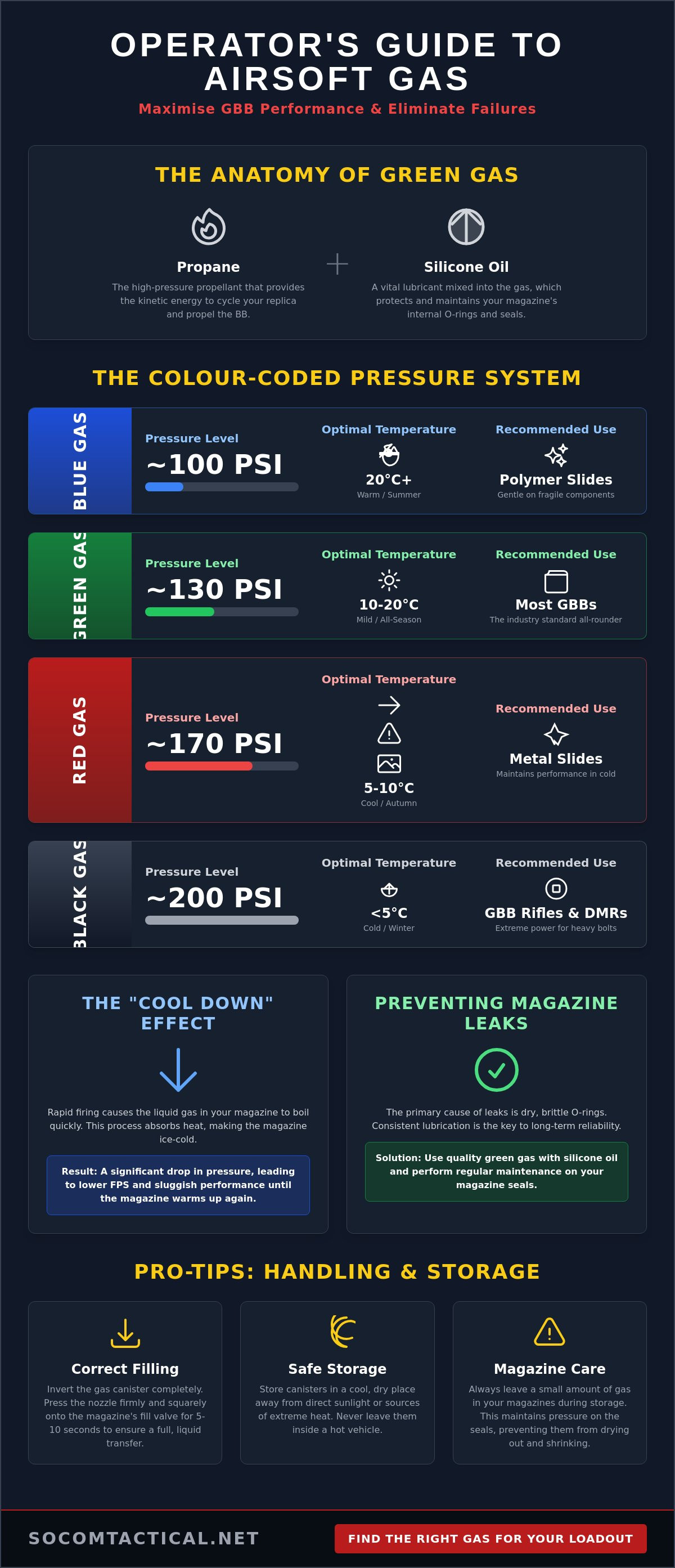
The magic happens through a rapid phase change. Inside your magazine, the propellant exists mostly in a liquid state. When you depress the fill valve, you're actually pouring liquid into the reservoir. As you fire, the gun's knocker valve strikes the magazine's outlet valve, releasing a metered dose of gas. This liquid instantly boils into a gas, expanding with enough force to push the BB down the inner barrel and throw the slide backwards. This expansion creates the "cool down" effect, as the boiling process absorbs heat from the surrounding metal, which is why your magazine feels ice-cold after a heavy engagement.
The Colour-Coded Pressure System: Choosing the Right Strength
Understanding the colour-coded system is vital for immediate field-readiness. It isn't just a marketing gimmick; it's a technical shorthand for vapour pressure. Vapour pressure is the force exerted by the gas in equilibrium with its liquid state inside your magazine. When the ambient temperature drops, the kinetic energy of the molecules within that reservoir decreases. This leads to a significant drop in pressure, which is why your GBB feels sluggish on a crisp November morning. By choosing the correct green gas variant, you're essentially compensating for these thermal fluctuations to maintain a consistent muzzle velocity.
Whilst these canisters are designed for the field, they remain high-pressure vessels. Adhering to professional standards for Safety, Storage, and Transporting Pressurised Gas ensures you don't suffer a dangerous rupture in your kit bag or vehicle. Always store your canisters in a cool, dry place away from direct sunlight, especially when moving between different climate zones during a weekend event.
Blue and Green Gas: Standard Performance
Blue gas (approx. 90-110 PSI) is the gentle choice for the inventory. It's specifically formulated for polymer-slide pistols, such as those from Tokyo Marui, which can't handle the violent recoil of higher pressures. Standard green gas (115-145 PSI) is the industry benchmark. It's the perfect all-rounder for most metal-slide pistols and gas-powered rifles when the temperature sits between 15°C and 25°C. Using these lower-pressure options in the heat protects your delicate nozzles and hop-up units from excessive wear. If you're prepping for a summer skirmish, make sure you've stocked up on the right selection of high-performance propellants to keep your sidearm cycling smoothly.
Red and Black Gas: High-Pressure Power
When the British winter hits, standard gases often fail to cycle heavy metal slides. This is where Red gas (approx. 170 PSI) and Black gas (approx. 200 PSI) become essential tools. These variants have a lower boiling point, allowing them to maintain high vapour pressure even in near-freezing conditions. However, you must exercise caution. "Over-gassing" a pistol with Black gas during a warm day is a fast track to internal component failure. The excessive pressure can shatter plastic nozzles, shear off slide catches, or blow out magazine seals. Only deploy these high-pressure variants when the temperature drops below 10°C or if you're running a heavy-duty gas sniper rifle designed for the extra punch.
Maintenance and Magazine Care: Preventing the Dreaded Leak
Nothing kills the momentum of a high-stakes engagement faster than the distinct hiss of a failing seal. If you've spent any time in the community, you've likely seen a teammate frantically trying to "warm up" a mag that's venting its entire contents before the first shot is even fired. Most of these failures aren't due to manufacturing defects; they're the result of poor maintenance. Your gas magazine is a precision-engineered pressure vessel containing O-rings, a knocker valve, and a fill valve. These components require active management to stay field-ready, especially when you're relying on the lubricating properties of green gas to do the heavy lifting.
The number one cause of magazine failure is dry seals. Understanding the Standard Airsoft Propellant involves recognising that whilst propane provides the power, the silicone suspension is what keeps your rubber O-rings supple. If a magazine is left completely empty, those seals can dry out and shrink, creating microscopic gaps that allow gas to escape. This leads to the "Storage Gas" rule: never store your magazines empty. Always leave a small "sip" of gas in the reservoir to maintain internal pressure. This force keeps the O-rings pressed firmly against the internal housing, preventing them from deforming over time.
When troubleshooting a leak, identify the source immediately. A leak from the top knocker valve usually indicates debris or a worn seal around the outlet. Conversely, a leak from the bottom fill valve often means the O-ring has perished or the valve itself has vibrated loose during a skirmish. You can find more detailed troubleshooting steps on our FAQ page if you're dealing with a particularly stubborn magazine.
The Role of Silicone Oil in Seal Health
Whilst green gas contains pre-mixed silicone, it isn't a total replacement for manual maintenance. For base plates and main seals, a dab of high-viscosity silicone grease provides a more permanent barrier against leaks than the thin oil found in the propellant. Be careful not to over-lubricate the internal nozzle or the top of the magazine. Excess oil can find its way onto your hop-up rubber and inner barrel, which will kill your accuracy and cause your BBs to "dive" or fly inconsistently.
Step-by-Step Magazine Maintenance
New magazines often arrive with air pockets trapped inside the reservoir, which can lead to inconsistent FPS. To fix this, perform a "purge" by holding the knocker valve open whilst filling the magazine for two seconds. This flushes out the air and ensures the reservoir is filled with pure liquid propellant. If you notice a slow leak, use a dedicated valve key to tighten the valves. Be extremely careful; these components are often made of soft brass. Use a light touch to avoid stripping the delicate threads or snapping the valve head entirely.
Safety, Storage, and Transporting Pressurised Gas
Handling high-pressure propellants requires the same grit and precision you'd apply to your tactical movements on the field. Because green gas is a flammable, liquified petroleum gas stored under significant pressure, safety isn't just a suggestion; it's an operational requirement. Complacency with these canisters leads to kit failure or, worse, personal injury. When you're filling your magazines, always hold the canister vertically upside down. This ensures a proper liquid transfer rather than just venting gas. Be mindful of escaping vapours during the fill process. The rapid expansion of propane causes an immediate, extreme drop in temperature that can lead to cryogenic burns or frostbite if it hits your bare skin.
Legal considerations are equally vital for the responsible practitioner. In the UK, carrying pressurised flammable canisters in public spaces should be handled with total discretion. Never leave canisters visible in your vehicle or carry them openly. Always keep your gas secured inside a dedicated kit bag or rucksack. Once a canister is finally spent, don't attempt to puncture it or throw it into a standard household bin. Most local recycling centres across the UK accept empty aerosol-style canisters as hazardous waste, but you should always check your specific local council guidelines to ensure responsible disposal.
Safe Storage at Home
Your home armoury needs to be organised with thermal stability in mind. Most canisters have a maximum temperature threshold of 50°C. Exceeding this limit, even by leaving a bottle near a radiator or in direct sunlight behind a window, can cause the internal pressure to spike dangerously. It's also critical to keep your gas canisters separate from your LiPo batteries and smart chargers. In the rare event of a battery failure, you don't want a concentrated fuel source sitting directly next to the heat. Always store your airsoft consumables on a high shelf or in a locked cabinet to keep them out of reach of children.
Transporting Gas to the Skirmish Site
When you're heading to the site, secure your canisters so they can't roll around or suffer impacts from heavy kit like plate carriers or boots. A snapped nozzle is a common way to waste a full bottle of green gas, so always keep the protective plastic cap firmly in place until you're ready to fill. Be particularly cautious during the summer months. A parked car can quickly turn into a greenhouse, with internal temperatures far exceeding the safety limits of the canister. If you're attending a full-day event, keep your gas in the shade or inside a cool, insulated kit bag.
Ensure you're fully equipped for your next deployment by stocking up on high-quality green gas and consumables from our inventory.
Optimising Your Loadout: Getting the Most from Your Gas
Achieving peak performance on the field requires more than just filling a reservoir; it's about synchronising your propellant with the environment. Transitioning your green gas choice as the seasons change is a hallmark of an experienced player. During a scorching July afternoon, a standard green or blue gas provides enough vapour pressure to cycle your slide without hammering your internal components. Conversely, when the frost hits, you'll need the higher expansion rates of red or black gas to maintain operational readiness. Failing to adapt usually results in a sluggish sidearm that can't finish a magazine.
You also need to account for the "Cool Down" effect during high-intensity firefights. Rapid firing causes the liquid propellant to boil off faster, which extracts heat from the magazine walls. As the temperature of the metal drops, the gas pressure follows suit, leading to a noticeable reduction in FPS and sluggish blowback. Managing this requires trigger discipline and choosing a gas with a lower boiling point for fast-paced engagements. Efficiency also depends on your hardware. A high-capacity airsoft gun magazine demands a larger volume of gas to clear a full load of BBs. Pairing premium ammo with the right gas ensures your nozzle doesn't struggle to chamber rounds, which saves precious propellant for the next engagement.
Top Green Gas Brands at Socom Tactical Airsoft
At Socom Tactical Airsoft, we stock a curated selection of propellants designed for reliability, including Nuprol, Abbey, and Vorsk. Nuprol is the industry workhorse, offering consistent pressures across their entire range. For those running Tokyo Marui platforms, we strongly advise using lower-pressure Abbey 144a or Nuprol Blue to protect those precision-engineered polymer slides from cracking. If you're looking for the latest high-yield canisters or specialised winter blends, keep a close eye on our New Products section for our most recent arrivals at Socom Tactical Airsoft.
Final Field-Ready Checklist
Don't be the player who runs dry during a critical push or discovers a leak in the safe zone. Follow this checklist before every deployment:
- 24-Hour Leak Test: Fill your magazines the night before and check them on game morning to ensure they've held their pressure.
- Pack for Volume: Always carry more gas than you think you'll need. A full day of heavy skirmishing can easily deplete a standard 500ml bottle.
- Professional Maintenance: If your GBB is cycling poorly or a magazine won't stop hissing, contact the technical team at Socom Tactical Airsoft for professional servicing and seal replacement.
Master Your GBB Performance and Dominate the Field
Mastering your GBB system is about more than just pulling the trigger. It's about understanding the synergy between your equipment and the environment. By selecting the correct green gas for the current temperature and adhering to the storage gas rule for your magazines, you've already eliminated the most common causes of field failure. You're now equipped to handle everything from mid-summer heatwaves to freezing winter raids without worrying about leaking seals or inconsistent FPS.
Our inventory is selected and tested by active airsoft skirmishers who understand that reliability is non-negotiable when the engagement heats up. Whether you need expert technical support in-store or reliable UK-wide delivery on all pressurised canisters, we've got your back. Don't let a poor propellant choice be the reason your sidearm fails during a critical tactical push.
Browse our full range of high-performance Green Gas and Consumables and ensure your kit is ready for the next deployment. We look forward to seeing you at the next skirmish.
Frequently Asked Questions
Can I use green gas in a CO2 powered airsoft gun?
No, you cannot use green gas in a standard CO2-only magazine. CO2 systems operate at significantly higher pressures, around 800 PSI, whilst gas magazines are designed for much lower thresholds. Some pistols are dual-power compatible, meaning they can accept separate CO2 or gas magazines, but the propellants themselves are never interchangeable within the same reservoir.
Is green gas the same as the propane used for camping stoves?
It's the same base chemical, but green gas is refined specifically for the field. Camping propane contains a pungent odourant for leak detection and lacks the silicone oil found in airsoft propellants. Using raw propane requires an adapter and manual lubrication, whereas dedicated canisters come pre-mixed to keep your internal components supple and operational.
How many magazines can I fill with a standard 700ml bottle of green gas?
You'll typically get between 40 and 60 full fills from a standard 700ml canister of green gas. This number fluctuates depending on the magazine's reservoir size and the ambient temperature. Gas blowback rifles with larger reservoirs will deplete a bottle much faster than a standard sidearm, so always carry a spare for full-day events.
Why does my gas pistol stop working when it gets cold?
Cold weather causes a drastic drop in vapour pressure, which prevents the liquid propellant from expanding into gas. When the temperature hits single digits, the gas doesn't have enough force to cycle the slide fully. Switching to a higher-pressure red or black gas is the best way to maintain a crisp blowback cycle during winter skirmishes.
Is it safe to leave green gas in my magazines when I am not playing?
It's not just safe; it's essential to leave a small amount of gas in your magazines for storage. This internal pressure keeps the O-rings pressed against the valves, preventing them from drying out or shifting. Storing a magazine completely empty is the fastest way to develop a permanent leak that requires a full teardown to fix.
Does green gas go off or have an expiry date?
No, green gas does not expire or go off like perishable goods. Propane and silicone oil are chemically stable and will remain effective for years if the canister remains sealed. The primary risk is the structural integrity of the metal bottle; ensure you store it in a dry environment to prevent rust from compromising the pressurised vessel.
Can I take green gas on a plane if I am travelling to an international event?
You are strictly prohibited from taking pressurised gas canisters on any commercial aircraft. They are classified as dangerous goods and won't pass through security in checked or hand luggage. If you're heading to an international event, organise to buy your consumables at the site or a local shop upon arrival.
Why is my gas canister leaking from the nozzle when I try to fill a magazine?
Hissing during a fill usually indicates a misalignment or a missing fill valve O-ring. Always ensure the canister is perfectly vertical and pressed firmly against the valve. If the leak persists, check the magazine's fill valve for a tiny rubber seal; if it's missing, the gas will spray out rather than entering the reservoir.