You've spent the morning flanking through dense brush, you've got the objective in your sights, and suddenly your pressure drops to zero. It's the ultimate field nightmare, yet many players still aren't sure exactly how long do HPA airsoft tanks last before they need a refill or a total replacement. We've all felt that sting of uncertainty, whether it's worrying about air capacity during a long mil-sim or feeling confused by the latest safety stamps required by site marshals. Keeping your kit operational requires more than just a quick fill; it demands a technical understanding of your gear's limits.
This guide promises to clear the air, showing you exactly how many shots you can expect per fill and how many years your HPA tank remains safe for the field. We'll break down the vital differences between aluminium and carbon fibre lifespans whilst explaining the new UK Rho certification rules that affect every player in Great Britain. You'll gain the confidence to predict your air usage with precision, ensuring you're never the one headed back to the safe zone early because of a dead tank or an expired hydro-test date.
Key Takeaways
- Distinguish between "playtime" and "structural lifespan" to accurately calculate how long do HPA airsoft tanks last during a high-intensity skirmish and over their entire service life.
- Master the "Rule of Thumb" formulas for 3000psi and 4500psi systems to predict your exact BB count before you deploy.
- Stay compliant with UK HSE guidelines by understanding the mandatory hydro-testing cycles for aluminium and carbon fibre vessels.
- Maximise air efficiency by fine-tuning your FCU dwell settings and using high-performance regulators to prevent wasted pressure.
- Ensure your setup is always field-ready by identifying the essential safety markings required by UK site marshals.
Defining HPA Tank Longevity: Playtime vs. Structural Lifespan
When you ask how long do HPA airsoft tanks last, you're actually asking two separate questions. One is about your tactical endurance on the field during a skirmish; the other is about the legal and physical life of the vessel itself. For the veteran UK player, High pressure air (HPA) systems are the gold standard for performance because they offer unmatched shot-to-shot consistency regardless of the British weather. Unlike gas blowbacks that suffer from cool-down, HPA remains rock steady.
An HPA setup is a precise piece of engineering. It consists of the main cylinder, a primary regulator to drop the internal pressure, and a line feeding your RIF. Some newcomers worry these tanks are "ticking time bombs", but that's a total myth. These are robust industrial-grade vessels designed to withstand massive pressures far beyond what we use. As long as you respect the safety cycles and don't abuse the equipment, they are amongst the safest power sources in the hobby. Understanding the distinction between your air capacity and the tank's expiry date is the first step toward HPA mastery.
Longevity Metric 1: Shots Per Fill
This is your "playtime" metric. It's dictated by the volume of the tank, measured in cubic inches (CI), and the pressure it holds, measured in pounds per square inch (PSI). A larger volume or a higher pressure means more potential shots. However, the tank is only half the story. Your regulator's efficiency and the specific parts and upgrades inside your HPA engine determine how much air is used per trigger pull. Your playstyle also dictates how long do HPA airsoft tanks last on a single fill. A support gunner laying down suppressive fire will drain a 48ci tank in minutes, whilst a bolt-action sniper might play an entire weekend on a tiny 13ci bottle.
Longevity Metric 2: The Physical Life of the Cylinder
This refers to the structural integrity and legal service life of the tank. Every cylinder has a manufacture date stamped on it, which acts as the starting gun for its lifespan. Over time, the repeated stress of filling and emptying can fatigue the material. This is why hydro-static testing exists. It's a mandatory safety standard that ensures your tank isn't developing micro-fractures. Aluminium tanks are the rugged, heavier workhorses of the community, whilst carbon fibre options offer significantly lighter weight but require more frequent checks. Safety isn't just a suggestion; it's the primary driver for these industry standards to keep everyone on the field out of harm's way.
Calculating Shot Capacity: How Many BBs Per Tank?
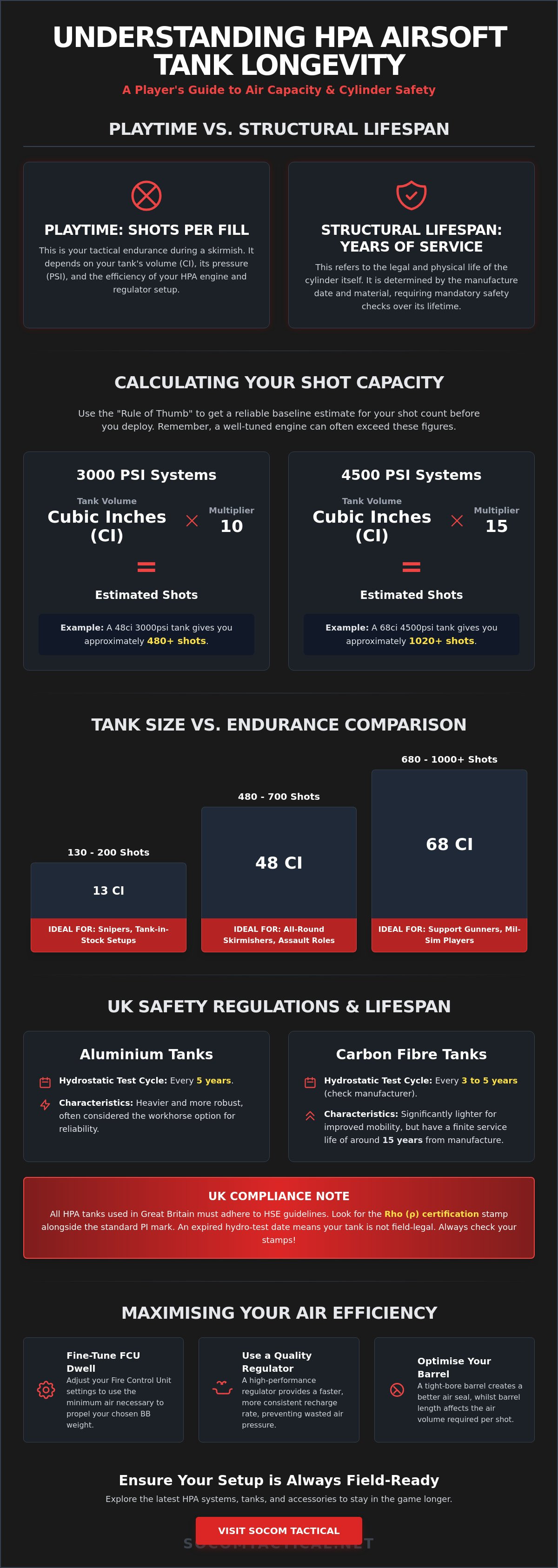
Stop guessing and start measuring. Calculating exactly how long do HPA airsoft tanks last involves a simple piece of field arithmetic known as the "Rule of Thumb". For a 3000psi system, multiply the tank's cubic inches (CI) by 10. If you're running a 4500psi setup, multiply the CI by 15. This provides a conservative baseline for your shot count. For example, a standard 48ci 3000psi tank should net you at least 480 shots, though a well-tuned engine can often push this closer to the 700-shot mark.
Engine efficiency is the great equaliser here. Systems like the Polarstar Jack or Wolverine Inferno are renowned for their air-sipping qualities, whilst older or unoptimised setups might bleed air like a sieve. Your physical build also dictates consumption. A longer inner barrel requires a larger volume of air to propel the BB to the muzzle, meaning your DMR might drain a tank faster than a compact CQB RIF. Even your bore size matters; tight-bore barrels create a more efficient air seal, potentially squeezing extra shots out of every fill. If you're looking to upgrade your efficiency, browse our latest HPA tech and accessories to stay in the game longer.
High rates of fire and aggressive trigger response also impact your air reserves. Rapid cycling puts immense pressure on your regulator to keep up, often leading to higher consumption per shot compared to controlled, semi-auto fire. If you're a support gunner pinned down and holding a lane, you'll watch your gauge drop significantly faster than a marksman picking off targets from the treeline.
Tank Size Comparison: 13ci vs 48ci vs 68ci
Choosing the right bottle is a trade-off between mobility and endurance. The 13ci tank is a favourite for tankers or players using "tank-in-stock" configurations, providing enough air for roughly 130 to 200 shots. This is perfect for snipers but risky for front-line skirmishers. The 48ci is the industry standard, offering enough "skirmish endurance" to last a typical 40-minute game without breaking a sweat. For those who refuse to visit the fill station, the 68ci carbon fibre tanks provide massive capacity but add bulk to your plate carrier or backpack.
The 3000 PSI vs 4500 PSI Difference
The jump from 3000psi to 4500psi is a game-changer, offering roughly 50% more air within the same physical volume. However, this extra capacity comes with caveats. You'll need a regulator specifically rated to handle the higher input pressure to remain safe. It's also vital to remember that whilst 4500psi vessels are built to stringent UK hydro-testing regulations, not every UK site has the compressor kit required to fill them to their maximum limit. Always check your local site's capabilities before investing in a high-pressure setup.
Structural Lifespan and UK Hydro-testing Regulations
Whilst calculating your shot count is vital for tactical success, understanding the legal framework behind your gear is what keeps you on the right side of the safety tape. In the UK, the Health and Safety Executive (HSE) maintains strict guidelines for pressure vessels to prevent catastrophic failures. This is not just red tape; it is a critical safety protocol that every site marshal takes seriously. If you turn up with a tank that doesn't meet British standards, you will be refused a fill, effectively ending your day before the first whistle blows.
The most significant detail for any UK player is the certification mark. Since Brexit, new tanks sold in Great Britain must carry the "Rho" (ρ) or "UN" stamp. Whilst older "Pi" (π) marked tanks are still common, they must be within their valid test dates to be legal for use. These regulations ensure that the vessel was manufactured to withstand the extreme pressures required for HPA play. Ignoring these stamps or using uncertified tanks from overseas is a gamble that puts you and your teammates at risk. If you have questions about your current kit, our FAQ page covers the basics of gear maintenance and safety.
How to Check Your Tank’s Expiry Date
To determine how long do HPA airsoft tanks last in a legal sense, you need to find the manufacture date. This is usually printed on the label or stamped directly into the aluminium near the neck. Look for a date in a MM/YYYY format; this is your "born on" date. For composite and carbon fibre tanks, you have a five-year window from this date before a mandatory hydro-static test is required. Aluminium tanks typically offer a ten-year stretch before their first structural test. Beyond the date, always check for "white stress marks" on carbon wrap or deep gouges in aluminium, as these visual cues can void your tank's safety rating instantly.
The 15-Year Rule for Carbon Fibre Tanks
Carbon fibre vessels are the top-tier choice for weight savings, but they come with a hard retirement date. Most of these tanks have a maximum service life of 15 years from the date of manufacture. Once you hit that 15-year milestone, the tank must be decommissioned, regardless of how pristine it looks. Aluminium tanks are different; they technically have no "end date" as long as they continue to pass their ten-year hydro-tests. However, for many players, the cost of a professional hydro-test can approach the price of a brand-new bottle. In these cases, it is often more cost-effective to retire the old unit and invest in a fresh, Rho-certified tank to ensure total field-readiness.
Maximising Efficiency: Making Your Air Last Longer
You've done the math and checked your safety stamps. Now, let's talk about squeezing every last drop of performance from your setup. Many players wonder how long do HPA airsoft tanks last on a single fill, but they forget that their RIF's internal settings are often the biggest culprit for air waste. A high-quality regulator is your first line of defence. It ensures a stable output pressure, preventing the "spikes" that lead to inconsistent FPS and wasted volume. Pair this with a perfectly sealed airline, and you've already won half the battle against the dreaded "empty tank" mid-game.
Beyond the tank and regulator, your engine's health is paramount. A neglected HPA engine with worn O-rings will bleed air internally, forcing you to use higher pressures just to maintain your site's limit. Regular maintenance isn't just about reliability; it's about air conservation. Ensuring your hop-up unit and nozzle alignment are perfect prevents air from escaping around the BB. This technical precision allows you to lower your operating pressure whilst maintaining the same muzzle velocity, effectively stretching your tank's endurance.
Dwell Tuning for Peak Efficiency
Dwell refers to the specific amount of time your nozzle remains open to release air for each shot. If your Fire Control Unit (FCU) is set to a factory default, it's likely dumping air long after the BB has actually left the barrel. This is pure waste. To fix this, lower your dwell setting in small increments whilst using a chronograph. Keep dropping the value until you see a dip in FPS, then back it up slightly until the velocity stabilises. Tuning your dwell can save between 20% and 30% of your air fill, which is the most effective way to extend how long do HPA airsoft tanks last during a high-intensity skirmish.
Maintenance and Storage Best Practices
We highly recommend using precision inner barrels to ensure a superior air seal between the nozzle and the hop-up. A tighter seal means less air is required to propel the BB, saving your tank for those critical final moments of the game. When you're off the field, never store your tank completely empty. Leaving approximately 500psi of "storage air" keeps the internal seals seated and prevents moisture from entering the vessel through the regulator.
A critical safety warning: never use petroleum-based oils or greases near the fill nipple or regulator intake. Under high pressure, these substances can become highly combustible and cause an explosion. Always stick to specialist silicone lubricants designed for HPA systems. Ready to optimise your kit for the next engagement? Explore our range of parts and upgrades to build the most efficient HPA machine on the field.
Choosing Your Next HPA Setup at Socom Tactical Airsoft
Sifting through the HPA market often feels like a minefield of conflicting advice and questionable certifications. At Socom Tactical Airsoft, we've cemented our position as the UK specialist for HPA conversions and gear amongst the local community by focusing on what actually works on the skirmish field. We understand that knowing how long do HPA airsoft tanks last is only one part of the puzzle; you also need a setup that is operationally ready whilst maintaining the highest safety standards. Our commitment is simple: we only stock UK-compliant, Rho or PI-marked cylinders. Whether you're a newcomer or a seasoned practitioner, our Fleet retail outlet is the perfect place to get hands-on with the latest kit and receive face-to-face advice from a team that shares your passion for the hobby.
This isn't just about selling kit; it's about providing solutions to specific situational challenges you'll face under fire. We frame every item in our inventory through the lens of functional utility. If a tank doesn't offer the reliability we'd expect in a high-stakes engagement, it doesn't make it onto our shelves. By choosing a vetted setup from Socom Tactical Airsoft, you ensure that your equipment is an essential tool for a broader experience rather than a source of frustration. Explore our new HPA products to see the latest advancements in lightweight cylinders and high-refresh regulators.
Expert Tech Support for HPA Conversions
Professional installation is the defining factor between a high-performance machine and a frustrating air-hog. Our Technical Labour services are designed to take the guesswork out of engine fitting. If your nozzle isn't perfectly aligned or your dwell isn't tuned, you're effectively throwing air away with every trigger pull. Our veteran techs ensure that your engine is seated with surgical precision, maximising your air efficiency and helping your tank last longer during those gruelling mil-sim events. If you're tackling a build yourself and hit a technical snag, our FAQ page is a goldmine for troubleshooting common HPA issues and maintenance tips.
Essential Consumables for HPA Users
Don't let a budget bottle of BBs ruin a high-end HPA build. To truly understand how long do HPA airsoft tanks last in a practical sense, you must consider the total system efficiency. Using high-quality BLS Airsoft BBs ensures consistent feeding and a superior air seal, which prevents wasted pressure and keeps your shot counts predictable. Because professional-grade HPA gear is always in high demand at Socom Tactical Airsoft, we recommend checking our back in stock items regularly for the most popular tank sizes and regulator kits. Get your rig kitted out today and experience the grit and precision that only a professional-grade HPA setup can deliver on the field.
Ready Your Rig for the Next Engagement
Mastering your HPA system is about more than just filling a bottle; it's about tactical readiness and safety. You've learned how to calculate shot counts using the Rule of Thumb and why tuning your dwell is the secret to staying in the game longer. Understanding how long do HPA airsoft tanks last requires a dual focus on your immediate air reserves and the long-term structural integrity of your cylinder. Whether you're running a rugged aluminium workhorse or a lightweight carbon fibre setup, staying compliant with UK hydro-testing regulations is non-negotiable for any serious player.
Since 2009, Socom Tactical has supported the UK community from our physical storefront with expert technical advice and vetted, PI-marked gear. Don't leave your performance to chance when you're deep in a skirmish. Our team provides the expert UK-based technical support you need to ensure every component of your HPA rig is optimised for the field. It's time to stop worrying about your gauge and start focusing on the objective.
Upgrade your loadout with our range of HPA-ready airsoft guns and accessories and step onto the field with total confidence in your equipment. We'll see you in the safe zone.
Frequently Asked Questions
How many shots can I get from a 48ci 3000psi HPA tank?
A standard 48ci 3000psi tank typically provides between 500 and 700 shots per fill depending on your engine's efficiency. Factors such as your dwell settings and barrel length will push this number toward the higher end or drain it faster. It's the most common size for a reason; it usually lasts a full 40-minute skirmish for most riflemen without needing a trip to the fill station.
Do HPA tanks expire if they aren’t used?
Yes, HPA tanks expire based on their manufacture date regardless of how many times they've been filled. The structural lifespan is determined by the "born on" date stamped on the vessel. Even if it's sat in your kit bag for five years, it still requires a hydro-static test to remain legal and safe for use at UK sites.
What is the difference between a 3-year and 5-year hydro-test cycle in the UK?
Most modern composite and carbon fibre tanks follow a 5-year hydro-test cycle in the UK, whilst some older or specific industrial-spec vessels required testing every 3 years. You should always check the manufacturer's label or the specific HSE guidelines for your bottle. Knowing how long do HPA airsoft tanks last between tests is vital for staying field-ready and avoiding a refusal at the fill station.
Can I fill my HPA tank with a standard bike pump or compressor?
You cannot use a standard bike pump or a typical workshop compressor to fill an HPA tank. These devices usually top out at 100 to 150 PSI, whereas your tank requires 3000 to 4500 PSI. You must use a dedicated high-pressure HPA hand pump or a specialist scuba-grade compressor found at airsoft sites or dive shops to reach operational pressures safely.
Is it safe to transport a full HPA tank in my car to a skirmish site?
Why do carbon fibre tanks cost more than aluminium ones if they expire after 15 years?
Carbon fibre tanks cost more because they are significantly lighter and can hold 4500 PSI, providing 50% more air than a same-sized aluminium bottle. Even with a 15-year hard expiry, the tactical advantage of reduced gear weight and higher shot capacity makes them the preferred choice for competitive players. Aluminium is cheaper but much heavier and limited to 3000 PSI.
How do I know if my HPA tank is PI-marked for use in the UK?
Check the neck or label of your tank for the Greek letter Pi (π) or the newer UK Rho (ρ) symbol. These markings confirm the vessel meets the necessary safety standards for the UK market. Understanding how long do HPA airsoft tanks last involves checking these stamps; if your tank only has US-specific DOT markings, most UK sites will legally refuse to fill it.
What should I do if my HPA tank fails its hydro-test?
If a tank fails its hydro-static test, it is legally condemned and cannot be used again. The testing centre will typically drill a hole in the vessel or strip the threads to ensure it can't be filled. At this point, it's time to retire the gear and invest in a new Rho-certified cylinder to ensure you're back on the field safely for your next engagement.