Last Saturday at a rain-soaked site in Kent, a seasoned player watched their high-end AEG drop 40 FPS in the biting wind, whilst a polarstar f2 user across the trench continued to pick off targets with surgical precision. It’s a scenario we see far too often; the UK’s unpredictable climate can turn a finely tuned gearbox into a liability in seconds. We agree that your focus should be on the objective, not on whether your trigger response will hold up under pressure or if your nozzle is slightly out of alignment.
This guide promises to give you the technical edge needed to build a truly elite HPA platform that ignores the cold and delivers unmatched consistency. We’re going to walk you through the precise steps to master the dual-solenoid system, from fine-tuning the FCU for a lightning-fast rate of fire to achieving the perfect nozzle centring. By the time you’ve finished reading, you’ll have the knowledge to transform your loadout into a reliable, high-performance tool that’s ready to dominate any skirmish field in the country.
Key Takeaways
- Discover how the dual solenoid system delivers independent control over your nozzle and poppet to achieve unparalleled shot-to-shot consistency on the field.
- Master the versatile operating pressure range to seamlessly transition your platform from high-speed CQB engagements to precision-focused DMR roles.
- Compare the polarstar f2 against industry rivals like the Jack and Inferno Gen 2 to identify exactly why this engine remains the gold standard for high-performance builds.
- Gain expert insights into the installation process, focusing on the critical importance of nozzle alignment for maximising your effective range and accuracy.
- Learn why opting for professional installation and the right precision accessories is the most efficient way to ensure your loadout is truly skirmish-ready.
Understanding the PolarStar F2: The Pinnacle of HPA Technology
Dominating the skirmish field requires gear that doesn't just keep up but sets the pace for every engagement. The polarstar f2 represents the peak of this evolution, acting as the refined successor to the legendary Fusion Engine that originally sparked the HPA revolution. By taking the dual-solenoid technology that made their flagship system famous and shrinking it down, PolarStar has created a powerhouse that fits within the footprint of a standard cylinder.
Unlike the original Fusion Engine, which required a proprietary gearbox shell, the F2 is designed as a universal "drop-in" cylinder replacement. This compact engineering allows for installation in almost any gearbox platform on the market. Whether you're running a standard V2 M4 or a more niche V3 AK, the F2 provides a level of versatility that was previously impossible. It's a system built on a "By Players, For Players" philosophy, ensuring that technical nuances like nozzle alignment and air efficiency are prioritised for the end user.
The Evolution of the Fusion Engine
Shrinking the flagship technology wasn't about cutting corners; it was about enhancing precision. PolarStar successfully miniaturised their dual-solenoid system, allowing the poppet and nozzle to move independently. This shift from proprietary shells to universal cylinder compatibility has made high-performance builds more accessible. As we move through 2026, the polarstar f2 remains the gold standard for precision builds because it offers the same level of adjustment as a full gearbox replacement while maintaining the structural integrity of your original RIF.
Why UK Players are Switching to HPA Platforms
British airsoft presents unique environmental challenges that often push standard AEGs to their limits. When the weather turns damp or freezing during a mid-November skirmish, mechanical components and batteries often fail. High Pressure Air (HPA) systems are inherently more resilient to the British climate, providing consistent performance regardless of the temperature. Beyond weatherproofing, the tactical advantages are clear:
- Instant Trigger Response: Essential for winning snap-shot engagements in tight CQB environments.
- Unmatched Consistency: HPA provides a stable FPS output, which is vital for long-duration skirmishes where accuracy is paramount.
- Reliability: With fewer moving parts than a traditional gearbox, the risk of mechanical failure during a game is significantly reduced.
For players who demand the most from their loadout, moving to an HPA platform isn't just an upgrade; it's a complete shift in how you approach the game. The F2 provides the reliability needed to endure the harshest field conditions whilst delivering the precision required to dominate the opposition.
Technical Specifications and the Dual Solenoid Advantage
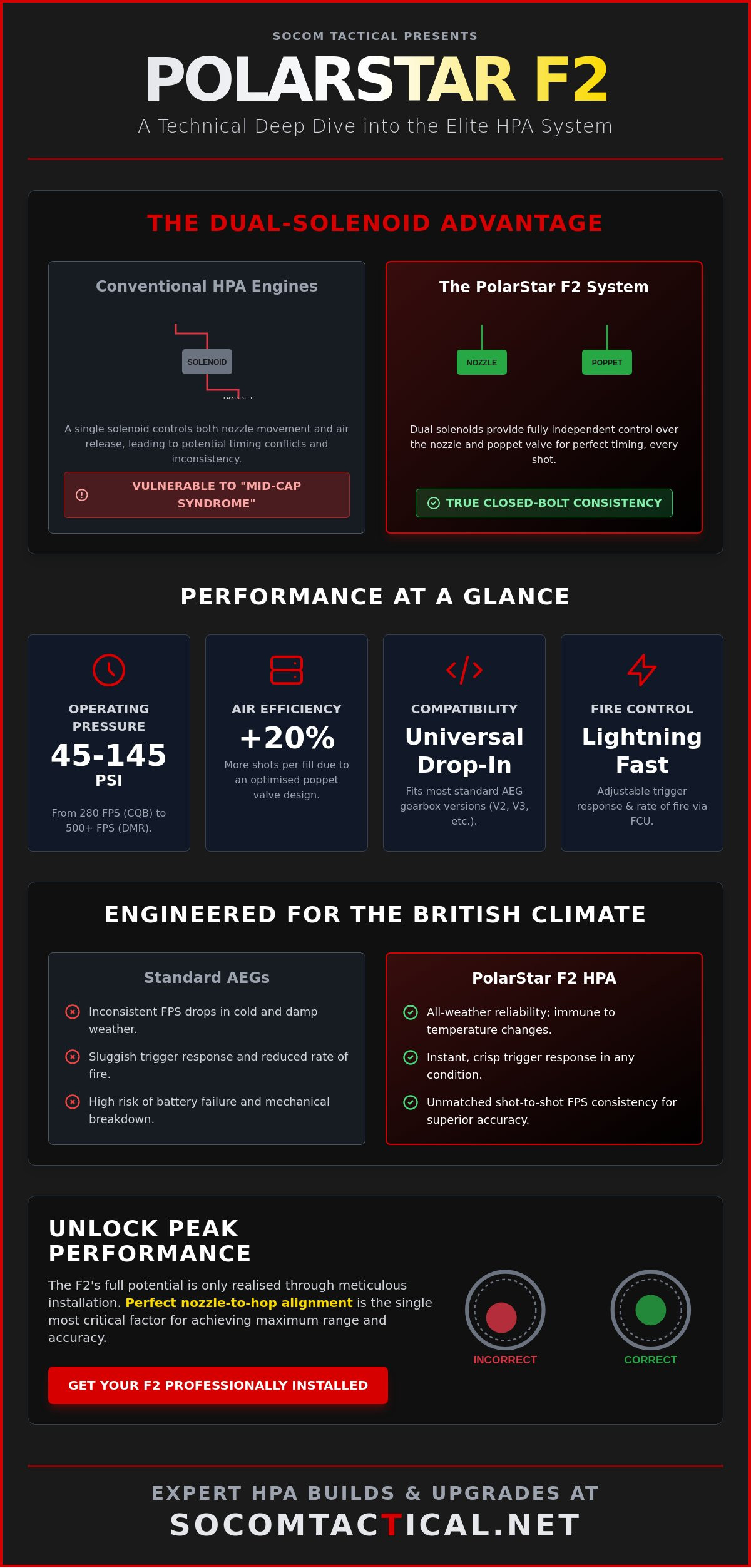
The polarstar f2 represents a significant leap in HPA engineering, effectively shrinking the legendary Fusion Engine's performance into a drop-in cylinder. This system operates within a versatile pressure range of 45psi to 145psi. Such a broad window allows you to transition from a 280 FPS indoor CQB setup to a 500 FPS long-range DMR platform by simply adjusting your regulator. Efficiency is a core pillar of this design; the one-piece poppet valve reduces dead volume within the engine, ensuring that every cubic centimetre of air from your tank contributes directly to the BB's velocity. This design choice often results in a 20% increase in shots per fill compared to older, less efficient nozzle designs.
The Power of Independent Solenoid Control
Most HPA engines rely on a single solenoid to manage both the nozzle movement and the air release, which often leads to timing conflicts. The polarstar f2 utilises a dual solenoid valve configuration that allows for total independence between these two critical functions. This separation is the primary cure for "mid-cap syndrome," a common issue where high-tension magazine springs push the nozzle out of alignment. By fine-tuning the loading time versus the air volume, you ensure the BB is perfectly seated in the hop-up bucking before the air is released. The dual solenoid mechanism serves as the definitive technical solution for achieving consistent closed-bolt accuracy on the skirmish field.
Navigating the Fire Control Unit (FCU)
The Fire Control Unit (FCU) acts as the central nervous system for your build, providing digital control over mechanical actions. Mastering the jargon is essential for peak performance. Poppet Dwell (dP) dictates how long the valve stays open to release air, whilst Nozzle Dwell (dn) controls the time the nozzle remains retracted to feed the next BB. If you're aiming for a high-speed setup reaching 30 RPS, you'll need to decrease these values carefully. For those building a precision DMR, increasing the Return to Battery (dr) setting ensures the nozzle is fully forward and sealed before the shot initiates.
Protecting these electronics is vital for field reliability. We recommend wrapping the FCU in a small piece of foam or heat shrink before tucking it into the buffer tube or motor grip. This prevents the delicate wires from snagging or vibrating loose during heavy movement. If you're looking to refine your build even further, explore our selection of internal parts and upgrades to find the perfect hop-up pairing for your new engine. Keeping your battery leads organised and clear of the stock adjustment rails will prevent accidental shorts during a frantic skirmish.
PolarStar F2 vs. The Competition: Why Upgrade Your Platform?
Selecting the right HPA engine is the most critical decision for any high-end build. Whilst the PolarStar Jack offers a solid entry point for those on a budget, it lacks the sophisticated air volume control found in the polarstar f2. The Jack uses a single-solenoid, open-bolt design, which is great for high rates of fire but can sacrifice that first-shot consistency required for long-range engagements. In contrast, the F2 utilises a dual-solenoid system that allows for independent adjustment of the nozzle and poppet, mirroring the legendary performance of the Fusion Engine in a much smaller footprint.
When you stack the F2 against rivals like the Wolverine Inferno Gen 2 or the Gate Pulsar, the differences become clear. The Inferno Gen 2 is a fantastic hybrid engine, but it doesn't offer the same level of granular control over the loading cycle. For players building a featherweight speed loadout, the F2 is the gold standard. It weighs approximately 90 grams, making it significantly lighter than traditional gearbox setups. This weight reduction allows for faster transitions between targets during intense CQB skirmishes, giving you a tactical advantage when every second counts.
- Weight: 90g (F2) vs 300g+ (Standard AEG Gearbox)
- System Type: Dual-solenoid closed bolt
- Compatibility: Fits V2, V3, and various proprietary shells
F2 vs. Fusion Engine: Is Smaller Better?
The Fusion Engine is a beast, replacing the entire gearbox shell with a CNC-machined powerhouse. However, its size is its limitation. The polarstar f2 provides the same dual-solenoid performance but fits inside your existing gearbox shell. This makes it far more versatile for non-standard RIFs where a Fusion Engine simply won't fit. Whether you're upgrading a standard M4 or a niche bullpup, the F2 offers unmatched nozzle flexibility. If you're looking to customise your build further, check out our range of Socom Tactical parts and upgrades to find the perfect fit for your platform.
F2 vs. The Wider HPA Market
Precision shooters often prefer the F2 for its true closed bolt operation. Unlike single-solenoid engines that chamber the BB and fire in one motion, the F2 chambers the round before the air is released. This ensures the BB is seated perfectly in the hop-up bucking every single time, which is a massive advantage for MilSim players who value accuracy over spray-and-pray tactics.
Maintenance is another win for PolarStar. The O-ring system is straightforward to service, requiring only basic tools and a bit of high-quality lube to keep it running for hundreds of thousands of rounds. For the serious skirmisher, the price-to-performance ratio is unbeatable when you factor in the long-term reliability and the competitive edge it provides on the field. It’s a rugged, detail-oriented solution for players who refuse to compromise on their gear.
Installation Mastery: Getting Your F2 Skirmish-Ready
Transitioning from a standard AEG to a high-performance HPA system is a rite of passage for many serious players. Stripping your V2 or V3 gearbox shell of its gears, piston, and motor marks the start of a precision build. Once you've cleared the internal components, the polarstar f2 engine drops into the cylinder space, but the work doesn't stop at the drop-in. Success on the field depends on how meticulously you handle the wiring and seating. Ensure your trigger switch is perfectly positioned; even a 0.5mm gap can result in a mushy pull or intermittent firing. Route your FCU cables through the motor grip with care, using small strips of electrical tape to secure them against the gearbox wall to prevent the shell from pinching the wires during reassembly.
Gearbox Preparation and Nozzle Alignment
Nozzle alignment is the single most important factor for achieving the "laser beam" accuracy HPA is known for. If your nozzle enters the hop-up chamber at even a slight angle, you'll suffer from inconsistent hop-up application and mid-cap feeding issues. You can verify this by looking down the inner barrel with a torch or using a 5mm alignment laser. If the nozzle isn't perfectly centred, you can adjust the gearbox tilt using small shims or by slightly tightening the motor grip screws. Avoid these common installation blunders:
- Pinched Solenoid Wires: Always double-check that the thin wires connecting the solenoids to the FCU aren't caught in the gearbox seams.
- Loose Engine Seating: If the engine wobbles inside the shell, use O-rings or electrical tape to create a snug fit.
- Trigger Over-travel: Customise your trigger pull using a grub screw to eliminate take-up, giving you that crisp, hair-trigger response.
Tuning for UK Site Limits (FPS and PSI)
UK skirmish sites strictly enforce power limits, usually 1.14 Joules for full-auto platforms and up to 1.88 Joules for locked DMRs. Because the polarstar f2 is exceptionally efficient, you must be wary of Joule creep. This occurs when the air volume is high enough to continue accelerating a heavier BB down the barrel, resulting in higher energy levels than measured with 0.20g BBs. Always chronograph your RIF using the specific BB weight you'll use in the game to stay within legal and site-specific limits. You can find more details on choosing the right base for your build in The Ultimate Guide to Airsoft Guns.
Tuning the FCU is where the magic happens. Start by setting your PSI on your regulator, typically between 80 and 120 PSI for most UK builds. Use the "dP" (poppet dwell) setting to maximise air efficiency. Lower the dP value until you see a drop in FPS, then increase it by two units. This ensures the solenoid closes exactly when the BB leaves the barrel, saving air and silencing your muzzle report. A well-tuned F2 can easily get over 3,000 shots from a standard 48ci 3000psi tank, keeping you in the fight longer without needing a refill.
Customising Your Loadout with Socom Tactical
Dropping a polarstar f2 into your favourite RIF is only the beginning of the journey. To truly dominate the skirmish field, you need a setup that is tuned for maximum consistency and reliability. While DIY builds are popular, HPA systems involve complex air seals and precise alignment that can be difficult to master without professional tools and experience. A millimetre of misalignment between the nozzle and the hop-up unit can lead to inconsistent feeding or a massive drop in FPS.
Professional HPA Fitting and Support
Our tech team at Socom Tactical brings over 15 years of combined experience to every high-performance build. We don't just install the engine; we optimise the entire platform. Our technical labour services include fine-tuning your dwell settings, which can improve air efficiency by up to 25% compared to standard out-of-the-box configurations. This ensures your tank lasts longer during intense weekend events. If you want a bespoke build that performs perfectly from the very first trigger pull, Contact Us for a custom quote and professional support.
Essential HPA Accessories
Precision engines like the polarstar f2 are unforgiving when it comes to low-quality consumables. Using sub-standard ammo often leads to jams or erratic groupings that negate the benefits of your upgrade. We recommend using high-grade BLS Airsoft BBs for their consistent diameter and polished finish. These BBs ensure that every shot leaves the barrel with the same velocity and spin.
To take full advantage of the F2's rapid trigger response, pair your rifle with a high-clarity Red Dot or Holo Sight for instant target acquisition. You should also ensure your FCU is powered by a dedicated 7.4v JST LiPo battery. These batteries are small enough to fit into most buffer tubes or pistol grips, keeping your electronics running throughout a full day of skirmishing.
Maintenance is the lifeblood of any HPA system. You should inspect your internal O-rings every 20,000 rounds and apply a light coating of high-quality silicone grease to keep the seals airtight. Avoid petroleum-based lubricants at all costs, as they will degrade the rubber seals and cause leaks. Before you head to your next event, run through this final checklist to ensure you are skirmish-ready:
- Check tank hydro dates and fill levels to ensure you have enough air for the day.
- Test the FCU settings to confirm the dwell and ROF are compliant with UK site limits.
- Clean your precision inner barrel with a lint-free cloth to maintain long-range accuracy.
- Check all macro line fittings for leaks by listening closely while the system is pressurised.
- Verify that your hop-up bucking is clean and free from excess lubricant.
By following these steps and utilising professional support, you transform a standard airsoft gun into a world-class tactical platform. Socom Tactical is here to ensure your gear never lets you down when the heat is on.
Master the Field with HPA Precision
The polarstar f2 isn't just an upgrade; it's a complete shift in how you engage on the field. By utilising its dual solenoid system, you gain independent control over the nozzle and poppet. This setup provides the shot-to-shot consistency required to dominate any engagement. We've seen countless players transform their standard platforms into high-performance tools that deliver surgical precision at every range. At Socom Tactical, we're active skirmishers ourselves, so we understand the technical grit needed to keep your gear running at its peak. We maintain a wide range of nozzle variants in stock to ensure compatibility with your specific build. When you're ready to overhaul your loadout, our team provides expert technical support to guide you through the process. We offer fast UK-wide shipping on all high-performance parts, ensuring you're never left waiting when the next event is around the corner. Take your platform to the next level and experience the reliability that comes from industry-leading engineering.
Ready to upgrade? Shop the PolarStar F2 and HPA range at Socom Tactical today
Get your gear skirmish-ready and we'll see you in the thick of the action.
Frequently Asked Questions
Is the PolarStar F2 compatible with all airsoft gearboxes?
The PolarStar F2 isn't compatible with every single gearbox on the market, but it fits the vast majority of standard platforms including Version 2, Version 3, and M249 shells. You'll need the specific nozzle and wire harness kit designed for your rifle's unique geometry. For example, a standard M4 uses a V2 kit whilst an AK-47 requires a V3 offset nozzle to ensure a perfect air seal and reliable feeding during a skirmish.
What is the difference between the PolarStar F2 and the Jack?
The primary difference lies in the solenoid configuration; the F2 utilises a dual-solenoid system whilst the Jack uses a single-solenoid design. This allows the F2 to operate with a true closed-bolt function, providing superior consistency and shot-to-shot accuracy. While the Jack is a fantastic entry-level HPA engine, the F2 offers 20% better air efficiency and independent adjustment of the nozzle movement and poppet dwell for maximum performance.
What battery do I need for the PolarStar F2 FCU?
You need a 7.4v LiPo battery equipped with a JST-RCY connector to power the PolarStar F2 FCU. Most players opt for a compact 250mAh or 300mAh pack because the electronics draw minimal current during a game. A single 300mAh charge typically lasts for over 20,000 shots, so you won't need a bulky battery taking up precious space in your stock tube or handguard whilst on the field.
How many rounds per second (RPS) can the PolarStar F2 achieve?
The PolarStar F2 can achieve a staggering rate of fire up to 75 rounds per second when tuned correctly. However, most UK sites limit full-auto fire, and standard mid-cap magazines struggle to feed reliably above 30 RPS. To hit these high numbers, you must precisely calibrate the FCU settings and use high-quality BBs to prevent jams during high-speed strings of fire in intense tactical engagements.
Do I need a specific regulator for the PolarStar F2?
You must use a dedicated HPA regulator capable of outputting between 40 PSI and 145 PSI to run the PolarStar F2 safely. Standard paintball regulators output 800 PSI, which will instantly destroy the internal seals of your engine. We recommend a high-flow regulator like the PolarStar MRS to ensure your air supply remains consistent during rapid-fire transitions. This ensures your platform remains skirmish-ready and performs reliably under pressure.
Is the PolarStar F2 better for CQB or DMR builds?
The PolarStar F2 excels in both CQB and DMR roles due to its extreme adjustability and closed-bolt precision. For CQB, you can set a hair-trigger response and high ROF to dominate tight corridors. For a DMR build, the dual-solenoid design allows you to fine-tune the nozzle timing, ensuring a perfect seal for every shot. This is essential for hitting targets consistently at distances of 60 metres or more.
How often should I service my PolarStar F2 engine?
You should service your PolarStar F2 engine every 6 to 12 months, or after every 250,000 rounds fired. Maintenance involves a simple teardown to clean out debris and apply a fresh coat of synthetic lubricant to the O-rings. Regular servicing prevents mid-game failures and maintains the 5% FPS consistency that makes this platform a top-tier choice for serious players who demand the very best from their tactical gear.
Can the PolarStar F2 run on CO2 instead of HPA?
Yes, the PolarStar F2 can run on CO2 provided you use a regulated source that brings the pressure down to the 40 to 145 PSI operating range. Systems like the PolarStar CGS allow you to use 12g or 33g CO2 cartridges housed directly within the stock. This setup is perfect for players who want a streamlined loadout without the traditional HPA tank and line setup hindering their movement on the field.