What if the loudest part of your concealment isn't your movement, but the violent "clack" of your piston hitting the cylinder head? For many UK snipers, balancing the 2.5 Joule legal limit with the need to lift heavy 0.48g BBs feels like a constant battle against physics. You've likely spent hours chasing a perfect air seal only to be let down by inconsistent output or that dreaded piston slap that gives away your position after a single shot.
We understand that a truly elite bolt-action build requires more than just a stiff spring; it demands absolute control over air volume and kinetic energy. This guide is your deep dive into the Sniper Mechanics w.a.s.p Piston, a modular physics engine designed to revolutionise your rifle's consistency. We'll explore the 2026 design refinements, master the art of weight adjustment for perfect Joule Creep, and show you how to achieve a near-silent shot profile that keeps the opposition guessing. It's time to stop settling for "good enough" and start building for the win.
Key Takeaways
- Understand how to manipulate piston mass to optimise air compression, allowing your rifle to lift heavy 0.48g BBs with ease.
- Master the modular sleeve and airbrake system of the Sniper Mechanics w.a.s.p Piston to fine-tune your rifle's sound signature and energy output.
- Identify the correct internal configurations for VSR-10 and Silverback platforms to ensure 100% compatibility and a smooth bolt cycle.
- Discover how to stay field-legal within UK Joule limits whilst maximising the performance benefits of "Joule Creep" for long-range engagements.
- Access expert maintenance advice from Socom Tactical Airsoft to keep your upgraded internals running at peak performance in the heat of battle.
What is the Sniper Mechanics W.A.S.P Piston?
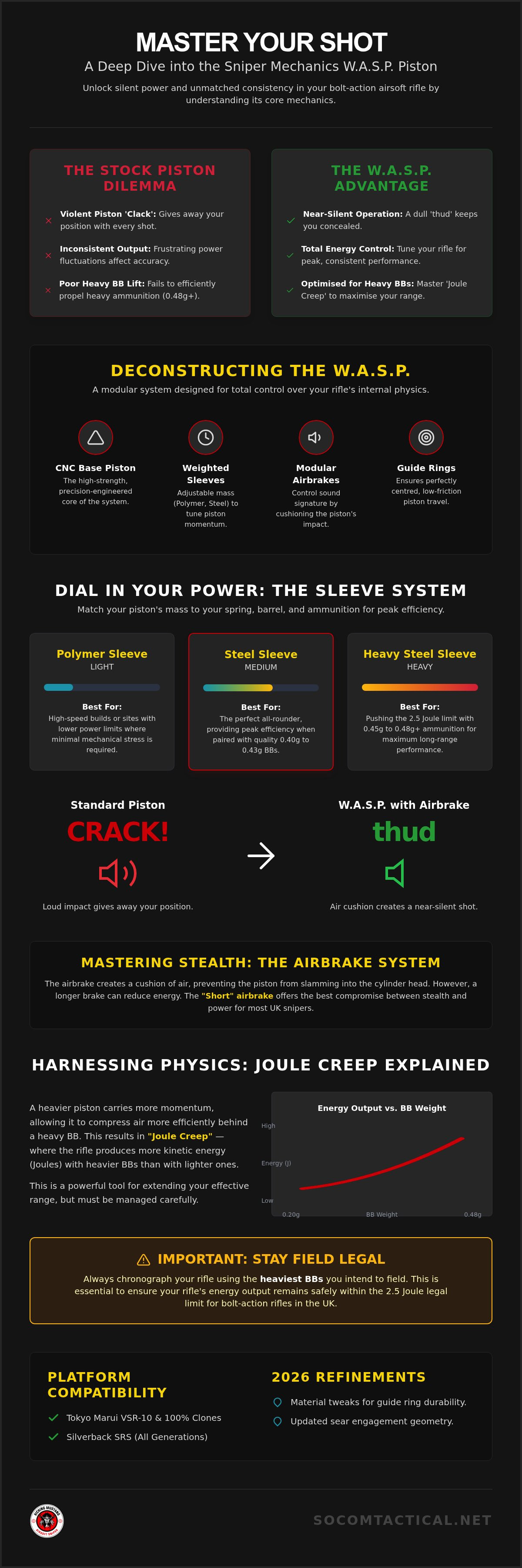
The Sniper Mechanics w.a.s.p Piston is more than just a replacement part; it is a comprehensive tuning kit designed to give bolt-action users total control over their shot cycle. W.A.S.P stands for Weight Adjustable Sniper Piston, and its core mission is to solve the inherent flaws found in lightweight factory pistons. By allowing the user to increase or decrease the moving mass within the cylinder, it provides a tailored solution for those seeking the perfect balance between power, sound, and air volume. It has become a foundational component for high-end builds across the UK, specifically for those pushing the limits of airsoft gun platforms like the VSR-10 and SRS.
Inside a typical kit, you will find a selection of precision-engineered components:
- CNC-Machined Base Piston: The high-strength core of the system.
- Weighted Sleeves: Includes Polymer for light builds, alongside Steel options for medium and heavy configurations.
- Modular Airbrake Fittings: Long, Short, and Non-airbrake options to control the piston's deceleration.
- Friction-Reducing Guide Rings: Designed to ensure the piston stays perfectly centred during travel.
The Evolution of the W.A.S.P System
The Sniper Mechanics brand grew out of the community’s desire for a more professional approach to spring sniper rifle optimisation. The piston has seen significant design refinements in 2026, including material tweaks to the guide rings and updated sear engagement geometry. These changes ensure that the piston remains field-ready for the long term, even under the stress of high-power springs. At Socom Tactical Airsoft, we keep our finger on the pulse of these updates, stocking the latest revisions in our "New Products" collection to ensure our customers have access to the most reliable tech available.
The Physics of Weighted Pistons
The primary reason snipers switch to the Sniper Mechanics w.a.s.p Piston is to master the physics of air compression. A standard piston is often too light to effectively compress the air behind a heavy 0.45g BB before the projectile begins its travel. By adding mass via the steel sleeves, you increase the piston's momentum. This allows for a more efficient energy transfer, often resulting in "Joule Creep," where the rifle produces more energy with heavier BBs than with lighter ones. Whilst this is a powerful tool for extending range, UK practitioners must use it responsibly to stay within the 2.5 Joule legal limit. Managing this mass is what separates a standard build from a truly elite, site-legal marksman rifle.
Technical Breakdown: Sleeves, Airbrakes, and Guide Rings
The versatility of the Sniper Mechanics w.a.s.p Piston is rooted in its ability to let the player dictate the internal physics of the shot cycle. Whilst a standard piston offers a fixed mass, this modular system allows for precise adjustments to the moving weight within the cylinder. This approach aligns with fundamental spring-piston design principles, where the relationship between piston inertia and air displacement determines how efficiently energy is transferred to the projectile. Beyond the weights, the inclusion of custom guide rings ensures the assembly stays perfectly centred, preventing the metal-on-metal wear that often ruins high-power builds.
Choosing Your Weight Sleeve
The kit provides three distinct tiers of mass to help you find the "sweet spot" for your specific barrel length and spring strength. The Polymer sleeve is the go-to for high-speed builds or sites with lower power limits where a heavy piston would cause unnecessary mechanical stress. On the opposite end, the Heavy Steel sleeve is a beast. It is designed for those pushing the 2.5 Joule limit with 0.45g or 0.48g ammunition, where the extra mass helps maintain air pressure through the entire length of the barrel. The Steel Medium sleeve is the perfect middle ground, providing peak efficiency when paired with high-quality 0.40g to 0.43g BBs. If you are unsure which weight suits your current spring, our team at the Socom Tactical Airsoft tech centre can help you calculate the ideal setup for your platform.
Mastering the Airbrake System
Silence is a sniper's best friend. The airbrake fittings included with the Sniper Mechanics w.a.s.p Piston work by restricting air flow at the very end of the piston's travel. This creates a cushion of air that prevents the piston from slamming into the cylinder head. The result is a dull "thud" instead of a sharp "crack." However, there is a trade-off. Longer airbrakes offer the best sound reduction but can lead to a loss in FPS if the brake enters the cylinder head nozzle before the BB has left the barrel. Finding the "break point" is essential; if your airbrake is too long for your spring power, you will see a massive energy drop. Most UK snipers find the "Short" airbrake offers the best compromise between stealth and power retention.
To round off the technical package, the piston utilises a high-grade injection-moulded cup. Unlike traditional O-rings that can flatten or perish over time, this cup expands under pressure. It ensures a perfect, consistent air seal on every single shot, even in the freezing conditions of a UK winter. When combined with the friction-reducing guide rings, the result is a shot-to-shot consistency that standard factory parts simply cannot match.
Platform Compatibility: VSR-10, SRS, and Beyond
The Sniper Mechanics w.a.s.p Piston isn't a "drop-in-and-forget" part that fits every rifle on the market. It is precision-engineered for specific spring-piston airsoft gun mechanics, meaning you need to select the variant that matches your rifle's cylinder dimensions. Currently, the system is split into two primary camps: the VSR-10 architecture and the Silverback bullpup ecosystem. Both versions share the same modular philosophy but differ in their external diameters and sear engagement heights to ensure reliable cocking and firing.
One critical factor across all platforms is spring compatibility. The W.A.S.P is built to work with 13mm internal diameter (ID) springs. This has become the "pro" standard in the UK, as it allows for thicker, more stable spring coils that don't kink or vibrate against the piston's internal walls. If you're trying to use a standard 7mm or 9mm spring, you'll find it won't fit the W.A.S.P's rear guide, making a high-quality 13mm spring an essential companion for this upgrade.
VSR-10 and SSG10 Specifics
For those running the classic VSR-10, the W.A.S.P is compatible with a wide range of aftermarket parts. You'll find it fits perfectly in cylinders from:
- Tokyo Marui (Standard specification)
- Maple Leaf (CeraKote and Twisted variants)
- Action Army (Teflon-coated cylinders)
However, we often see players struggling with the Novritsch SSG10. Whilst the SSG10 is VSR-based, its cylinder often has tighter internal tolerances. You might find that the guide rings need a tiny amount of "bedding in" or very light sanding to ensure the bolt pull remains buttery smooth. It's also vital to use a 90-degree trigger unit; the W.A.S.P isn't designed for the old 45-degree sears that cause piston tilt and uneven wear. If you're starting a fresh build, you can explore our range of Airsoft Sniper Rifles to find the perfect base for these internals.
Silverback SRS and Tac-41 Integration
The Silverback SRS presents a different challenge due to its massive air volume. The W.A.S.P handles this by allowing you to add significant mass, which prevents the piston from "dry firing" against the air cushion when using heavy 0.48g BBs. You'll need to be aware of your specific SRS generation, as changes to the spring guide and buttpad design over the years can affect how the piston seats. For the Tac-41, the W.A.S.P is arguably the single most impactful upgrade you can install. It transforms the out-of-the-box performance by stabilising the air seal and providing that signature silent shot profile that Silverback owners crave.
Installation and Maintenance: Tech Tips for Peak Performance
Installing the Sniper Mechanics w.a.s.p Piston is a methodical process that rewards patience with unmatched consistency. Because this is a precision-engineered component, simply throwing it into a dirty cylinder will negate the performance gains you are paying for. You need to treat your rifle like a high-performance engine. Follow this structured flow to ensure your build is field-ready and site-legal within the UK's 2.5 Joule limit.
- Step 1: Cylinder Preparation. Strip your cylinder completely. Use a lint-free cloth and isopropyl alcohol to remove every trace of old, gritty grease. A pristine surface is essential for the guide rings to glide without friction against the cylinder walls.
- Step 2: Component Selection. Select your weight sleeve and airbrake based on the BB weight you intend to use. As we discussed in the technical breakdown, heavier sleeves paired with 0.45g+ BBs often yield the best energy stability. Ensure all threaded parts are hand-tightened securely.
- Step 3: Strategic Lubrication. Apply a thin film of high-quality silicon oil to the piston cup to ensure it expands and seals instantly. Use a dedicated PTFE grease on the spring guide and the internal walls of the piston to dampen vibration and eliminate "spring twang."
- Step 4: Sear Engagement. Before closing the receiver, test the cocking motion. Ensure the sear engages the piston securely and releases cleanly without excessive force. This is particularly important for the tighter tolerances of the SSG10 cylinders mentioned earlier.
- Step 5: The Chronograph Test. Always chrono using your game-day BBs. Because the W.A.S.P excels at Joule Creep, a rifle that's legal on 0.20g BBs might be "hot" on 0.48g BBs. Testing with heavy ammunition is the only way to ensure field legality.
Troubleshooting Sear Release Issues
One common hurdle with high-end pistons is the interaction between the rear guide ring and the trigger sear. If you experience a "sticky" trigger or the piston fails to release, it's usually because the sear height is set too high for the W.A.S.P's precision tolerances. You may need to adjust the sear engagement screw on your 90-degree trigger unit to find the perfect release point. If you find the technical side daunting, our team at Socom Tactical Airsoft offers Professional Technical Labour and Upgrades to ensure your build is perfect from the first shot.
Long-Term Maintenance Schedule
To keep your Sniper Mechanics w.a.s.p Piston performing at its peak, you should perform a "mini-service" every 5,000 rounds or after a particularly dusty skirmish. Check the guide rings for signs of uneven wear and re-apply silicon oil to the piston cup to maintain that perfect air seal. Most importantly, follow the "No Dry Fire" rule. The massive momentum of a weighted piston is designed to be cushioned by an air pocket behind a BB. Dry firing is the fastest way to turn your expensive upgrade into scrap metal by slamming the piston head into the cylinder nozzle without resistance.
Ready to push your rifle to the limit? If you're looking for the latest revisions of these kits, check our New Products section for the most recent 2026 updates.
Why Source Your Sniper Upgrades from Socom Tactical?
Choosing the right components for your bolt-action rifle is only half the battle; the other half is knowing how to make them work in the unique conditions of the UK airsoft scene. At Socom Tactical, we don't just shift boxes. We are active participants in the community who skirmish with the same gear we sell. When you invest in a Sniper Mechanics w.a.s.p Piston through us, you're gaining access to a wealth of operational experience. We've spent years testing these systems on the field, which means we can offer technical advice that goes beyond the manual.
Our commitment to performance extends to our inventory. We ensure that we stock the latest W.A.S.P revisions and the essential 13mm springs required to make the system sing. To achieve the unparalleled consistency we've discussed throughout this guide, we recommend pairing your upgraded piston with BLS BBs. By combining high-mass projectiles with the adjustable physics of the W.A.S.P, you create a platform that is stable, quiet, and incredibly accurate at the limits of your engagement range.
UK Specialist Knowledge
Navigating the legal landscape of UK airsoft requires precision. Site marshals are increasingly strict about Joule limits, and a build that isn't properly tuned can easily fall foul of the 2.5 Joule cap during a spot check. If you're local to Hampshire, you can visit our physical outlet for a face-to-face consultation. Our technicians can help you calibrate your Sniper Mechanics w.a.s.p Piston to ensure it provides maximum "Joule Creep" efficiency whilst remaining strictly field-legal. For those just starting their journey, our Ultimate Guide to Airsoft Guns provides the foundational knowledge needed to choose the right base rifle for these high-end upgrades.
The Socom Community Advantage
We pride ourselves on being more than just a retailer; we're a cornerstone of the local scene. This allows us to secure exclusive access to brands that prioritise technical excellence, such as Sniper Mechanics and 4uantum. By joining the Socom community, you're connecting with a network of snipers who value reliability and grit over flashy, unproven parts. We provide the technical support you need to troubleshoot complex builds, ensuring your rifle is always ready for the next engagement. Don't leave your performance to chance. Browse our latest sniper upgrades today and take the first step towards mastering the long-range game.
Dominating the Long-Range Engagement
Mastering your bolt-action rifle requires more than just luck; it demands a deep understanding of the physics within your cylinder. By implementing the modular weight and airbrake system of the Sniper Mechanics w.a.s.p Piston, you've taken the most significant step towards achieving that elusive silent shot and rock-solid Joule consistency. Whether you're lifting 0.48g BBs in an SRS or fine-tuning a VSR-10 for the 2.5 Joule limit, you now have the tools to dictate the energy curve of every shot with surgical precision.
We're here to support your build with expert technical advice from seasoned UK airsoft veterans who know exactly what it takes to win. As an authorised retailer for Sniper Mechanics, we keep a full range of 13mm springs and precision BBs in stock to ensure your rifle is always field-ready. It's time to stop guessing and start outperforming the opposition on game day. Upgrade your rifle with the Sniper Mechanics W.A.S.P at Socom Tactical and experience the difference that professional-grade internals make to your skirmish experience. See you on the field.
Frequently Asked Questions
Is the Sniper Mechanics W.A.S.P piston compatible with the Novritsch SSG10?
Yes, the VSR-10 variant fits the Novritsch SSG10, but the tighter cylinder tolerances often mean you'll need to "bed in" the guide rings. A light sanding ensures the bolt pull remains smooth. Always pair it with a 90-degree trigger, as the W.A.S.P isn't designed for 45-degree sears. This combination provides a much quieter shot profile than the factory internals whilst maintaining the reliability you expect from a pro build.
Which weight sleeve should I use for a 2.3 Joule sniper build?
The Steel Medium sleeve is the ideal choice for a 2.3 Joule build. It offers the perfect balance of mass to ensure efficient air compression behind 0.43g BBs without putting excessive strain on your spring. If you're pushing closer to the 2.5 Joule limit with 0.48g ammunition, you might consider the Heavy Steel sleeve to maximise your energy retention through the entire barrel length.
Do I need a specific spring guide for the W.A.S.P piston?
You definitely need a 13mm spring guide to accommodate the pro-standard springs used with this system. The Sniper Mechanics w.a.s.p Piston is built specifically for 13mm internal diameter springs, which are thicker and more stable than standard variants. Using a smaller 7mm or 9mm guide will cause the spring to kink, leading to vibration, noise, and a significant loss in shot-to-shot consistency during long skirmishes.
Can I use the airbrake with a low-power spring?
It's possible, but generally not advisable for low-power setups. The airbrake creates a cushion of air that requires significant spring tension to push through the cylinder head nozzle. With a weak spring, the piston slows down too much, causing a dramatic drop in energy. For builds under 1.5 Joules, we recommend using the non-airbrake fitting to maintain a snappy trigger response and reliable muzzle velocity.
Why is my piston not catching the sear after installing the W.A.S.P?
This issue is almost always related to sear height adjustment. The rear guide ring on the Sniper Mechanics w.a.s.p Piston has very tight tolerances to ensure perfect centring, which can prevent the sear from popping up if it's set too high. Adjust the engagement screw on your 90-degree trigger unit to lower the sear slightly. This should allow the piston to catch reliably every time you cycle the bolt.
What is the best lubricant to use for the W.A.S.P piston cup?
High-quality, pure silicon oil is the only lubricant you should use on the injection-moulded piston cup. Silicon oil allows the material to stay supple and expand instantly when the piston moves, ensuring a 100% air seal every time. Avoid using heavy greases on the cup itself, as they can cause drag and lead to inconsistent FPS. Save the PTFE grease for the spring and spring guide.
Does the W.A.S.P piston fit into a stock Tokyo Marui VSR-10 cylinder?
Yes, it fits perfectly. The VSR variant was designed specifically around the Tokyo Marui cylinder specification, making it a straightforward upgrade for the world's most popular sniper platform. Replacing the stock plastic piston with the W.A.S.P instantly improves the rifle's weight balance and sound signature. It's the most effective way to turn a standard TM into a silent, heavy-hitting tool for the UK woods.
How much does the W.A.S.P piston weigh with the heavy steel sleeve?
When configured with the heavy steel sleeve, the VSR version of the piston weighs approximately 115g. This extra mass is the secret to lifting heavy 0.45g or 0.48g BBs at UK power limits. The momentum generated by the weighted piston ensures the air is fully compressed before the BB begins its travel, providing the Joule stability and "creep" needed for consistent long-range accuracy.