Why does your high-end kit feel like a tactical liability the moment you sprint for cover? It’s a common frustration amongst the community; you invest in a professional-looking plate carrier, only to find it bounces uncontrollably or leaves you overheating before the first objective is even secured. We know the grit required for a full day on the field, and nothing kills your momentum faster than a rig that restricts your breathing or forces you to fumble for a fresh magazine during a high-stakes engagement.
You deserve a loadout that feels like a second skin rather than a burden. We've mastered the art of tactical setups to help you achieve a sleek profile that offers instant, intuitive access to your kit. This guide breaks down everything from achieving a rock-solid fit to ensuring your pouches are fully compatible with your chosen chassis. We'll explore the latest 2026 trends in minimalism and modularity, giving you the technical expertise to organise a rig that's ready for immediate field use.
Key Takeaways
- Understand why modern airsofters favour a modular chassis for both realism and superior protection against close-range BB hits.
- Learn to distinguish between high-speed minimalist profiles and heavy-duty rigs designed to carry hydration and tools for sustained skirmishes.
- Master the golden rule of plate carrier sizing to ensure your vital areas are protected without restricting your breathing or mobility.
- Discover how to organise your rig using placard systems and the 'Three-Mag Rule' to maintain a slim, efficient loadout that won't snag on field obstacles.
- Identify the specific features that make tactical gear field-ready, ensuring your equipment survives the rigours of the most intense engagements.
What is a Plate Carrier? The Foundation of a Modern Airsoft Loadout
A plate carrier is more than just a tactical vest; it's a modular chassis designed to secure ballistic plates or, for our purposes, airsoft dummy plates. While many players start with a basic vest, the transition to a dedicated carrier marks a shift towards a more professional, field-ready loadout. These systems serve as a central hub for your magazines, communications, and utility pouches, ensuring every piece of kit is held securely against your body. This stability is vital when you're moving at pace, as it prevents your equipment from shifting or bouncing, which can throw off your balance and slow your reaction times.
In the field, airsofters favour these rigs for their unparalleled modularity and the authentic aesthetic they provide. Beyond the look, they offer superior protection during high-intensity skirmishes. Taking a close-range hit to the ribs from a high-powered AEG is never pleasant; a solid carrier acts as a buffer, turning a painful welt into a simple "thud." Modern designs have evolved significantly, moving away from the heavy, suffocating body armour of previous decades towards systems like the Soldier Plate Carrier System (SPCS). This evolution prioritises weight distribution and ventilation, allowing you to carry a full combat load without feeling like you're wearing a lead weighted jacket.
Plate Carriers vs Chest Rigs: Which Suits Your Playstyle?
Choosing your rig often comes down to the environment of your local site. Chest rigs are the masters of mobility and breathability, making them a popular choice for snipers or recon players who need to stay low and move fast. However, if you're frequently engaging in CQB, the plate carrier is the superior choice. It provides essential torso coverage that a chest rig lacks, protecting you from those "spicy" point-blank exchanges in tight corridors. If you're still weighing up your options for a complete setup, our UK Tactical Gear Guide offers a broader look at the essential equipment needed for modern skirmishing.
The Anatomy of a Modern Carrier
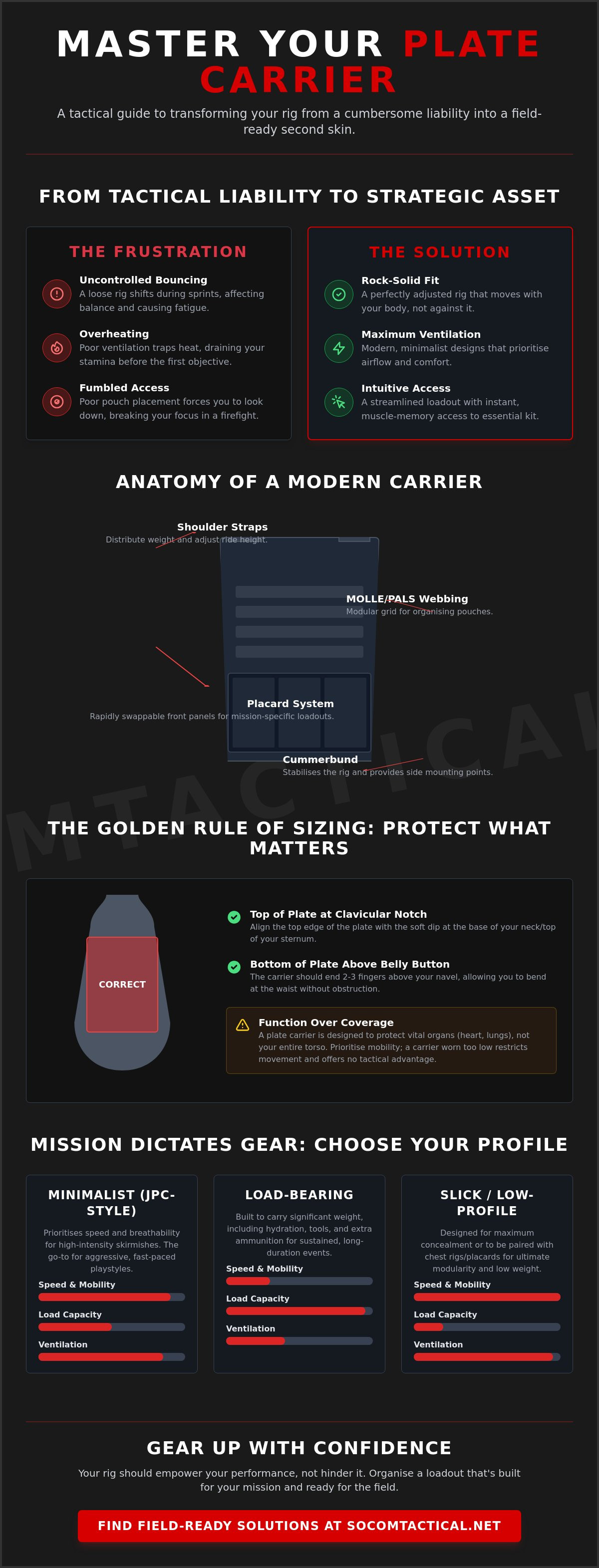
Understanding the components of your rig is the first step to mastering your loadout. A standard carrier consists of front and rear plate bags connected by shoulder straps and a cummerbund. The cummerbund is the unsung hero of the system; it wraps around your torso to stabilise the rig during sprints and provides extra real estate for side pouches. Most high-end carriers utilise MOLLE (Modular Lightweight Load-carrying Equipment) webbing. This grid of reinforced nylon allows you to organise your pouches with surgical precision, ensuring your magazines and tools are always within reach when the engagement heats up.
Minimalist vs. Load-Bearing: Choosing the Right Profile
Every skirmish presents a unique set of challenges, and your choice of plate carrier profile should reflect the specific demands of your role. Selecting the wrong chassis often leads to premature fatigue or a lack of essential supplies when the objective is far from the safe zone. Generally, modern rigs fall into three categories: minimalist JPC-style carriers, heavy-duty load-bearing systems, and ultra-low-profile "slick" carriers. The right choice depends heavily on your mission duration. A 30-minute high-intensity round at a local CQB centre requires a different approach than a 24-hour MilSim event where you must carry everything needed to sustain yourself in the field.
Minimalist carriers, such as the industry-standard Jumpable Plate Carrier (JPC) style, prioritise speed and breathability. These are designed for high-speed play where every gram counts. Slick carriers take this a step further; they are often designed to be worn under a jacket or paired with detachable front placards for a completely modular experience. Conversely, heavy-duty carriers are built to handle significant weight. If you're looking to upgrade your current setup, exploring our new products is a great way to see how modern chassis designs are evolving to meet these diverse needs.
Minimalist Rigs for High-Speed Skirmishing
Minimalist rigs are the go-to for players who favour a "Primary Only" loadout. By stripping away excess material and utilizing skeletal cummerbunds, these carriers maximise ventilation and prevent the overheating that often plagues players in thick tactical gear. This reduced footprint is particularly effective in tight CQB corners, as it offers a superior range of motion. You can transition your rifle between shoulders or lean into a slice-the-pie manoeuvre without the bulk of the carrier obstructing your movement or catching on door frames. It’s about being lean, fast, and lethal.
Full-Scale Carriers for Long-Duration MilSim
When the mission clock stretches into hours or days, a minimalist rig can quickly become uncomfortable. Full-scale, heavy-duty carriers are essential for distributing the weight of a sustained combat load, which might include six or more magazines, a hydration bladder, and various tools. These systems feature heavily padded shoulder straps and structured cummerbunds to prevent the rig from digging into your collarbones. They also excel at technical integration, often featuring dedicated radio pouches and built-in cable management channels. This ensures your comms wires stay snag-free whilst you're navigating dense woodland or urban ruins, maintaining that vital link with your team.
Finding the Perfect Fit: Sizing, Comfort, and Dummy Plates
A common mistake amongst newcomers is assuming that "one size fits all" just because the straps are adjustable. In reality, a plate carrier is sized according to the plates it is designed to hold, not your t-shirt size. If your plates are too large, they'll restrict your arm movement; too small, and the rig looks out of proportion whilst leaving vital areas exposed. The golden rule for placement is simple: the top of the front plate bag should sit level with your collarbone, whilst the bottom should end approximately two inches above your navel. This specific positioning ensures your vitals are protected but allows you to bend, crouch, and sit without the rig riding up into your chin.
Once the vertical height is dialled in using the shoulder straps, you must address the cummerbund. A loose rig is a tactical nightmare. If your carrier wobbles or slaps against your torso during aggressive movement, you aren't just losing style points; you're wasting energy and slowing your draw time. The fit should be snug enough to stabilise the load but must allow for full lung expansion. Test this by taking a deep breath after tightening; if it feels restrictive, back it off slightly. Achieving this balance is what separates a professional loadout from a budget vest that hinders your performance on the field.
The Role of Dummy Plates in Airsoft
You should never run an empty plate carrier. Without the internal structure of a plate, the Cordura fabric sags, causing your magazine pouches to flop forward and making a clean reload nearly impossible. Foam plates are a fantastic lightweight option for those prioritising breathability and comfort during a long day of skirmishing. If you prefer a more rigid, authentic feel, plastic SAPI-style plates provide the necessary tension to keep your pouches exactly where you need them. For those seeking the ultimate MilSim physical challenge, weighted training plates can be used to simulate the true burden of a real-world combat load.
Ventilation and Cooling Solutions
Heat soak is a genuine risk during the UK summer, especially when you're active in a thick tactical rig. To mitigate this, many experienced players utilise 'pontoon' pads or breathable mesh liners that velcro into the inside of the plate bags. These create a physical gap between your torso and the carrier, allowing for essential airflow. Pairing your rig with a moisture-wicking combat shirt from our clothing and gear range will further help transport sweat away from your skin. This setup keeps you focused on the objective rather than the discomfort of an overheating core.
Building Your Rig: Essential Pouches and Placard Systems
Once you’ve dialled in the fit of your plate carrier, the next phase is optimising your "work space." This is the front-facing area of your rig where high-speed actions like reloads and weapon transitions occur. A common mistake amongst newer players is over-cluttering this area with utility pouches or double-stacked magazines. We advocate for the "Three-Mag Rule" on the front panel. By keeping only three magazines across your chest, you maintain a slim, professional profile that allows you to get low in a prone position without your gear acting as a pivot point. This streamlined approach ensures your rifle transitions remain snag-free during the heat of a high-stakes engagement.
Your cummerbund serves as the secondary real estate for gear that doesn't require an immediate, sub-second draw. This is the ideal placement for your radio, an extra magazine, or a medical kit (IFAK). By shifting these items to your sides, you clear your front work space and improve your overall range of motion. It’s about balance; a well-organised rig distributes weight evenly across your torso, preventing the front-heavy sag that leads to back fatigue during a long day of skirmishing. If you're looking to expand your carry capacity, browse our tactical belts and pouches to find the perfect modular additions for your cummerbund.
Placard Systems: From AEG to Sniper in Seconds
The industry has moved away from permanently threaded MOLLE pouches in favour of the "Buckle Up" or placard system. By utilising standard 1-inch buckles and a large Velcro field, you can swap your entire front loadout instantly. This allows you to transition your plate carrier from an M4-based AEG setup to a submachine gun or a .308 marksman loadout without the tedious task of re-weaving nylon straps. It’s the ultimate solution for players who run multiple weapon platforms. You can find the right capacity for any mission by checking out our latest airsoft gun magazines to match your new placard configuration.
The Rear Panel: Hydration and Team Access
The rear of your carrier is often overlooked, yet it plays a vital role in your field endurance. We generally advise against placing essential items like spare BBs or tools on your back unless you’re working closely with a teammate who can access them for you. Instead, the rear panel should be reserved for mission-specific kit or hydration. A slimline 1.5L or 2L hydration bladder is an absolute necessity for summer skirmishes in the UK, as it keeps you in the fight without the bulk of a traditional backpack. For more dynamic roles, zip-on back panels allow you to swap between a hydration carrier and a larger assault pack for longer MilSim objectives.
Selecting Your Plate Carrier at Socom Tactical: Field-Ready Solutions
Choosing the right plate carrier is a pivotal moment in your tactical progression. At Socom Tactical, we specialise in providing gear that has been skirmish-tested in the harshest environments. We understand that a rig needs to do more than just look the part; it must endure the rigours of crawling through damp woodland and scraping against concrete ruins. This commitment to longevity is why we prioritise high-denier materials and reinforced stitching across our entire clothing and gear range. Every item in our inventory is selected because it offers the functional utility required for immediate operational readiness.
Finding the perfect chassis often requires a hands-on approach. We highly recommend visiting our shop to try on different frames and sizes. A rig that looks excellent on screen might not suit your specific physical build or playstyle once it's loaded with magazines and kit. If you can't make it to us in person, our seasoned veterans are always available to provide expert advice on bespoke loadout builds. You can reach out to us directly through our Contact Us page to ensure your chosen setup is perfectly tailored to your mission requirements.
Top Brands We Trust
We believe in offering a spectrum of solutions that cater to every level of the hobby. For those just starting their journey, we stock reliable entry-level options from Viper that provide an excellent balance of cost and performance. If you're a seasoned practitioner looking for professional-grade kit, our range of Warrior Assault Systems rigs offers the grit and precision expected by elite players. We also carry essential Tokyo Marui accessories and high-quality nylon gear to complement your chassis. You can explore our full manufacturer lineup on our dedicated brands page to find the name that fits your standards.
Final Checklist Before Your Next Game
Before you step onto the field, perform a final inspection of your equipment. A poorly configured rig is a liability. Follow this checklist to ensure you're ready for the first engagement:
- MOLLE Integrity: Ensure every pouch is correctly "woven" through the webbing loops. Simply tucking the straps without weaving them will cause the pouch to sag and eventually detach during a sprint.
- Eye Pro Compatibility: Check that your ballistic eye protection doesn't interfere with your cheek weld. If your goggles hit the shoulder straps of your plate carrier, you won't be able to sight your rifle accurately.
- Plate Security: Verify that your dummy plates are seated firmly within the plate bags. If they rattle or shift, use additional foam or internal straps to secure them, ensuring a silent and stable profile during movement.
Master Your Loadout for the Next Engagement
Building a professional loadout isn't just about the aesthetic; it's about functional utility and operational readiness. You've now learned how to distinguish between high-speed minimalist rigs and heavy-duty chassis systems, ensuring your gear matches your mission duration. By mastering the golden rule of fitment and adopting a modular placard system, you've transformed your plate carrier from a simple vest into a high-performance tool tailored to your specific role. These technical nuances ensure you remain agile and effective whilst others are hindered by bouncing gear or poor ventilation.
At Socom Tactical, we've been providing expert advice from active airsofters since 2009. We maintain a comprehensive range of modular pouches and placards in our UK-based stock, all ready for immediate dispatch to get you field-ready faster. Our team understands the grit required for a full day of skirmishing, and we only stock brands that we'd trust in our own kits. Don't let poor equipment hold you back when the objective is in sight. Browse our full range of field-ready Plate Carriers and Chest Rigs today and build a setup that stands up to the rigours of the field. We'll see you at the next game.
Frequently Asked Questions
What is the best plate carrier for a beginner in airsoft?
A minimalist JPC-style rig or a modular "Buckle Up" system is usually the best starting point for a newcomer. These designs offer a perfect balance of affordability and adaptability without overwhelming you with unnecessary weight. Look for a rig that includes a built-in triple magazine shingle so you're field-ready for your first skirmish without needing to buy extra pouches immediately.
Do I need real ballistic plates for airsoft skirmishing?
No, you should avoid real ballistic plates as they're unnecessarily heavy and will cause premature fatigue during a long day of play. Instead, use foam or plastic dummy plates to maintain the structural integrity of your plate carrier. These lightweight inserts provide the "look" of real armour and protect your torso from painful close-range hits whilst ensuring you remain agile on the field.
How do I clean and maintain my tactical plate carrier?
You should hand wash your rig using lukewarm water and a mild detergent rather than risking damage in a washing machine. Remove all pouches and dummy plates before you begin. Use a soft-bristled brush to scrub away mud and sweat from the MOLLE webbing and Cordura fabric. Always air dry your carrier away from direct sunlight or radiators to prevent the nylon fibres from becoming brittle.
Can I fit different sized plates into any plate carrier?
Most carriers are designed around specific SAPI or ESAPI plate sizes, so you must match your plates to your bag size. Whilst some rigs feature internal adjustment straps to secure slightly smaller inserts, a medium plate carrier generally requires medium plates for a proper fit. Using plates that are too small will cause them to shift internally, whilst oversized plates simply won't fit into the bags.
What is the difference between a plate carrier and a tactical vest?
A carrier is a modular chassis designed to hold armour plates, whereas a tactical vest is typically a fixed-pouch system built on a mesh or fabric base. Carriers offer superior customisation through MOLLE webbing, allowing you to organise your loadout for specific roles. Tactical vests are often cheaper and more breathable but lack the structural stability and professional "look" that modern airsofters favour.
How tight should my plate carrier be for maximum comfort?
Your rig should be snug enough to remain stationary whilst you sprint, but loose enough to allow for a full, deep breath. If the carrier bounces or slaps against your torso when you jump, you need to tighten the cummerbund. If you feel restricted whilst crouching or taking a deep breath, loosen the tension. Achieving this balance is vital for maintaining your endurance during high-stakes engagements.
Are plate carriers legal to own and wear in the UK?
It is perfectly legal for civilians to purchase, own, and wear plate carriers and body armour in the United Kingdom for personal protection or hobby use. There are no specific laws prohibiting their use in airsoft. However, you should never wear tactical gear in public places or use it in the commission of a crime, as this will inevitably result in a police response.
What are the most essential pouches to put on a new plate carrier?
The most essential additions are three magazine pouches, a dedicated radio pouch, and a small utility pouch for tools or spare batteries. If you're running a sidearm, you'll also need a holster and two pistol mag pouches. We recommend starting with this basic "fighting load" and only adding extra kit once you've identified a specific situational challenge on the field that requires more equipment.