Your £500 custom-built AEG is only as good as the 6mm plastic sphere you're feeding it. It's a common frustration on the skirmish field; you've spent hours tuning your MOSFET and polishing your inner barrel, yet your shots are still veering off-target or dropping short at 40 metres. You aren't alone in wondering what weight bbs should i use for different airsoft gun types to finally stop the wind from ruining your groupings. Most players struggle with the technical trade-off between muzzle velocity and flight stability, often sticking to 0.20g rounds because they're cheap, even whilst their RIF is crying out for something heavier.
At Socom Tactical Airsoft, we're here to help you master the physics of your loadout and discover the perfect BB weight to maximise range and accuracy across all platforms. Whether you're clearing rooms with a GBB pistol or hunting targets from the treeline with a bolt-action sniper rifle, matching your ammo to your power output is essential for tactical dominance. This guide breaks down the gold standard for AEGs, the heavy-hitters required for DMRs, and how to tune your hop-up to ensure every shot is skirmish-ready. We'll demystify the Joule limits versus FPS debate, helping you achieve the grit and precision your next engagement demands.
Key Takeaways
- Understand why BB mass is more critical than high FPS for maintaining momentum and resisting wind during outdoor engagements.
- Identify exactly what weight bbs should i use for different airsoft gun types to strike the perfect balance between muzzle velocity and flight stability.
- Learn how to match heavyweight 0.30g+ ammunition to your sniper or DMR platform to maximise effective range and shot consistency.
- Discover how to calculate environmental factors like windage and foliage to select the most effective BB weight for your specific skirmish site.
- Ensure your gear stays skirmish-ready by understanding why seamless, high-quality BBs are vital for protecting your precision inner barrels and hop-up units.
The Physics of Airsoft BBs: Why Weight Matters More Than FPS
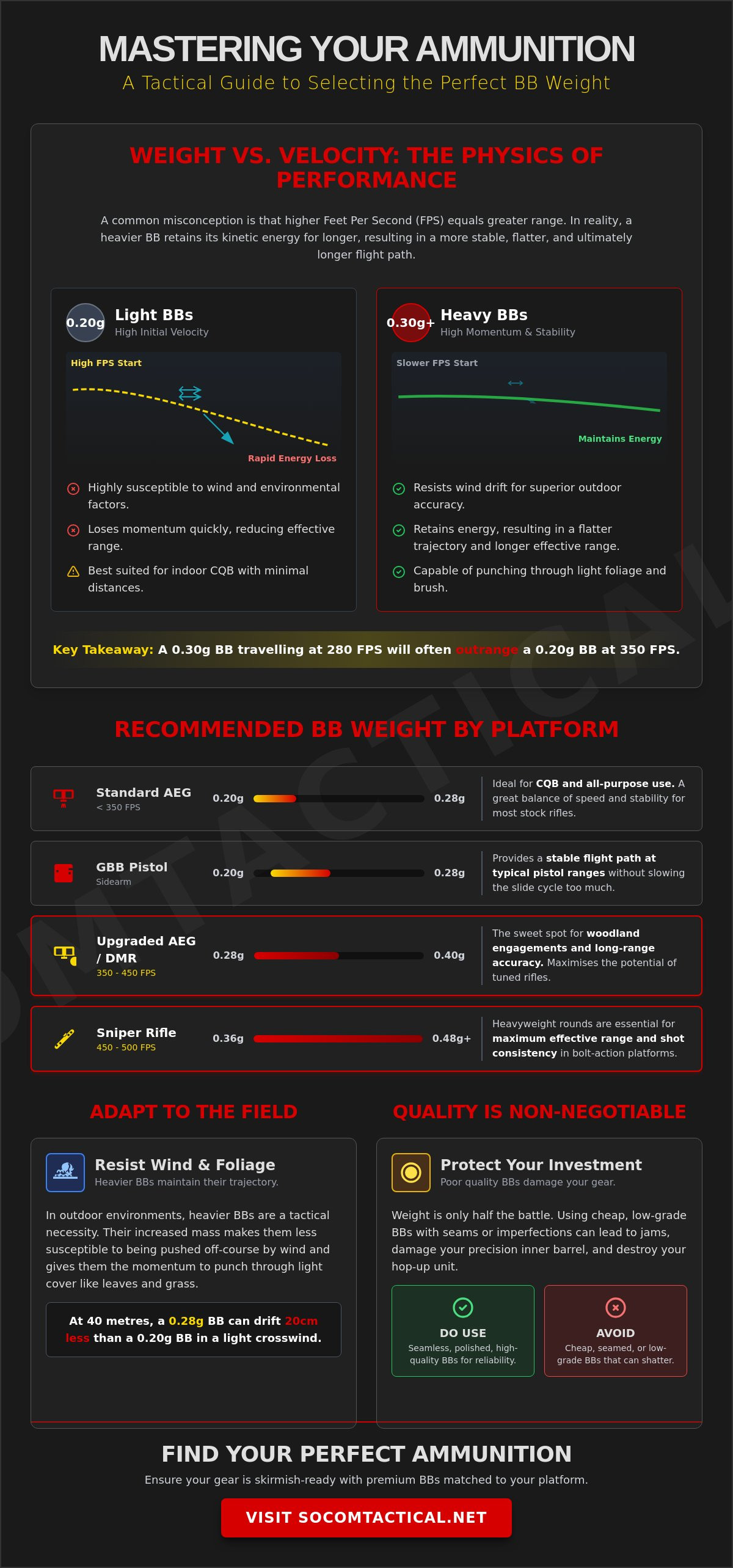
Velocity is a seductive statistic, but physics doesn't care about your ego. Whilst a high FPS looks impressive on a chrono screen, it's the mass of your Airsoft pellets that determines whether you actually hit your target at 50 metres. When asking "what weight bbs should i use for different airsoft gun types", you're really asking how to balance momentum against air resistance. A lighter BB, such as a 0.20g, leaves the muzzle at a blistering speed but sheds that energy almost immediately. In contrast, a heavier BB possesses greater inertia. It's harder to start moving, but it's also much harder for the atmosphere to slow it down or push it off-course.
This leads us to the "FPS Trap". Many newcomers believe that higher speed equals more range. In reality, a 0.30g BB travelling at 280 FPS will often outrange a 0.20g BB travelling at 350 FPS. The heavier round retains its kinetic energy for longer, allowing it to maintain a flatter trajectory at the end of its flight path. Your hop-up unit facilitates this by applying backspin, creating the Magnus Effect which generates lift. Heavier BBs require more "grip" from the bucking to achieve this spin, but once they're stable, they resist the erratic tumbling that causes missed shots. Stock up on high-quality consumables to ensure your hop-up can work efficiently without clearing out debris from shattered rounds.
Understanding Joules vs FPS
Joules represent the total kinetic energy your RIF produces. In the UK, most sites still chrono using 0.20g BBs for a baseline, but the shift towards measuring Joules is a vital safety necessity. This ensures that players using different weights aren't exceeding the legal 1.14J limit for AEGs or 2.5J for bolt-action snipers. Joule Creep is a critical factor for GBB or HPA users, where the expanding gas continues to accelerate a heavier, slower-moving BB for longer than a lighter one, resulting in higher energy output at the muzzle than the initial chrono suggested.
The Stability Factor: Fighting Wind and Drag
Air resistance, or drag, is the primary reason 0.20g BBs are usually relegated to indoor CQB centres. Without wind, their speed is an asset for fast-paced room clearing where engagement distances are short. However, once you step into a woodland skirmish, even a 5mph breeze can ruin your day. Heavier BBs are less susceptible to "windage" and are far more capable of punching through light foliage or brush that would otherwise deflect a lighter round. When deciding what weight bbs should i use for different airsoft gun types, consider that a 0.28g round might drift 20cm less than a 0.20g round in a light crosswind at 40 metres, making it the superior tactical choice for outdoor dominance.
The physics of how small spheres travel through the air is a science shared by many precision sports; for those who also enjoy the technical challenge of the fairway, you can read more about selecting the right gear at Golf Ball Monkey.
Standard Loadouts: BB Weights for AEGs and GBB Pistols
For the vast majority of players, the "sweet spot" for ammunition lies between 0.20g and 0.28g. This range covers everything from entry-level AEGs to high-performance gas blowback pistols. Selecting the right mass within this bracket is often the first step in fine-tuning your loadout for specific field conditions. Before diving into the specifics, it's worth checking our Ultimate Guide to Airsoft Guns to ensure your platform is ready for the weight you've chosen. Understanding The Science of Airsoft helps you realise that even small increments in weight can drastically change your effective engagement distance.
When considering what weight bbs should i use for different airsoft gun types, don't overlook your magazines. Mid-cap magazines rely on internal spring tension to feed rounds into the hop-up chamber. Whilst heavier BBs offer better flight paths, they also put more strain on these springs. High-quality, polished BBs are essential here to prevent jams, especially in high-ROF builds. For your sidearm, a 0.23g or 0.25g round usually offers the best compromise. It provides enough mass to stay accurate at 15 metres without slowing down the slide cycle of your GBB pistol too much, ensuring you stay skirmish-ready during intense transitions.
0.20g and 0.23g: The CQB Specialists
The 0.20g BB is the industry standard for chronoing, but its tactical use is best limited to indoor CQB centres where wind is non-existent. These lighter rounds are also perfect for grenade launchers and budget-friendly target practice. Many speedsoft players prefer 0.20g or 0.23g rounds because they reach the target faster at short ranges, allowing for rapid target acquisition. The 0.23g weight is a favourite amongst those running high-ROF builds who need a tiny bit more stability than a 0.20g provides without sacrificing the snappy trigger response they crave.
0.25g and 0.28g: The Outdoor Workhorses
The 0.25g BB is arguably the most versatile choice for the average UK woodland skirmisher. It offers a significant boost in accuracy over the 0.20g whilst maintaining a respectable velocity. However, if you want to push your range further, 0.28g is the way to go. Most modern AEG Airsoft Rifles are designed to hop 0.28g rounds straight out of the box, providing a much flatter trajectory in the wind. If you're still unsure about what weight bbs should i use for different airsoft gun types, starting with a 0.25g is always a safe bet. You can easily upgrade your consistency by grabbing a bottle of our precision-grade BLS BBs for your next game day.
Precision Platforms: Ammunition for Snipers and DMRs
For those operating in the designated marksman or sniper roles, the ammunition choice becomes the most critical component of the entire loadout. If you are questioning what weight bbs should i use for different airsoft gun types built for distance, the answer always points toward heavyweight projectiles starting at 0.30g. These platforms utilise high-power springs and precision hop-up assemblies to "lift" rounds that would simply fall short in a standard AEG. The primary advantage is energy retention. A 0.40g BB maintains its momentum far more effectively than lighter alternatives, ensuring that when your shot connects at 75 metres, the target actually feels the impact and calls the hit.
Tracking your shot is equally vital for long-range dominance. We recommend using white or light-coloured heavyweight BBs, as they allow you to follow the flight path clearly through your optical sights and make micro-adjustments to your aim. This visual feedback is essential when you're dealing with the complex ballistics of a woodland skirmish. Without being able to see the Magnus Effect taking hold through your scope, you're essentially guessing where your follow-up shot needs to land.
0.30g to 0.36g: The DMR Range
These weights are the industry standard for semi-locked DMRs firing between 400 and 450 FPS. At this level, you need to balance the ability to provide rapid follow-up shots with the necessity for pinpoint accuracy. Achieving this requires a high-quality hop-up bucking, typically with a 70 or 75-degree hardness, to provide the necessary friction without tearing under the increased stress of heavyweight ammo. If your platform isn't properly tuned, you'll find these rounds dropping prematurely regardless of how much hop you apply.
0.40g to 0.48g+: Professional Sniper Tier
This is the extreme end of the spectrum, reserved exclusively for bolt-action rifles pushing the 500 FPS (2.32 Joule) UK limit. For consistent heavyweight performance, BLS Airsoft BBs are the preferred choice amongst the veteran sniping community. Whilst the cost per bag is higher, the performance trade-off is undeniable. Every shot counts when you've spent 20 minutes crawling into a flanking position; using a 0.45g or 0.48g round ensures that a sudden gust of wind won't rob you of a hard-earned elimination.
Tactical Selection: Matching Weight to Your Environment
Your skirmish environment dictates your ammunition choice as much as the internal components of your gearbox. When asking "what weight bbs should i use for different airsoft gun types", you must consider the specific terrain of your local site. For example, a 0.20g BB can drift as much as 50cm in a moderate 10mph crosswind over a 30-metre flight path. By switching to a 0.30g round, you can reduce that lateral drift to under 15cm, ensuring your shots stay on target even in gusty conditions. Most UK outdoor sites, approximately 90% of them, now strictly enforce the use of biodegradable ammo to protect local ecosystems. High-quality Bio BBs perform identically to standard plastic variants, so you won't sacrifice precision to stay site-compliant.
There's also a significant psychological edge to consider. Heavier rounds carry more kinetic energy upon impact, delivering a more distinct "thud" against plate carriers and tactical gear. This increased impact energy makes opponents far more likely to call their hits, reducing the frustration of "teflon" players on the field. Whether you're using an AEG or a GBB, matching your weight to the environment is the fastest way to improve your hit-to-miss ratio.
Woodland Skirmishing: Penetrating the Canopy
Dense UK forests present the persistent "leaf deflection" problem. A light 0.20g or 0.23g BB will deviate wildly if it clips even a single twig or leaf whilst in flight. To maintain a skirmish-ready profile in the woods, 0.28g or 0.30g is the minimum recommended weight. These heavier rounds possess the inertia to punch through light brush and out-range opponents who are relying on lighter, less stable ammo. It's a tactical advantage that allows you to dominate the treeline with confidence.
CQB and Milsim: Speed vs Stealth
In indoor CQB centres, flight speed often trumps long-range stability. Here, 0.20g or 0.25g rounds are ideal for rapid-fire engagements where you need to hit the target the instant you pull the trigger. If you're running night ops or low-light missions, remember that most tracer units are specifically optimised for 0.20g or 0.25g tracer BBs. For Milsim players focused on stealth, using non-reflective, darker-coloured BBs prevents the enemy from tracing the flight path back to your hidden position.
Prepare for your next event by browsing our full range of skirmish-ready consumables and find the perfect match for your environment.
Why BB Quality is Just as Vital as Weight
Selecting the correct mass is only half the battle. If you're still asking what weight bbs should i use for different airsoft gun types but feeding your RIF low-grade, "bottle-fair" ammo, you're risking a catastrophic failure. Cheap BBs often feature visible seams or internal air pockets that cause them to shatter upon impact with the hop-up bucking or, worse, inside the barrel. These fragments can shred your MOSFET-controlled AEG internals or permanently score your precision bore. At Socom Tactical, we only stock consumables that are proven to be skirmish-ready, ensuring every round is triple-polished and seamless.
Proper storage is also vital for maintaining tactical readiness. BBs are susceptible to moisture; biodegradable variants, in particular, can swell if left in a damp garage or open bag. This swelling increases the diameter of the round, leading to mid-cap feeding issues or mid-barrel jams. Always keep your bags sealed and stored in a cool, dry place to prevent your ammo from becoming a liability on the field. Cleanliness is equally important. Even a small amount of grit transferred from a speedloader can ruin your hop-up's consistency.
Tolerance and Diameter
The industry standard for high-performance BBs is 5.95mm with a tolerance of +/- 0.01mm. If you've upgraded to high-precision inner barrels, such as a 6.01mm or 6.03mm bore, this tolerance becomes non-negotiable. Even a tiny protrusion can cause a jam that strips your piston teeth. Internal air bubbles are another hidden killer; they shift the centre of gravity, making your carefully selected 0.32g BB fly like a knuckleball regardless of how well you've tuned your hop-up.
The Final Verdict: Socom’s Recommended Loadout
Finding the perfect match requires experimentation, but you can use the table below as a tactical baseline for your next skirmish. We suggest grabbing a few different weights to see what your specific hop-up can lift effectively without sacrificing too much muzzle velocity.
- Standard AEG (Woodland): 0.28g BBs for the best balance of range and wind resistance.
- AEG / GBB (CQB): 0.20g - 0.25g BBs for maximum flight speed and snappy response.
- DMR (450 FPS): 0.32g - 0.36g BBs for consistent long-range groupings.
- Sniper (500 FPS): 0.40g - 0.48g BBs to maximise the effective range of your platform.
If you're still stuck on what weight bbs should i use for different airsoft gun types, visit our Fleet shop or browse the full range online for expert advice on your specific build. Our team of seasoned veterans is always on hand to ensure your loadout is optimised for total field dominance.
Maximise Your Tactical Advantage
Mastering the ballistics of your RIF is the fastest way to bridge the gap between a standard skirmisher and a high-performance operator. By now, you should have a clear understanding of what weight bbs should i use for different airsoft gun types, whether you're pushing the 2.32 Joule limit with a bolt-action rifle or clearing rooms with a snappy GBB pistol. Remember that while muzzle velocity gets the BB out of the barrel, it's the mass and quality of the round that ensures it reaches the target through wind and brush.
Since 2009, Socom Tactical has provided expert technical advice to the UK community, stocking only the most reliable, skirmish-tested gear. We carry industry-leading brands like BLS and Tokyo Marui because we're players ourselves and we know that consistency is everything when the game is on the line. Don't let poor-quality ammo or incorrect weight selection hold back your build's potential. Every shot counts, so ensure yours are backed by 17 years of retail expertise and a passion for the hobby.
Upgrade your ammunition today and dominate the field with Socom Tactical BBs. Get out there and make every engagement count.
Frequently Asked Questions
What weight BBs are best for a standard M4 AEG?
A weight of 0.25g or 0.28g is the ideal choice for a standard M4 AEG. Most out-of-the-box M4 platforms in the UK shoot between 330 and 350 FPS. Using 0.25g rounds provides a perfect balance of muzzle velocity and stability for woodland sites. If you find your shots drifting at 40 metres, stepping up to 0.28g will tighten your groupings without requiring internal upgrades.
Will using heavier BBs damage my airsoft gun?
No, heavier BBs will not damage your airsoft gun provided you use high-quality, seamless ammunition. The internal components of your gearbox don't feel the weight of the projectile. The only part that works harder is your hop-up bucking, which requires more pressure to apply backspin. While this might lead to slightly faster wear on the rubber over 10,000 rounds, it's a standard maintenance task for any skirmisher.
Why do airsoft sites chrono with 0.20g BBs?
Airsoft sites use 0.20g BBs to establish a universal baseline for muzzle velocity across all players. It's the industry standard for measuring FPS. However, approximately 85% of UK sites now also measure Joules with your actual game-day ammo. This ensures that heavier rounds aren't causing Joule Creep, keeping everyone safely under the legal 1.14J limit for AEGs or 2.5J for bolt-action rifles.
Can I use 0.12g BBs in a gas blowback pistol?
You should never use 0.12g BBs in a gas blowback pistol or any high-performance RIF. These lightweight rounds are typically low-quality and intended for cheap spring toys. In a GBB, they're likely to shatter inside the chamber, causing expensive damage to your nozzle or inner barrel. They're also far too light to remain accurate beyond 5 metres, making them useless for tactical engagements.
What are Bio BBs and do they weigh the same as standard ones?
Bio BBs are biodegradable pellets made from Polylactic Acid (PLA), and they weigh exactly the same as their non-bio counterparts. They are designed to decompose within 12 to 36 months when exposed to moisture and soil microbes. Performance and density are identical to plastic BBs. This is why 90% of UK outdoor sites now mandate their use to protect the local environment.
How do I know if my hop-up can handle 0.30g BBs?
You can determine your hop-up's capability by applying maximum spin and observing the flight path. If a 0.30g BB over-lifts and curves upwards at 30 metres, your bucking is strong enough. If the round drops even at the highest setting, your hop-up unit lacks the friction needed for that mass. You may need to upgrade to a harder bucking or a different tensioner nub.
Is there a difference between 0.25g and 0.28g in terms of range?
Yes, 0.28g BBs typically offer a 5% to 10% increase in effective range over 0.25g rounds. The extra mass helps the projectile retain its kinetic energy for longer against air resistance. This is a vital factor when deciding what weight bbs should i use for different airsoft gun types in outdoor environments. The heavier round stays stable for several extra metres before gravity takes over.
What weight BBs should I use for a sniper rifle?
You should use 0.40g to 0.48g BBs for a bolt-action sniper rifle pushing the 500 FPS limit. High-powered snipers need this significant mass to maintain a stable trajectory at distances of 70 metres or more. It's the ultimate answer to what weight bbs should i use for different airsoft gun types in a precision role, ensuring your single shot isn't ruined by a light breeze.