Your AEG might be reliable, but it will never match the raw, surgical precision of a properly tuned High Pressure Air system. Most skirmishers eventually hit a ceiling where mechanical gearboxes simply cannot provide the shot-to-shot consistency required to dominate at long range. You want that perfect FPS stability, but choosing the right hpa tank and regulator often feels like a technical minefield. We understand the hesitation; nobody wants to lug around a heavy setup or worry about the legalities of UK Rho markings and hydrostatic test dates whilst in the middle of an intense firefight.
This guide simplifies the process of selecting the ideal air system for your specific loadout. You'll discover how to choose, configure, and maintain a setup that offers unrivalled performance without the anxiety of safety or compliance issues. We'll break down the weight-to-cost ratio of aluminium versus carbon fibre, explain why a £39.95 entry-level regulator might suit you better than a £149.95 Wolverine Storm, and ensure your kit is fully skirmish-ready for your next event. By the time you've finished reading, you'll have the tactical knowledge to build a reliable, lightweight system that lasts a full day of hard-hitting gameplay.
Key Takeaways
- Understand the fundamental roles of storage and control within an HPA system to ensure your engine receives a steady air supply for maximum consistency.
- Learn the technical differences between 3000 PSI and 4500 PSI storage pressures and how to distinguish between first and second-stage regulation.
- Compare the weight and durability of carbon fibre and aluminium to choose the best hpa tank and regulator setup for your specific skirmish playstyle.
- Master essential safety protocols, including why you must never use oil in fill nipples and how to identify critical burst disc functions to prevent field failures.
- Optimise your tactical loadout by learning how to mount your air system on a plate carrier to maintain a perfectly balanced centre of gravity whilst moving.
What is an HPA Tank and Regulator System?
High Pressure Air (HPA) is the gold standard for players who demand absolute control over their performance. Unlike traditional Gas Blowback (GBB) systems that rely on liquid propellants like Green Gas, HPA uses pure, compressed atmospheric air. This setup relies on a high-quality hpa tank and regulator to function. The tank acts as your reservoir, holding air at immense pressures, while the regulator serves as the gatekeeper. It steps that pressure down to a usable level for your engine. At Socom Tactical Airsoft, we believe this transition from chemical propellants to mechanical air systems is what defines a truly skirmish-ready platform in the modern era.
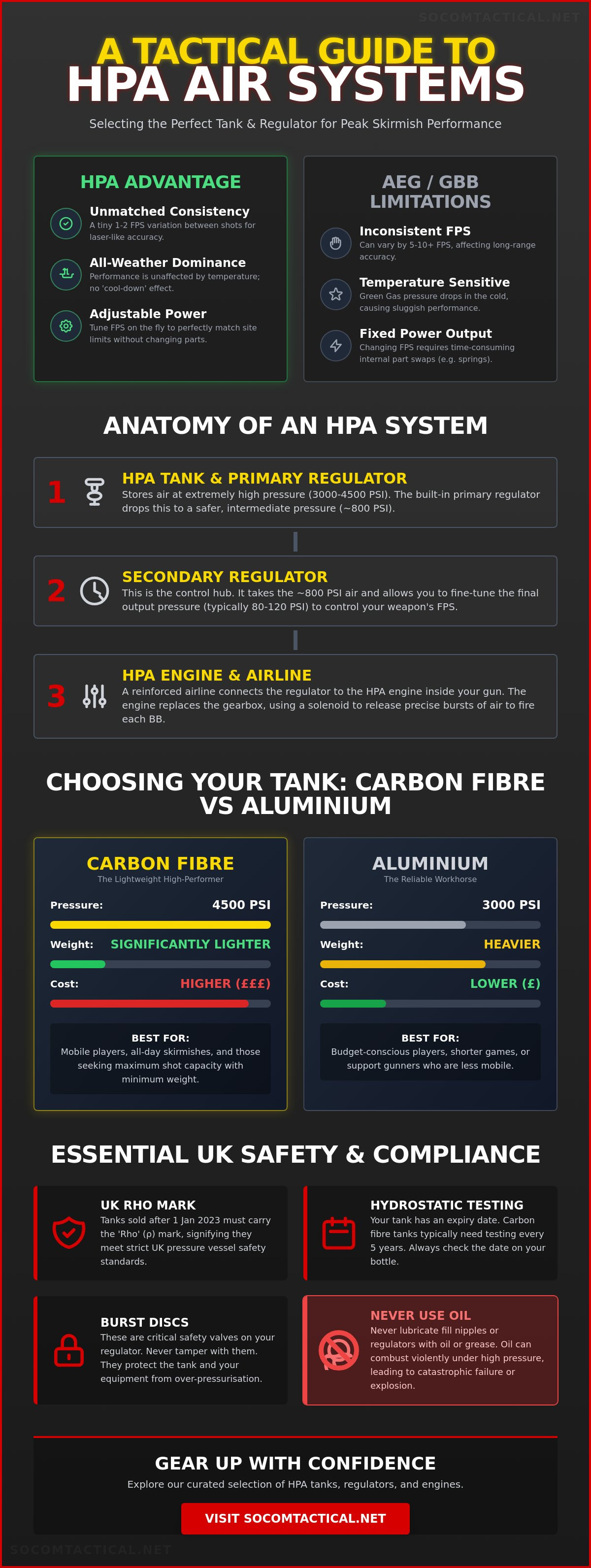
One major reason UK players are ditching Green Gas is the "cool-down" effect. In a typical British winter, gas magazines lose pressure rapidly, leading to sluggish cycling and pathetic range. HPA is chemically inert. It's unaffected by ambient temperature. Whether you're playing in a frost-covered woodland or a humid CQB site, your first shot will have the exact same velocity as your last. The engineering behind these systems relies on advanced pressure vessel technology, which is why modern tanks sold after 1 January 2023 must carry the UK "Rho" mark to ensure they meet strict safety standards.
The Advantages of Switching to HPA
Switching to HPA isn't just about being different; it's about tactical superiority. You'll experience unmatched FPS consistency. Whilst an AEG might vary by 5 to 10 FPS between shots, a well-tuned HPA engine often stays within a 1 to 2 FPS margin. This precision turns a standard rifle into a laser-accurate tool.
Another benefit is the ability to adjust power levels on the fly. UK site limits are strict, typically aligning with the legal caps of 1.3 Joules for full-auto and 2.5 Joules for single-shot weapons. With an HPA system, you can tune your regulator to hit the limit perfectly without swapping springs. Additionally, because there's no heavy piston slamming into a cylinder head, mechanical wear is significantly reduced, meaning your primary stays in the fight longer.
How the System Integrates with Your Airsoft Gun
The journey of a BB starts at the tank. Air travels from the main bottle through a primary regulator, then into a secondary hpa tank and regulator setup via a reinforced airline. This line connects directly to the HPA engine, such as a Polarstar Jack or a Wolverine Inferno, housed inside your gun's receiver.
These engines replace the traditional gearbox, using solenoids to release precise bursts of air. This streamlined path allows for incredible trigger response. If you're looking to understand how this fits into your wider loadout, check out our ultimate guide to airsoft guns for more context on choosing the right platform. It's a total shift in how you play, offering a level of reliability that traditional systems just can't touch.
Technical Breakdown: HPA Tanks, Regulators, and Pressure
Understanding your hpa tank and regulator setup requires a grasp of two-stage regulation. Your tank's primary regulator drops the internal pressure from thousands of pounds per square inch down to a manageable output, typically around 800 PSI. However, your airsoft engine operates at much lower levels, usually between 80 to 120 PSI. This is where the secondary regulator comes in. It sits between the tank and your airline, acting as the final control point for your FPS. For high-ROF (Rate of Fire) builds, the refresh rate of this secondary regulator is vital. If the regulator cannot "recharge" the air in the line fast enough between shots, you'll experience a significant drop in velocity during full-auto bursts, effectively starving your engine of power.
A common point of confusion for UK players is the SLP (Super Low Pressure) versus standard pressure debate. Standard tank regulators output at 800 PSI, while SLP variants output at a much lower 300 PSI. You must match your secondary regulator to your tank's output. Using a standard regulator on an SLP tank often results in poor flow rates, whilst using an SLP-only regulator on a standard tank can cause catastrophic seal failure. Safety is paramount when handling these systems, as they are governed by the UK Pressure Systems Safety Regulations (PSSR). Ensuring your gear meets these legal standards isn't just about performance; it's about field safety.
Understanding Tank Capacity and Pressure
Tanks are measured in Cubic Inches (ci) for volume and PSI for pressure. A standard 48ci 3000psi aluminium tank is the entry-level workhorse, providing enough air for roughly 1,500 to 2,000 shots depending on your engine's efficiency. In contrast, a premium 68ci 4500psi carbon fibre bottle offers a massive increase in shot capacity whilst actually reducing the weight on your back. PSI is the measurement of potential energy stored within the vessel. By jumping from 3000 to 4500 PSI, you're packing 50% more potential energy into the same physical space, allowing for longer skirmish days without needing a refill. If you're looking to push your platform further, explore our range of high-performance internal upgrades to maximise every cubic inch of air.
The Role of the Secondary Regulator
The secondary regulator is the heart of your shot-to-shot consistency. It ensures a steady 80-120 PSI reaches your engine, regardless of how much air is left in the main bottle. For UK site compliance, most regulators include "tournament locks." These are physical covers or zip-tie points that prevent you from adjusting the pressure once you've passed the morning chronograph. This feature is essential for maintaining trust on the skirmish field. High-end adjustable regulators allow for incredibly fine-tuning, letting you dial in the exact pressure needed for long-range precision shots, ensuring your BBs fly with the same energy every single time the trigger is pulled.
Choosing Your Setup: Carbon Fibre vs Aluminium Tanks
Selecting the right hpa tank and regulator combination is a balancing act between your budget and your physical endurance on the field. Whilst both aluminium and carbon fibre tanks serve the same purpose, they offer vastly different experiences during a long skirmish day. The choice often comes down to how much weight you're willing to carry and how often you want to visit the fill station. Beyond the initial purchase, you must also consider the long-term maintenance cycles. Composite carbon fibre tanks require a hydrostatic retest every 5 years and have a hard retirement age of 15 years. Aluminium tanks are more lenient, typically requiring a retest every 10 years without a mandatory expiry date, provided they pass inspection.
Ergonomics play a massive role in tactical effectiveness. Carrying a heavy aluminium bottle in a backpack or hydration carrier shifts your centre of gravity backwards, which can lead to fatigue or slower pivots during CQB engagements. Carbon fibre bottles mitigate this by offering a significant weight reduction, often weighing nearly 50% less than their metal counterparts. This allows you to stay more agile and keep your profile tight. If you're looking to further refine your platform's efficiency, check out our range of airsoft parts and upgrades to ensure your engine isn't wasting a single drop of that precious air.
Aluminium Tanks: The Rugged Workhorse
Aluminium tanks are the go-to choice for players entering the HPA scene. They're incredibly durable and can withstand the rough-and-tumble nature of woodland skirmishes, where knocks against trees or bunkers are common. With an entry-level price point of around £44.95 for a 48ci 3000psi bottle, they're accessible for those on a budget. However, the 3000 PSI limit means you'll have a lower shot capacity, likely requiring a trip to the safe zone for a refill after 1,500 to 2,000 shots. It's a reliable, "set and forget" option for the casual player who doesn't mind the extra heft.
Carbon Fibre: The Elite Choice for Modern Skirmishers
For the dedicated player, carbon fibre is a game-changer. These tanks are rated for 4500 PSI, which allows you to store 50% more air in the same volume as a 3000 PSI tank. This extra capacity is a lifesaver during multi-hour Milsim events where fill stations are miles away. Whilst a 68ci carbon fibre tank costs approximately £194.95, the investment pays off in comfort and performance. You aren't just buying a bottle; you're buying the ability to stay in the fight longer without the physical toll of a heavy loadout. It's the ultimate upgrade for those who prioritise mobility and high-volume fire.
Safety, Maintenance, and Filling in the UK
Safety is the absolute priority when you're running a high-pressure air system on the skirmish field. The most critical rule you must follow is to never, under any circumstances, put oil, WD40, or grease into your tank's fill nipple. When air is compressed rapidly during a fill, it generates intense heat. If oil is present, it can ignite under pressure, causing a "diesel effect" explosion that can lead to catastrophic failure. Always keep your hpa tank and regulator fill points bone dry and free from debris. If you notice a leak from the fill nipple, it's usually a tiny internal O-ring that has perished, which is a simple fix that doesn't require lubricants.
Your regulator is equipped with burst discs, which act as safety fuses. A standard tank regulator usually has two: a 1.8k disc and a 7.5k disc (for 4500 PSI tanks). The 7.5k disc protects the bottle itself; if the pressure exceeds safe limits during a fill, this disc ruptures to vent the air safely. The 1.8k disc protects the low-pressure side. If your primary regulator fails and dumps high pressure into your airline, the 1.8k disc pops to prevent that pressure from reaching your expensive HPA engine. If either of these discs "pops," do not attempt to patch them with solder or tape. They must be replaced with genuine parts to remain skirmish-ready.
Maintaining your seals is the best way to avoid a mid-game failure. A hissing sound from the top of your regulator usually indicates a dry or nicked O-ring. You can easily perform a field repair by swapping these out. Check our range of consumables for specific HPA-safe O-rings and maintenance kits. For filling your system, most established UK airsoft sites now offer on-site fill stations, but you can also visit local dive shops or invest in a personal 4500 PSI electronic compressor for home use.
UK Hydrostatic Testing Regulations
All HPA tanks in the UK must adhere to strict pressure vessel legislation. You can find the "born date" stamped on the bottle's neck or label. Composite carbon fibre tanks require a professional hydrostatic retest every 5 years to remain legal for filling, whilst aluminium bottles typically have a 10-year test cycle. Most UK tanks require testing every five years to remain legal for filling. A professional retest service currently costs approximately £39.95. Remember that composite tanks have a maximum lifespan of 15 years from their manufacture date, after which they must be retired and replaced, regardless of their condition.
Safe Storage and Transport
Heat is the enemy of stored pressure. Never leave a fully pressurised hpa tank and regulator in a hot car during the summer, as the rising temperature increases the internal PSI, potentially triggering a burst disc. When transporting your gear, always use a thread protector on the regulator and a cap on the fill nipple to prevent dirt from entering the system. This simple habit prevents grit from shredding your internal seals and keeps your air system reliable for years of gameplay.
Ready to upgrade your air system for the next big event? Visit our UK airsoft shop to find the latest Rho-marked tanks and high-refresh regulators.
Organising Your Loadout: Carrying Your HPA System
Owning the hardware is only half the battle; the real challenge is integrating your hpa tank and regulator into your UK tactical gear. A standard 48ci aluminium tank adds roughly 1.2kg of dead weight to your rear profile, which can significantly impact your agility if not mounted correctly. A poorly secured tank will bounce, snag, and throw off your balance during high-intensity movements. You need a setup that feels like a natural extension of your body rather than an afterthought strapped to your back. Whether you're a front-line rusher or a concealed marksman, how you carry your air supply determines your mobility and endurance on the field.
Mounting orientation is a frequent debate amongst experienced skirmishers. Vertical mounting is the standard, usually tucked into a pouch on the back of a plate carrier. It's simple and keeps your profile slim. However, horizontal mounting along the lower back or cummerbund is becoming a favourite for players who need to access their regulator quickly or want to keep their centre of gravity lower. This position also makes it easier for teammates to check your pressure or help with a line snag in tight spaces. High-quality, flexible air lines are non-negotiable here. A stiff line will pull on your engine and snag on every doorway in a CQB environment, so choosing a line with a high-flex braided cover is a tactical necessity.
Tank Pouches and Backpacks
Choosing between a dedicated MAP (Modular Assault Pack) and a simple MOLLE pouch depends on your mission length. A MAP pack offers extra room for hydration and spare consumables, whilst a dedicated MOLLE tank pouch takes up roughly 3 to 4 columns of webbing, making it a compact choice for minimalists. Whichever you choose, line management is vital. Route your air line through shoulder pads or cable management loops to keep it tucked away. This prevents the "line snag" that can ruin a tactical breach. Ensure your regulator remains accessible; you don't want to be stripping off your entire rig just to perform a quick pressure check before a new game starts.
The Socom Tactical Airsoft Advantage
At Socom Tactical Airsoft, we don't just sell kit; we use it. Our team is committed to testing every hpa tank and regulator for "skirmish-ready" status before it hits the shelves. We understand the nuances of UK sites and the specific challenges players face on the field, from internal component compatibility to external aesthetic appeal. If you're struggling to balance your loadout or need advice on the best mounting solutions for your plate carrier, please contact us or visit our retail outlet. You can also browse our latest HPA arrivals to find the most innovative carrying solutions currently hitting the UK market. A balanced, reliable air system is the final piece of the puzzle for achieving unrivalled performance.
Dominate the Field with HPA Precision
Mastering your air system is about more than just buying gear; it's about gaining a tactical edge that traditional platforms simply cannot match. You now understand how to balance the lightweight agility of carbon fibre against the rugged durability of aluminium. You've also learned the vital safety protocols and the technical nuances of dual-stage regulation. By selecting the perfect hpa tank and regulator combination, you've ensured your shots remain surgical and consistent regardless of the unpredictable UK weather.
Socom Tactical Airsoft has been a cornerstone of the community since 2009, serving thousands of players with equipment that survives the grit of real gameplay. Our team consists of active skirmishers who provide expert technical support based on years of field experience. We stock a wide range of UKARA-compliant platforms to ensure your transition to high-pressure air is seamless, legal, and effective. Whether you're building a high-ROF CQB monster or a precision marksman rifle, a reliable air system is your foundation for victory.
Upgrade your loadout with our premium HPA tanks and regulators today!
Get your kit sorted and we'll see you in the safe zone, ready for the next engagement.
Frequently Asked Questions
How many shots can I get from a 48ci 3000psi HPA tank?
You can expect between 1,500 and 2,000 shots from a standard 48ci 3000psi aluminium tank. This range varies based on your engine's dwell settings and the length of your precision inner barrel. Efficient engines often push towards the higher end of this estimate. Always monitor your gauge during the lunch break to ensure you aren't running dry before the final afternoon engagement.
Do I need a specific regulator for a Polarstar engine?
Any high-quality second-stage regulator will work with a Polarstar engine, provided it has a fast refresh rate. Polarstar engines require a consistent air supply to maintain their high ROF capabilities without experiencing "shoot-down." Regulators like the Wolverine Storm or the Airtac AT200 are designed to prevent velocity drops during long full-auto bursts, keeping your platform surgical and skirmish-ready at all times.
Can I fill my airsoft HPA tank with a standard bike pump?
You cannot fill an HPA tank with a standard bike pump because they only reach roughly 120 PSI. HPA tanks require pressures between 3,000 and 4,500 PSI to function safely and effectively. To fill your tank at home, you need a specialised high-pressure stirrup pump or a dedicated 4500 PSI electronic compressor. Most established UK airsoft sites provide these high-pressure fills as part of your game day fee.
What is the difference between an SLP regulator and a standard one?
The main difference is the output pressure; SLP tank regulators output at 300 PSI, whereas standard tank regulators output at 800 PSI. You must ensure your secondary hpa tank and regulator are compatible to avoid damaging internal seals. Using a standard regulator on an SLP tank will often result in sluggish performance because the regulator cannot draw enough air to cycle the engine properly.
Is it safe to leave air in my HPA tank when not in use?
It is actually recommended to leave roughly 500 to 1,000 PSI of air in your tank during storage. This internal pressure keeps the seals firmly seated and prevents moisture or debris from entering the bottle through the fill nipple. Storing a tank completely empty for long periods can lead to seal shrinkage, which causes annoying leaks the next time you head out for a skirmish.
How do I know if my HPA tank needs hydrostatic testing?
Look for the "born date" or manufacture stamp on the bottle's label or neck. In the UK, composite tanks must undergo a professional hydrostatic retest every 5 years, while aluminium bottles require testing every 10 years. If your tank's date has expired, it's legally non-compliant for filling. Most professional testing services in the UK will charge approximately £39.95 to certify your tank for another cycle.
Why is my HPA regulator leaking from the relief valve?
A leak from the relief valve usually indicates that your regulator's output pressure has exceeded the valve's safety rating. This often happens if the internal seals are "creeping," allowing high-pressure air to bypass the regulator's seat. If your gauge shows a steady rise in pressure whilst the gun is idle, your hpa tank and regulator need a professional service to replace the internal piston O-rings.