Your plate carrier is either your greatest tactical asset or your biggest physical liability when you're in the thick of a skirmish. There's nothing more frustrating than having your mag pouches bouncing around during a sprint or realising your front loadout is so thick you can't actually get low enough to find cover. We've all been there, struggling with a rig that sits too low or fumbling for a fresh magazine whilst the opposition closes in. It's a common hurdle that separates the casual players from the seasoned veterans who move with precision.
This airsoft plate carrier setup guide is designed to fix those operational headaches once and for all. You'll learn how to master the art of the perfect loadout to improve your mobility, reload speed, and overall field effectiveness. We're diving deep into the technical nuances of weight distribution, ergonomic pouch placement, and the essential gear needed for a professional, high-speed aesthetic. By the end of this guide, you'll have a streamlined rig that feels like a natural extension of your body rather than a heavy burden.
Key Takeaways
- Adopt a "less is more" philosophy to maintain peak mobility and avoid the common mistake of over-encumbering your tactical rig.
- Master the "nipple-to-nipple" sizing rule to ensure your carrier is perfectly positioned for both protection and ergonomic comfort.
- Follow our airsoft plate carrier setup guide to prioritise magazine pouch accessibility and significantly streamline your reload times.
- Customise your loadout for the specific environment, balancing "slick" CQB configurations with sustainment-focused setups for woodland skirmishes.
- Utilise the "jump test" to identify gear bounce and secure your cables to ensure total field-readiness before the first shot is fired.
The Fundamentals of an Efficient Airsoft Plate Carrier Setup
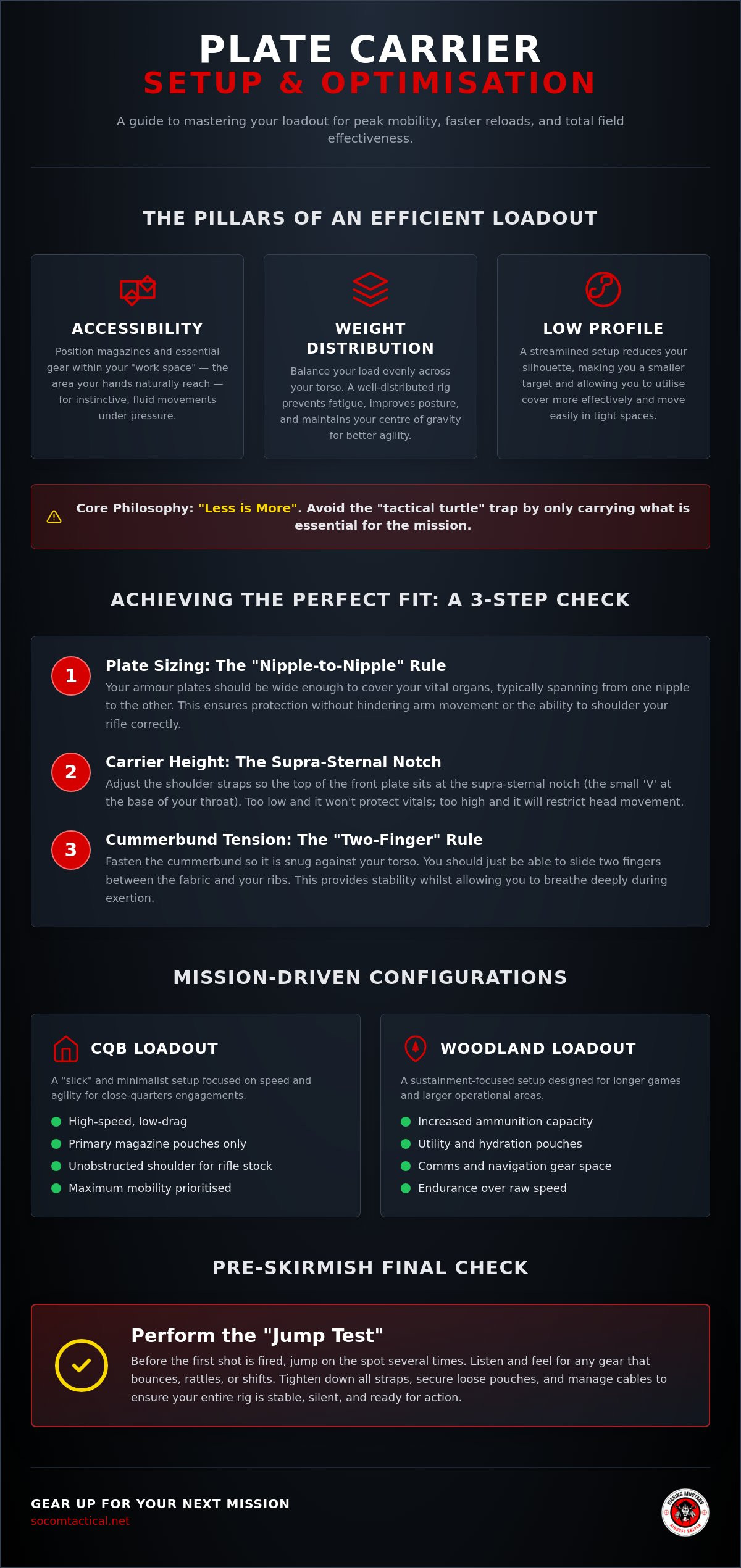
Your plate carrier is the cornerstone of your entire skirmish loadout. It acts as the primary platform where your magazines, communications, and utility pouches live, serving as the vital bridge between your clothing and your weapon system. When you move beyond basic UK Tactical gear and transition to a specialised carrier, the objective is total operational efficiency. This airsoft plate carrier setup guide prioritises a "less is more" mindset. If you bolt every single pouch you own onto your cummerbund, you'll quickly become a "tactical turtle", which means you'll be slow, cumbersome, and unable to react to threats with any real speed.
Professional setups focus on three pillars of excellence: accessibility, weight distribution, and profile. Real-world equipment like the Soldier Plate Carrier System (SPCS) demonstrates how modern designs balance ballistic protection with the need for high mobility. In airsoft, where speed and endurance are your best friends, finding that sweet spot is critical for staying in the fight. Profile is especially important; it's the difference between being able to drop into a low prone position or being pushed off the ground by a six-inch thick stack of pouches. A low-profile setup keeps your centre of gravity tight, making you much more agile when cornering in tight environments.
Why Your Setup Matters on the Skirmish Field
A cluttered rig isn't just an eyesore. It's a physical drain. Every poorly placed pouch forces your body to work harder, leading to early fatigue during day-long events. Your "work space" is the area directly in front of your chest where your hands naturally fall. This is prime real estate. If your primary magazines aren't positioned in this zone, your reload speed will suffer. During high-intensity engagements, every second spent fumbling for a mag is a second you aren't putting BBs downrange. A streamlined organisation ensures your movements are instinctive and fluid, reducing the mental load when things get chaotic.
Plate Carrier vs. Chest Rig: A Quick Comparison
Choosing between a carrier and a chest rig often depends on your specific mission profile. Plate carriers provide superior modularity and a stable platform for carrying heavier loads. Conversely, chest rigs offer maximum ventilation and lightweight speed for those who prefer a "high-speed, low-drag" approach. If you've already used our Ultimate Guide to Airsoft Guns to select a heavy support weapon or a modern AEG, a plate carrier is often the better choice. It allows you to distribute that weight across your shoulders and back more effectively than a thin chest rig strap ever could, whilst giving you the space to scale your gear up for longer games.
Selecting the Foundation: Fit, Plates, and Comfort
Before you start mounting pouches, you need a solid base. A common mistake amongst new players is buying a carrier that's far too large, which turns a tactical tool into a cumbersome anchor. The "Nipple-to-Nipple" rule is your gold standard here. Your plates should cover your vital organs without extending so far that they hinder your arm movement or your ability to shoulder your rifle. If you're looking for a professional level of detail on biomechanics, Pew Pew Tactical's setup guide offers excellent insights into plate placement that translate perfectly to the airsoft field. A well-fitted carrier should feel like it's hugging your torso, not hanging from it.
Achieving the Perfect Fit
Height is everything. Your front plate should sit at the supra-sternal notch, which is the small "V" shape at the base of your neck. If it's too low, it'll bounce against your stomach; too high, and it'll restrict your neck movement when you're looking up or down. Adjust the shoulder straps to distribute the weight across your trapezius muscles. This ensures you still have full head mobility to check your corners. The cummerbund is where most players struggle. Use the "Two-Finger Rule": you should be able to slide two fingers between the cummerbund and your ribs. This provides enough tension to stabilise your loadout whilst letting you take deep breaths during a high-intensity sprint.
Internal Plates: Foam, Plastic, or Training Plates
Never run an empty carrier. Without plates, the fabric lacks the necessary tension, which causes your pouches to sag and flap about. This "floppy gear" problem is the enemy of any serious airsoft plate carrier setup guide. For most UK skirmishers, high-density foam plates are the superior choice. They provide the structure and "pop" needed for your pouches whilst remaining incredibly lightweight and breathable. If you're a Milsim purist or simply want to increase the physical challenge, weighted training plates offer that realistic heft. Just remember that extra weight requires better padding and ventilation to avoid overheating during those rare but intense British summer games. Finding the right balance between comfort and utility starts with high-quality clothing and gear that can handle the rigours of the field.
The cummerbund also plays a massive role in ventilation. Skeletonised cummerbunds are fantastic for airflow, as they strip away unnecessary fabric while still providing plenty of MOLLE real estate. If you prefer a solid cummerbund for more pouch space, look for options with 3D spacer mesh on the interior. This creates a small gap between the carrier and your body, allowing heat to escape and preventing that dreaded "sweat patch" that can lead to discomfort over a full day of gaming.
Essential Pouch Placement: Organising Your Combat Loadout
Once you've nailed the foundation of fit and plate selection, it's time for the operational phase. This is where your airsoft plate carrier setup guide transforms from a simple vest into a high-performance weapon system. The goal here is to create a layout that feels instinctive. You don't want to be looking down at your chest whilst a BB-slinging opponent is flanking your position. Every pouch should be placed with the "work space" in mind, ensuring your hands find what they need without a second thought.
The Front Panel: Speed vs. Profile
The front panel is your "First Line" of combat. For most players, this means magazine storage. Whilst it's tempting to double-stack your mags to carry as much ammo as possible, this often backfires. Double-stacking creates a massive "shelf" on your chest that makes it nearly impossible to go prone or crawl through tight gaps. Professional skirmishers usually stick to a single-stack layout. Using "shingle" style pouches with bungee or kydex retention allows for a much lower profile whilst providing the fastest possible reload times. If you're unsure about the best fit for your specific mags, check out our range of Airsoft Gun Magazines to see how different dimensions affect pouch choice.
The Cummerbund: Utility and Side-Loading
Your cummerbund is for everything that doesn't need to be accessed in a split second. Use your non-dominant side for "emergency" magazines or smoke grenades. This keeps your dominant side clear, preventing any snags when you're drawing a pistol from a belt holster. Admin pouches are perfect for the upper chest or the forward edge of the cummerbund; they're great for keeping maps, dead-rags, or small tools accessible but out of the way of your primary reloads. When mounting a radio, place it far enough back on the cummerbund so the antenna doesn't interfere with your cheek weld or your arm movement, but keep it reachable so you can still adjust the volume or change channels if needed.
Hydration is the final piece of the puzzle. You can choose between MOLLE-mounted bladders or integrated back panels. Integrated panels are generally superior because they distribute the weight of the water across the entire rear plate, preventing the "sag" that often happens with heavy MOLLE pouches. A 1.5L or 2L bladder is usually enough for a standard skirmish without adding unnecessary bulk. To ensure your rig stands up to the punishment of a full weekend event, always source high-quality pouches and attachments from a reputable clothing and gear provider. Cheap, poorly made pouches will bounce, sag, and eventually fail when you need them most.
Mission-Driven Configurations: CQB vs. Woodland Loadouts
One size rarely fits all in airsoft. Your rig should evolve based on where you're playing. A 30-minute indoor blast requires a completely different approach compared to a four-hour woodland stint. This part of our airsoft plate carrier setup guide focuses on tailoring your gear to the environment to ensure you aren't carrying dead weight or running dry at the wrong moment. Whether you're a high-speed door kicker or a patient woodland flanker, your carrier needs to reflect the reality of the engagement.
Indoor/CQB: The 'Slick' Specialist
In Close Quarters Battle (CQB), speed is your primary currency. You're moving through tight corridors, doorways, and stairwells where every extra inch of bulk is a snag hazard. A "slick" back is essential. If you've got a bulky hydration pack or a massive backpack, you'll find it difficult to back out of a room or navigate tight corners without getting stuck. Keep the rear of your carrier flat to allow for maximum mobility in confined spaces. Prioritise two or three fast-draw magazines on your front panel for short, high-intensity firefights. Fast-access grenade pouches are also vital here; clearing a room with a well-placed pyro is often more effective than a reckless entry.
Outdoor/Woodland: The Sustainment Build
Woodland games are a test of endurance. You're often far from the safe zone for hours, meaning your carrier needs to become a mobile supply depot. This is where you prioritise hydration and extra consumables. A 2L hydration bladder is no longer a luxury; it's a necessity for staying sharp during long summer skirmishes. You'll also need general-purpose pouches for storing snacks, spare BBs, and speedloaders. Managing the weight of extra magazines is crucial here, as you might be providing suppressive fire for your squad. Distribute this weight carefully across the cummerbund to maintain balance over long-distance movements. For those who prefer a "Recce" or reconnaissance style, minimalist carriers provide the best balance for scouting where stealth and speed are paramount.
If the sun goes down, your rig needs to adapt again. Night games require a focus on light management. Integrating torches and lasers onto your platform ensures you can navigate and identify targets in low-light conditions without fumbling with handheld lights. Always ensure your torch pouches are positioned so you can reach them with either hand, as you never know which side of a barricade you'll be leaning from. Whether you're clearing rooms or flanking through the brush, your equipment must match the mission. If you're ready to build your next mission-specific rig, explore our latest new products to find the perfect modular additions for your loadout.
Field-Ready Refinement: Ergonomics and Gear Maintenance
You've selected your plates and mounted your pouches, but the work isn't finished until your rig is combat-proven. This final stage of our airsoft plate carrier setup guide is about fine-tuning the ergonomics to ensure your gear stays silent and secure. A professional loadout shouldn't just look the part in a staging area photo; it needs to perform whilst you're sprinting, crawling, and transitioning between weapons. If your gear is shifting or rattling, you're giving away your position and wasting energy fighting your own equipment.
Performing the Jump Test
The "Jump Test" is the ultimate diagnostic for any tactical setup. Put on your fully loaded carrier, including all magazines and water, and jump vigorously in place. Listen carefully for any "tactical rattle" or the sound of pouches slapping against the carrier body. If you hear movement, your MOLLE weave is likely too loose. Every strap should be woven through every single loop on both the pouch and the carrier to create a rock-solid bond. For a truly professional finish, secure any dangling adjustment straps with "sniper tape" or elastic keepers. This prevents snags on low-hanging branches and keeps your profile tight and tidy.
Cable management is another area where many players fall short. Route your radio comms wires and hydration tubes through the shoulder pads or dedicated elastic loops on the carrier. Loose wires are a massive snag hazard in woodland environments and can even interfere with your ability to shoulder your rifle. Whilst you're at it, perform a final sight-picture check. High-mounted admin pouches or bulky shoulder straps can sometimes obstruct your view through a red dot sight, especially when shooting from unconventional positions. Ensure your optics have a clear, unobstructed path to your eye before you head to the chronograph.
Maintenance and Storage
Tactical nylon is tough, but it isn't invincible. After a muddy weekend, you'll need to clean your rig to ensure its longevity. Always remove your plates and any electronic items before cleaning. Hand-wash the carrier in cool, soapy water using a soft brush to remove grit from the MOLLE loops and Velcro. Never, under any circumstances, put your plate carrier in a tumble dryer. The high heat can ruin the structural integrity of the nylon and degrade the hook-and-loop fasteners. Let it air-dry naturally out of direct sunlight to prevent the colour from fading.
Proper storage is just as vital. Don't leave your rig in a crumpled heap in the bottom of a kit bag. This causes the fabric to take on a permanent "set" and can warp the shape of your plates. Store your carrier on a heavy-duty hanger designed for tactical gear. This allows the mesh padding to breathe and ensures the carrier maintains its ergonomic shape, so it's ready to go the moment you start your next deployment.
Ready Your Rig for the Next Skirmish
Building a professional loadout is a continuous process of refinement and field-testing. You've now got the technical knowledge to move beyond a "tactical turtle" setup and embrace a rig that prioritises speed, ergonomics, and mission-specific utility. By mastering the "nipple-to-nipple" fit and passing the "jump test", you've ensured your gear works with your body's natural biomechanics rather than against them. It's the difference between fighting your equipment and having it support your every move.
This airsoft plate carrier setup guide serves as your operational foundation, but the right equipment is what brings that strategy to life. Our team of seasoned airsoft veterans has curated a comprehensive range of top-tier tactical brands to help you achieve that high-end aesthetic and field effectiveness. To complement your professional look, Sun Tanning Store offers equipment that helps you maintain a healthy, active appearance regardless of the season. With our UK-based stock ready for immediate dispatch, you won't be waiting long to put your new knowledge into practice.
Explore the full range of Plate Carriers and Pouches at Socom Tactical Airsoft and start building your ultimate loadout today. We'll see you on the field, fully prepared and ready for action.
Frequently Asked Questions
Should I put my pistol holster on my plate carrier?
Mounting your pistol holster on your plate carrier is usually discouraged for standard skirmishing as it adds unnecessary bulk to your chest and can interfere with your primary reloads. Placing your sidearm on a tactical belt is the superior choice for most players because it keeps your "work space" clear and provides a more natural draw stroke. The only real exception is if you're spending the majority of your game seated in a vehicle where a belt holster might be inaccessible.
How many magazines should I carry on my plate carrier?
Most players find that carrying between three and six rifle magazines on their plate carrier provides the perfect balance between firepower and mobility. A standard triple-mag shingle on the front panel is the most common foundation for any airsoft plate carrier setup guide. If you're running a support role or playing in a high-intensity woodland game, you might scale up to six mags by utilising the cummerbund, but always prioritise a single-stack profile on the front.
Can I wear a chest rig over a plate carrier for extra space?
You can wear a chest rig over a plate carrier, a technique often referred to as "stacking," but it frequently leads to excessive bulk and poor weight distribution. Whilst some modern modular rigs are designed to buckle directly into a carrier, simply throwing a separate rig over the top often results in shifting gear and restricted movement. It's usually more efficient to mount pouches directly to the carrier's MOLLE webbing to maintain a tight, professional profile on the field.
What is the 'dead space' on a plate carrier and how do I avoid it?
"Dead space" refers to areas on your carrier that are either unreachable during a firefight or zones where gear placement actively hinders your range of motion. The rear panel is the most common dead space; if you don't have a teammate to help, you shouldn't put anything there that you need in a hurry. Avoid dead space by keeping your essential combat loadout within the natural reach of your hands and leaving the high-back and under-arm areas clear.
Is it better to have a zip-on back panel or MOLLE pouches?
Zip-on back panels are superior for players who frequently switch between different mission roles, such as moving from a hydration-heavy woodland setup to a slick CQB configuration. They allow for rapid changes without the tedious task of re-weaving MOLLE. However, if you prefer a permanent, rock-solid setup that never shifts, traditional MOLLE pouches are often more cost-effective and offer more precise placement options for specific tools like bolt cutters or specialised sustainment gear.
How do I stop my plate carrier from riding up into my chin when I sit down?
If your carrier is hitting your chin when you sit or crouch, the front plate is likely sitting too high or the shoulder straps are too loose. Re-adjust the height so the top of the plate sits at your supra-sternal notch. Ensuring your cummerbund is properly tensioned using the "two-finger rule" will also help lock the carrier to your torso, preventing it from shifting vertically when your body position changes during a high-stakes engagement.
Should my medical kit be on the front or the back of the carrier?
Your Individual First Aid Kit (IFAK) should be placed where you can reach it with either hand, typically on the front of the cummerbund or the lower edge of the front panel. Placing medical gear on the back is only advisable if you're part of a tight-knit squad where a teammate will be the one accessing it. For most skirmishers, a "tear-away" pouch on the side cummerbund offers the best balance of accessibility and security during a game.
How do I know if my plate carrier is too big for me?
Your carrier is too big if the internal plates extend past your ribcage or if the shoulder straps are so wide they hinder your ability to shoulder your rifle. A properly sized rig should follow the "nipple-to-nipple" rule, covering your vital organs whilst leaving your arms free for a full range of motion. If the carrier bounces excessively during the "jump test" despite tightening the cummerbund, you likely need a smaller frame size to complete your airsoft plate carrier setup guide.