Why do so many players treat their airsoft plate carrier like a heavy vest when it's actually the most critical modular engine in their entire kit? It's a common mistake that leads to a miserable day on the field. We've all experienced that frustrating Sunday skirmish where your gear bounces whilst you run, you're overheating in the dense woodland, and your pouch placement feels more like a puzzle than a tactical advantage.
You deserve a setup that works as hard as you do. This guide is designed to help you master the art of tactical loadouts, ensuring you select, fit, and organise the perfect airsoft plate carrier for your specific playstyle. We'll show you how to achieve a professional, functional look that provides comfort for all-day play and scales as your hobby grows. From understanding MOLLE compatibility to perfecting your cummerbund tension, we're diving into the technical nuances that turn standard equipment into an essential tool for operational success. Whether you're a newcomer or a seasoned veteran, it's time to build a loadout that stays secure when the engagement heats up.
Key Takeaways
- Identify high-performance materials like Cordura and understand the technical differences between traditional PALS and laser-cut MOLLE for maximum field durability.
- Optimise your operational efficiency by organising your airsoft plate carrier around the "work space" concept to ensure lightning-fast magazine reloads during high-stakes engagements.
- Apply the "two-finger" rule and collarbone alignment techniques to achieve a secure, professional fit that eliminates gear bounce whilst maintaining full respiratory freedom.
- Learn how to integrate your carrier with a tactical belt to create a balanced, scalable loadout that transitions seamlessly from minimalist setups to heavy-duty configurations.
What is an Airsoft Plate Carrier and Why Do You Need One?
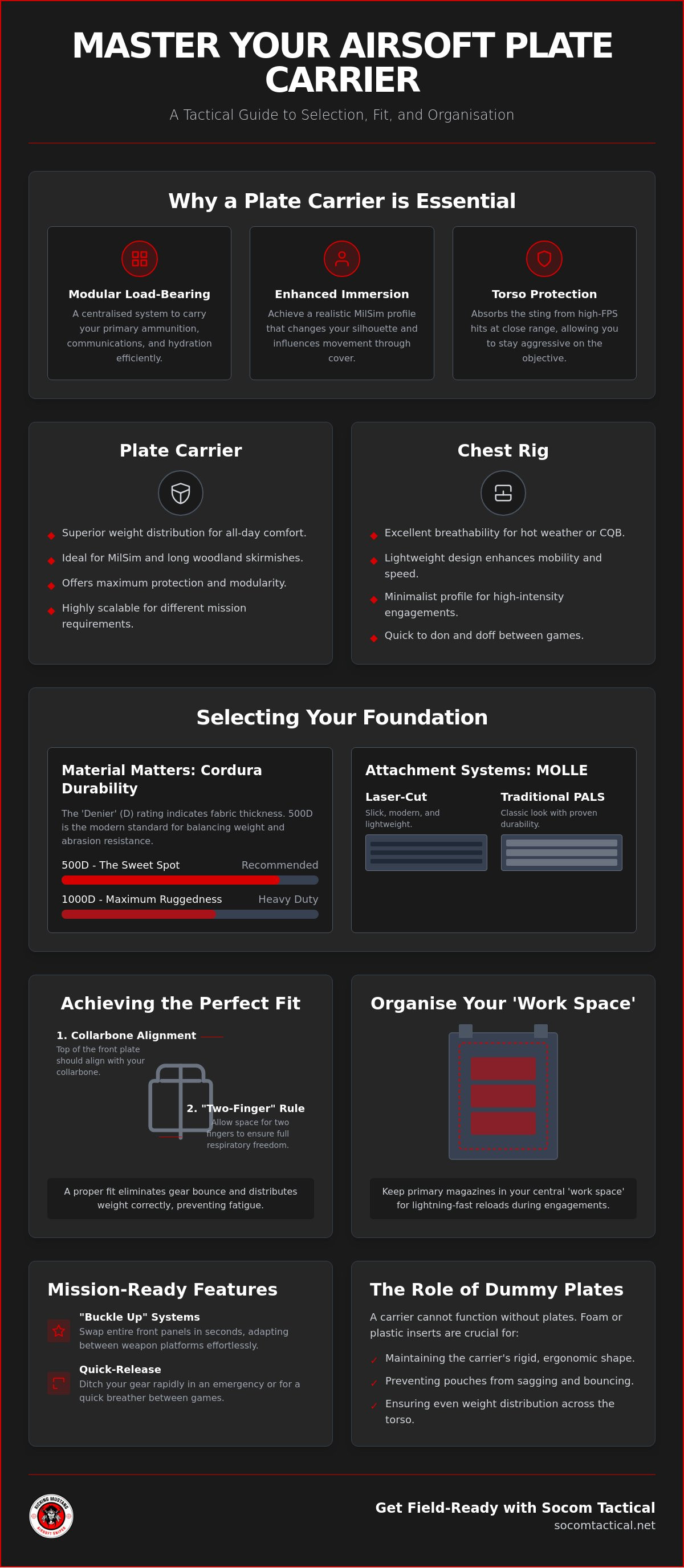
At its core, an airsoft plate carrier is a specialised load-bearing platform designed to mimic the profile and functionality of tactical body armour whilst providing a modular surface for your essential kit. Unlike a simple vest, it features internal pockets specifically sized for ballistic-style plates. In the field, this isn't just about looking the part; it's about having a centralised system that keeps your primary ammunition, communications, and hydration within easy reach. It transforms you from a casual player into a mobile, self-sufficient operator.
Immersion is a massive part of why we play. Stepping onto a MilSim site with a high-quality carrier provides a level of realism that a belt alone can't match. It changes your silhouette and influences how you move through cover. Beyond the aesthetics, it serves a vital defensive purpose. A well-fitted carrier offers torso protection against high-FPS hits at close range, turning a painful sting into a dull thud. This allows you to stay aggressive in the objective without flinching at every incoming BB, ensuring you maintain momentum during a breach.
Plate Carriers vs. Chest Rigs: Making the Choice
Choosing between these two platforms often comes down to the environment and the duration of the engagement. Plate carriers excel at weight distribution. By spreading the load across your shoulders and back, they prevent the gear-heavy fatigue that ruins long woodland skirmishes. MilSim enthusiasts almost always favour the carrier for its authentic impression. However, if you're hitting a high-intensity CQB site in the height of summer, a lightweight chest rig might offer better breathability. The carrier remains the superior choice for maximum protection and a scalable loadout that grows with your mission requirements.
The Role of Dummy Plates in Airsoft
You can't run a carrier empty. Without plates, the fabric lacks tension, causing your pouches to sag and bounce whilst you're moving. Most players opt for foam or plastic inserts to maintain that crisp, professional look. If you're looking for a workout, weighted training plates add a layer of physical challenge that many seasoned practitioners enjoy. The rigid structure of dummy plates ensures the tactical vest maintains its ergonomic shape and distributes weight evenly across the torso, rather than collapsing under the load of your gear. This keeps your clothing and gear sitting correctly, ensuring your reloads are always where you expect them to be.
Choosing Your Foundation: Materials, Cut, and Sizing
The base material of your airsoft plate carrier dictates how long it survives in the mud and briars of a typical UK woodland site. Most professional rigs use Cordura, a high-tenacity nylon known for its incredible abrasion resistance. You'll often see "Denier" ratings like 500D or 1000D. Whilst 1000D is rugged, it's often overkill for airsoft and adds unnecessary weight. Modern operators usually prioritise 500D for its balance of strength and flexibility. Whilst we use replicas, real-world ballistic gear follows NIJ's minimum performance standards to ensure survival in high-stakes environments. Choosing these same materials brings that level of operational reliability to your skirmish kit.
One major advancement often overlooked by basic guides is the "Buckle Up" system. These modular placard panels allow you to shed or swap your entire front magazine configuration in seconds. It's a game-changer for players who run multiple weapon platforms. You can transition from an AEG rifle setup to a sniper support role without the tedious task of re-threading MOLLE webbing between rounds. Quick-release buckles on the shoulders and cummerbund also ensure you can ditch your gear rapidly in an emergency or simply for a breather between games.
Laser-Cut vs. Traditional Webbing
Laser-cut platforms are rapidly becoming the standard for the modern skirmisher. By cutting slots directly into a reinforced laminate fabric, manufacturers eliminate the weight of traditional nylon webbing. This creates a "slick" aesthetic that's less likely to snag on foliage. However, traditional PALS webbing remains a favourite for those who prefer the classic tactical look and the proven durability of reinforced stitching under heavy loads. Both systems are fully compatible, so your choice often comes down to weight versus tradition.
Sizing and Plate Cuts (SAPI vs Swimmer)
Don't ignore the cut of your plates. SAPI (Small Arms Protective Insert) is the rectangular standard, offering maximum coverage and the most real estate for mounting pouches. If you're an aggressive player who spends time in deep crouches or awkward shooting positions, consider a Swimmer cut. These plates feature narrowed shoulders to increase arm mobility. Always ensure your cummerbund allows for a "second skin" fit to prevent the airsoft plate carrier from shifting during a sprint.
Versatility is king when selecting a base colour. Olive Drab and Coyote Brown are the gold standards for UK environments. They blend seamlessly with most camouflage patterns, from Multicam to DPM. This allows your rig to remain effective across different seasons and sites. If you're building a new rig from scratch, checking out our latest clothing and gear is the best way to ensure your base layers and carrier work in harmony.
Organising Your Loadout for Operational Efficiency
Efficiency on the field isn't about how many pouches you can cram onto your MOLLE; it's about reducing the time between "empty" and "ready." Your airsoft plate carrier is your second line of gear, and it must work in perfect synchronisation with your tactical belt. Whilst your belt handles your sidearm and emergency reloads, the carrier serves as your primary supply hub. If these two systems clash, you'll find yourself fumbling during a breach or, worse, losing gear whilst sprinting between cover.
We advocate for the "Rule of Three" when it comes to front-end magazine placement. Keeping three primary magazines front and centre ensures your ammunition stays within the "work space" directly below your line of sight. This centralised placement allows for rapid, muscle-memory reloads with either hand. Magazine pouches should be mounted high enough to clear your belt kit but low enough to ensure a clean, vertical draw that doesn't strike your chin or eye protection.
Front Panel Configuration
Placard systems are the ultimate solution for players who switch between weapon platforms. Instead of the tedious task of re-threading MOLLE, you simply unclip one panel and swap it for an SMG, 5.56, or 7.62 configuration in seconds. For those dedicated to a single rifle, triple mag shingles offer a low-profile foundation. This keeps your silhouette slim, which is a massive advantage when you're trying to hug a barricade in a tight CQB environment.
Back Panels and Hydration
In the UK, woodland skirmishes often involve long durations away from the safe zone. A hydration bladder is the most critical addition to your back panel to prevent fatigue. Beyond keeping you in the game, a full water bladder acts as a functional counter-weight to a heavy front magazine load, pulling the carrier back into a balanced position. If you're a solo player, avoid fixed back panels you can't reach yourself. Opt for a small assault pack or keep essential utility items like maps and multi-tools on your cummerbund where they are accessible.
Cable management is often the difference between a smooth day and a frustrating one. In dense brush, loose radio wires or hydration tubes are magnets for snags. Route your comms through the shoulder pads and use elastic loops to keep everything tight to the chassis. In CQB, keep the sides of your airsoft plate carrier as slick as possible to navigate narrow doorways. In woodland, you have more freedom to use the cummerbund for extra utility pouches, provided you maintain that essential balance and silence.
Achieving the Perfect Fit: Comfort and Weight Distribution
A professional-looking loadout is a liability if it causes injury or premature fatigue. Ergonomics is the silent factor that separates a successful 8-hour MilSim from a miserable morning on the field. When fitting your airsoft plate carrier, you must prioritise the "Two-Finger" rule. Once the cummerbund is secured, you should be able to slide two fingers comfortably between the plate and your chest. This ensures the rig remains stable whilst allowing your lungs to expand fully during high-intensity sprints. If it's any tighter, you'll find your stamina dropping as your breathing becomes restricted.
Ride height is the most common mistake we see at UK sites. Your front plate shouldn't be protecting your stomach; it needs to sit at the jugular notch, which is the soft spot at the base of your neck. If the carrier sags too low, the weight pulls on your shoulders and creates significant lower back strain. To manage the inevitable heat of a woodland skirmish, consider adding ventilated "pontoons" to the interior. These padded strips create a vertical air channel against your torso, allowing heat to escape rather than soaking into your base layers.
Cummerbund Adjustment and Tension
The choice between elastic and rigid cummerbunds depends on your environment. Elastic versions are superior for CQB as they flex with your body during aggressive cornering and crouching. Rigid cummerbunds, however, are essential for heavy load-bearing setups where you need to mount side pouches or extra protection. Always ensure your side plates are centred on your ribs. If they sit too far forward or back, they'll dig into your hips and throw off your balance during movement.
Preventing Gear Bounce
Before you even leave for the site, perform the "Jump Test." Fully load your carrier with BBs, gas, and water, then jump on the spot. If you hear rattling or feel pouches flopping, your tensioning straps need adjustment. Weight symmetry is vital here. If you run a heavy radio on the left, balance it with a utility pouch or secondary mag on the right to prevent the carrier from shifting. For the ultimate in ergonomic comfort, you can upgrade your setup with our professional-grade clothing and gear to ensure your rig sits perfectly over your tactical layers.
Shoulder pad upgrades are another quick win for long-duration play. Standard straps often lack the cushioning needed for an all-day engagement. Adding high-density foam pads distributes the weight across a larger surface area, preventing the "digging" sensation that leads to neck tension. By fine-tuning these small details, you transform your rig from a heavy burden into a seamless, high-performance extension of your tactical kit.
Get Field-Ready with Socom Tactical Airsoft
Every piece of gear we stock has to earn its place in our inventory through rigorous field testing. At Socom Tactical Airsoft, we're active participants in the community, which means we've experienced the same gear failures and tactical successes as you. When you select an airsoft plate carrier from our range, you're benefiting from years of technical testing in the harshest UK woodland and CQB environments. We've curated a selection that caters to every level of play:
- Entry-level rigs: Cost-effective platforms for those just starting their tactical journey.
- Mid-tier modularity: Versatile systems that balance weight and storage for regular skirmishers.
- Professional-grade platforms: Combat-proven gear designed for the grit and precision of MilSim events.
Our focus remains fixed on immediate field-readiness and the functional utility of every strap and buckle. Creating a truly effective loadout means looking at the bigger picture of your engagement style. A carrier works best when integrated into a complete system, paired with reliable red dot sights and high-torque internal components. We don't just sell products; we frame items as essential tools for a broader experience. The Socom Tactical Airsoft guarantee means you're receiving quality-controlled, field-ready gear delivered straight to your door across the UK. It's about giving you the rugged confidence to focus on the objective, knowing your equipment has been vetted by experts who actually play the game.
Why Shop with a UK Specialist?
We've been a cornerstone of the UK scene since 2009, rooted deeply in the community we serve. Unlike anonymous global retailers, Socom Tactical Airsoft offers the chance to visit our Fleet retail outlet. There's no substitute for trying gear on in person to check the ride height and cummerbund tension. If you're ordering online, our brisk and efficient shipping rhythm ensures your kit arrives in time for the next skirmish.
Explore Our Latest Tactical Arrivals
Stay ahead of the competition by browsing our new products, where we feature the latest in laser-cut technology and modular placard systems. Popular items don't stay on the shelves for long, so keep a close watch on our back in stock carriers to secure your preferred setup. For those looking for a specific tactical edge, contact the Socom Tactical Airsoft team for a custom loadout consultation to ensure your next airsoft plate carrier is perfectly tailored to your operational needs.
Master Your Tactical Loadout
Since 2009, Socom Tactical Airsoft has provided UK-based expert advice rooted in our own experiences as active community participants. We stock an extensive range of top industry brands that we trust in our own kits. Don't settle for gear that bounces or restricts your movement when the pressure is on. Browse our full range of field-ready Airsoft Plate Carriers at Socom Tactical Airsoft and get the professional edge you need for your next skirmish. We'll see you in the objective.
Frequently Asked Questions
Do I need a UKARA to buy an airsoft plate carrier?
No, you don't need a UKARA registration to purchase an airsoft plate carrier or any other piece of tactical clothing. UKARA is a database used by retailers to verify a player's defense under the Violent Crime Reduction Act (VCRA) specifically for purchasing Realistic Imitation Firearms (RIFs). Tactical gear is unrestricted, meaning you can start building your loadout before you've even completed your first three qualifying games at a registered site.
Can I put real ballistic plates in an airsoft plate carrier?
Whilst some high-end airsoft plate carrier models are built to real-world specifications, most are designed exclusively for foam or plastic dummy plates. Real ballistic plates are substantially heavier and can cause the stitching on entry-level rigs to fail prematurely. If you intend to use real plates for training purposes, ensure your carrier is constructed from genuine 500D or 1000D Cordura with reinforced bartack stitching to handle the additional load.
What is the difference between a plate carrier and a tactical vest?
A plate carrier is a modular chassis designed specifically to hold ballistic inserts, providing a rigid platform for customisable MOLLE pouches. In contrast, a traditional tactical vest is often a mesh or solid fabric garment with fixed, non-removable pouches. Plate carriers offer superior scalability and protection, whereas tactical vests are generally lighter but lack the ability to reorganise your kit for different mission requirements or weapon platforms.
How do I clean my airsoft plate carrier after a muddy game?
You should always hand wash your carrier using warm, soapy water and a soft-bristled brush. First, remove all dummy plates, pouches, and electronic equipment. Gently scrub away mud and sweat, then rinse thoroughly with cold water. Never use a washing machine or tumble dryer, as the agitation and heat can damage the internal stiffeners and degrade the fabric coatings. Always air dry your rig out of direct sunlight.
Will a plate carrier fit me if I am a larger or smaller build?
Most modern carriers feature highly adjustable shoulder straps and cummerbunds to accommodate a wide range of body types. If you have a smaller build, look for minimalist or JPC-style rigs that offer a tighter footprint. For larger players, ensure the cummerbund has enough length to overlap securely at the rear. Remember that the carrier is sized to the plates, not the person, so selecting the correct SAPI plate size is the first step to a proper fit.
What are the best pouches to start with for a beginner loadout?
A beginner should prioritise a triple magazine shingle, a small utility pouch, and a dedicated radio pouch. This core setup covers your primary ammunition needs whilst providing space for essential items like a dead rag or multi-tool. As you gain more experience, you can add specialised pouches for grenades or hydration bladders. Starting with a clean, simple front panel helps you master your reloads before adding the complexity of a full operator loadout.
Can I use a plate carrier for weighted vest training or CrossFit?
You can use a high-quality airsoft plate carrier for weighted training, provided it features reinforced stitching and genuine Cordura fabric. Many CrossFit enthusiasts use tactical carriers because they offer better breathability and a more secure fit than traditional weighted vests. However, avoid using budget-tier airsoft rigs for this purpose. The constant friction and high-intensity movement of a workout will quickly delaminate the fabric and snap the plastic buckles on cheaper, non-tactical replicas.
How do I attach MOLLE pouches correctly so they don’t fall off?
To attach pouches securely, you must weave the vertical straps through both the pouch and the carrier's webbing in an interlocking pattern. Many newcomers simply slide the strap through all the loops at once, which leads to gear bounce and lost pouches. By alternating between the carrier and the pouch, you create a rigid, tensioned bond. Always finish by tucking the end of the strap back into the final row of webbing or securing the press-stud firmly.