What if a familiar sounding game mode comes with a different objective or win condition than you expected? It’s easy to mix up the names, especially when team deathmatch, capture the flag and attack and defend can all have site specific variations. This Airsoft Game Modes & Rules guide explains what to expect, so you can focus on the game rather than trying to decode the briefing on the fly.
You’ll learn the basic aims of common formats and the safety and fair play rules to listen for, including how a site handles hit calls, respawns, boundaries and engagement distances. The names and general conventions are useful starting points, but they’re not a substitute for local instructions.
Before play, confirm how your chosen site runs each mode, what its rules require and which equipment is suitable. We’ll cover common objectives, then highlight what to check during your briefing so you can arrive prepared without assuming every site uses the same rulebook.
Key Takeaways
- Airsoft Game Modes & Rules vary by venue: use familiar mode names as a guide, then listen for the site’s specific objectives and conditions.
- Check the win condition before play so you know whether your team needs to eliminate opponents, hold an objective or complete a task.
- Pay close attention to the briefing on eye protection, safe conduct and the venue’s procedure for calling hits.
- Before the game starts, confirm boundaries, time limits and the signal that marks the end of play.
- Choose comfortable kit and suitable eye protection, and make sure your equipment meets the game and site requirements.
What are airsoft game modes, and what changes from one game to another?
A game mode sets a skirmish’s objective and the conditions for play. One match might centre on eliminating opposing players; another could ask teams to control an area or complete a task. The goal gives each side a focus, but a mode’s name won’t tell you every detail. Sites can adapt familiar formats, so the same label may mean a different match on another field.
That distinction is central to understanding Airsoft Game Modes & Rules: the objective tells you what your team is trying to achieve, while site rules explain how to play. Airsoft also relies on players honestly acknowledging hits, part of the honour system described in What is Airsoft. The briefing connects the broad format to the procedures for that session.
Quick definition: A game objective is your team’s goal; a site rule is an instruction that governs how you pursue it safely and fairly.
How does an airsoft game mode set the objective?
The objective shapes decisions from the opening push: whether to advance, defend, support a team-mate or prioritise a task. For example, a hypothetical mode might ask one team to hold a marked area while the other tries to take it. That’s an illustration, not a universal format. The briefing confirms the actual win condition, any limits on the game and what counts as completing the task.
Why can the same mode have different rules at different sites?
Each venue can adjust the playing area, boundaries, timings, objectives and player procedures to suit its field and session. A capture style game, for instance, might use a different objective or boundary at another site. Don’t assume you know the details from the mode name alone. Listen to the briefing and ask the organiser to clarify anything that could affect your role, route or next move.
Keep the two layers separate as you prepare: learn the mode’s broad aim, then follow local instructions for that game. Confirm where play takes place, what your team needs to achieve and how the session ends. This helps you move with purpose once the game starts, without carrying assumptions from another site onto the field.
Popular airsoft game modes: compare objectives before you play
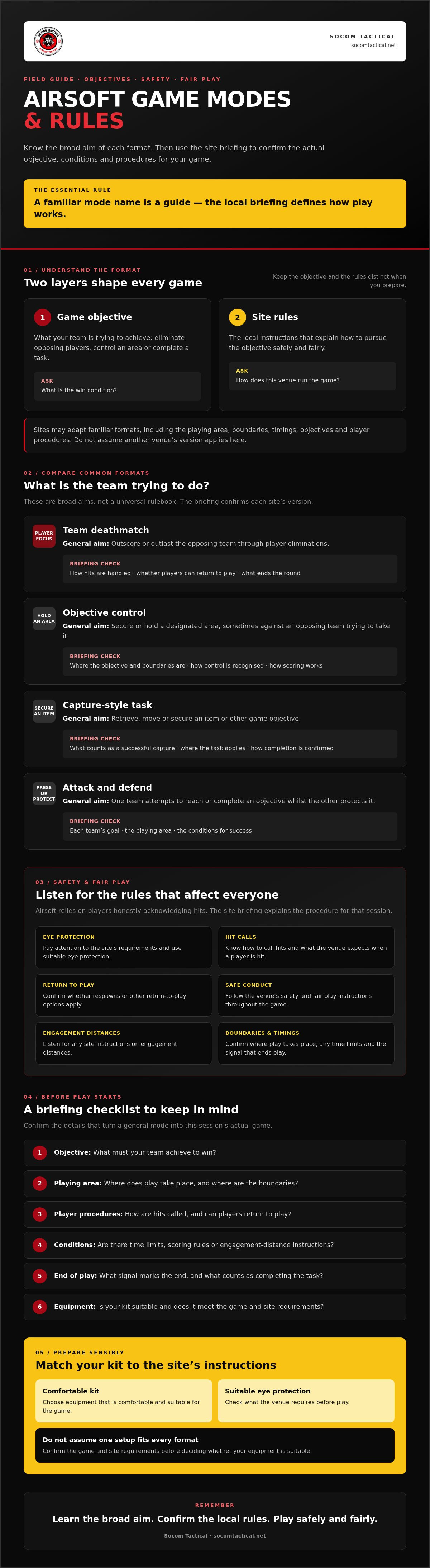
Mode names give you a quick sense of the mission, but the briefing sets the win condition. Team deathmatch centres on opposing players; objective games give teams a task to complete or an area to control. Use this comparison to understand the broad formats, then check how your site runs them.
| Format | General aim | Briefing details to check |
|---|---|---|
| Team deathmatch | Outscore or outlast the opposing team through player eliminations. | How hits are handled, whether players can return to play, and what ends the round. |
| Objective control | Secure or hold a designated area, sometimes against an opposing team trying to take it. | Where the objective and boundaries are, how control is recognised, and how scoring works. |
| Capture-style task | Retrieve, move or secure an item or other game objective. | What counts as a successful capture, where the task applies, and how completion is confirmed. |
| Attack-and-defend | One team attempts to reach or complete an objective whilst the other protects it. | Each team’s goal, the playing area and the conditions for success. |
What is the difference between team deathmatch and objective games?
The main difference is what your team is trying to achieve. In team deathmatch, the focus is on opposing players. In an objective game, winning depends on a task or location, so positioning and coordination can matter as much as engaging opponents. Elimination procedures, return to play options and end conditions vary by venue. Don’t treat one site’s version as the standard.
How do capture, control and attack-and-defend formats work?
Capture formats ask players to secure or move an objective, while control formats focus on holding an area. Attack and defend is a broad pattern: one side presses towards a goal and the other protects it. The details are site specific. Confirm the boundaries, scoring method and precise completion condition before choosing your route or role. For a separate example of how an organiser presents military simulation events, see Milsim game modes.
Once the objective is clear, match your preparation to the site’s instructions rather than assuming a particular replica suits every format. If you’re considering a primary platform, browse airsoft guns and check your chosen site’s requirements before play. This helps you avoid a mismatch between your kit and the session rules.
Airsoft rules that matter most: safety, hit-calling and fair play
Safety procedures and fair play are the backbone of a good skirmish. Pay close attention to the site briefing, especially its instructions on eye protection, safe conduct and handling replicas outside play. Hit calling is also central: players are expected to respond honestly when they believe a BB has hit them, then follow the venue’s procedure. These conventions help keep the game moving and build trust between teams.
Details can vary. Engagement procedures, respawns, medic rules and surrender calls aren’t universal, so don’t rely on an assumption from another site or an online summary. The organiser’s current rules and briefing apply to that session. If an instruction isn’t clear, ask a marshal before play rather than guessing under pressure.
What should players know about hit-calling and fair play?
If you believe you’ve been hit, acknowledge it promptly and clearly, even if you’re unsure whether the BB came from an opponent or a team-mate. Follow the site’s instructions for signalling that you’re out and leaving the active game area. Signals and procedures differ between venues, so don’t copy another player’s routine unless it was covered in the briefing.
Keep disagreements calm. If you think a hit or call has been misunderstood, don’t let an argument escalate during play. Follow the site’s process or ask a marshal to clarify. Honest calls and respectful communication make the game fairer for everyone.
Which safety rules should you confirm before a game?
Listen closely to the organiser’s eye protection requirements, including when protection must stay on and when, if ever, it may be removed. Check how the site defines safe zones and what it expects players to do with replicas there or elsewhere outside active play. Follow those instructions every time, even if you’ve played at other venues.
Ask how the site checks replica power and what limits or procedures apply to your equipment. Don’t assume one universal limit: requirements can depend on the venue and the replica’s permitted use. If your setup or role is unclear, get guidance from site staff before entering the game.
Use Airsoft Game Modes & Rules as a starting point for understanding common terms, not as a substitute for local instructions. A quick clarification before the whistle can prevent confusion once the action starts. Stay alert, follow the marshal’s directions and make safety your first priority.
Before the airsoft game starts: use the briefing to confirm the rules
A clear briefing turns a mode name into a plan you can act on. Even if you’ve played a similar game elsewhere, listen for the details that define this session. Keep the key points in mind and ask the marshal to clarify anything you’re unsure about before the game begins.
What should you ask the marshal before play begins?
Use this quick checklist to confirm the essentials:
- Objective: What must your team do to win, and how is success confirmed?
- Boundaries: Which areas are in play, and where must players stay clear?
- Time and finish: What’s the time limit, and what signal means the game has ended?
- Hit procedure: What counts as a hit, and how should you signal and leave the active game area?
- Return to play: Are respawns or medic rules in use, and how do they work for this game?
- Help and safety: Who should you approach if a rule or safety concern comes up during play?
Listen for marshal instructions alongside the objective. Asking now is better than a mid game misunderstanding about whether you’re inside the boundary or what to do after a hit.
How can you prepare without assuming every site is the same?
Before travelling, check the chosen venue’s current player information for its rules, equipment requirements and briefing process. Pack the protective equipment the organiser requires, and check that your kit is suitable for that venue. General advice can help you prepare, but it can’t confirm how a specific site runs its games.
Keep that distinction in mind as you read about Airsoft Game Modes & Rules: common terms describe broad formats, while the venue’s current instructions govern your session. Confirm details that could change your role or actions, including boundaries, end signals and return to play procedures. If the briefing moves quickly, ask a marshal to repeat or clarify an instruction rather than filling in the gaps yourself.
For equipment and shopping questions, read the airsoft shop FAQs. For game objectives, site procedures and session specific requirements, check directly with your chosen venue.
Choose airsoft equipment that supports the game, then get ready to play
Your kit should help you stay comfortable, focused and within the venue’s requirements, not distract you from the objective. Start with suitable eye protection and confirm the site’s standards before play. Then check that your replica and its battery or other power source are ready to use, following the equipment guidance for your setup. Don’t assume a particular loadout is right for every format or field.
What basic equipment should a player check before a game?
Run through a straightforward pre game check:
- Eye protection: Make sure it meets the chosen site’s requirements and is in good condition.
- Replica and power: Check that your replica is functioning and that its battery or power source is ready. Follow the manufacturer’s instructions and the venue’s rules.
- Clothing and carry: Choose comfortable clothing and a practical way to carry the equipment you need. Consider the venue’s terrain and any kit requirements in its player information.
Keep it manageable. Extra kit isn’t automatically useful if it gets in the way or doesn’t suit the site’s conditions.
How can you match your loadout to the game format?
The objective and layout can influence what feels practical. A game focused on holding an area may call for different equipment choices from a task that involves moving around the playing area, but there’s no single replica or setup that suits every player. Check the site’s rules first, then choose equipment you can handle comfortably and use in line with its requirements.
For more detail, explore the airsoft guns guide and the UK tactical gear guide. Treat these as general equipment advice, not a substitute for the venue’s instructions. Preparing for Airsoft Game Modes & Rules means understanding both your kit and the local requirements before you arrive.
Ready to compare equipment? Browse Socom Tactical Airsoft’s airsoft range for airsoft guns and tactical gear. Socom Tactical Airsoft is a retailer, not a game site operator, and doesn’t sell site entry, so contact your chosen venue directly about booking and session requirements.
Get set for your next skirmish
A strong start comes from knowing what your team needs to achieve and listening closely to the venue’s briefing. Game modes set the broad objective, but local rules define boundaries, hit procedures and how the game ends. Confirm those details before play, then choose comfortable equipment that meets the site’s requirements, especially suitable eye protection.
Keep the core of Airsoft Game Modes & Rules in mind: understand the objective, follow the organiser’s instructions and play fairly. Your loadout should support the session, not rely on assumptions about what every format requires.
Socom Tactical is a UK specialist retailer founded in 2009, stocking AEG rifles, protective equipment and tactical gear. If you’re preparing your kit, browse Socom Tactical’s airsoft range for equipment options. Site entry isn’t sold by Socom Tactical, so check booking and game day requirements directly with your chosen venue.
Arrive ready to listen, play considerately and enjoy the game. To prepare your loadout, browse Socom Tactical’s airsoft range and compare equipment for your next skirmish.
Frequently Asked Questions
What are the most common airsoft game modes?
Common airsoft formats include team deathmatch, objective control games, capture style tasks and attack and defend scenarios. Each name describes a broad goal, not a universal rule set. A site may change the scoring, boundaries, respawns or other conditions, so check the organiser’s briefing for the version being played. If the objective or win condition isn’t clear, ask a marshal before the game starts.
Are airsoft rules the same at every site?
No, airsoft rules can differ between sites. Venues set their own procedures for boundaries, hit calling, respawns, player conduct and equipment checks. Some fair play principles are familiar across the hobby, but don’t assume the details carry over from another venue. Read your chosen site’s current player information and listen to its briefing. If online guidance differs from the organiser’s current instructions, follow the site’s rules for that session.
What happens if you get hit in an airsoft game?
Follow the hit procedure explained in the site briefing. It should tell you how to signal that you’ve been hit, where to move and whether the game allows players to return or uses a medic system. Procedures aren’t identical at every venue. If you’re unsure during play, prioritise safety and follow marshal instructions. Ask for clarification before the next game rather than relying on what happened at another site.
Can beginners play different airsoft game modes?
Beginners may be able to join different formats, but the venue decides which sessions are suitable and what requirements apply. Ask the organiser what the game involves, what equipment you’ll need and whether an introduction is provided. You don’t need to memorise every mode in advance. Focus on understanding the objective and safety procedures in the briefing, and ask questions whenever an instruction or rule isn’t clear.
Do airsoft games always have respawns or medic rules?
No, respawns and medic rules depend on the format and the site. Some games may let eliminated players return under set conditions; others may handle them differently. Listen for whether returning to play is allowed, what steps apply and where to go. Don’t treat an example from another venue as the rule for your game. Confirm the procedure with the organiser during the briefing.
What should I listen for in an airsoft game briefing?
Listen for the objective, playing boundaries, start and end signals, hit procedure, any respawn or medic rules, and safety instructions. Also find out how to contact a marshal and what to do if a player or equipment issue arises. The briefing is your chance to clear up uncertainties before play begins. Ask concise questions rather than guessing once the game is under way.
What equipment do I need for an airsoft game?
Equipment requirements vary by site, so check the venue’s current player information before attending. Eye protection is a key safety consideration, but the organiser sets the applicable requirements and procedures. Depending on the session, you may need a suitable airsoft replica, BBs and practical clothing. Ask the site what’s required, whether equipment hire is available and how replicas must be handled at that venue.