Two Hex Plate dummy inserts come with the Novritsch ASPC 1.2 Airsoft Plate Carrier, giving you the carrier and its inserts together. Its design combines adjustable shoulder straps and cummerbund width with magnetic quick-release waist buckles, hinge shoulder buckles and a front MOLLE flap that attaches with two buckle clips. That makes the included inserts a useful part of the package, not an afterthought.
Choosing a plate carrier is about more than its look: fit, airflow, reinforcement and the way it carries your load all matter on the field. This review breaks down how the ASPC 1.2 is designed and adjusted, what its mesh construction and vented plates mean for ventilation, and where its 1000D nylon and reinforced stitching come into play. You’ll also get a closer look at the Hex Plate dummy inserts, so you can understand what arrives with the carrier and how its main features work together before deciding whether it suits your loadout.
Key Takeaways
- Use the adjustable shoulder straps and cummerbund width to shape the fit around your kit and movement.
- The 100% polyester mesh base and vented plates are central to the carrier’s airflow-focused construction.
- Its 1000D nylon construction and reinforced stitching are designed for hard-wearing use on the field.
- Review the MOLLE layout and insert fit to understand how the carrier can support your intended loadout.
ASPC 1.2 design and shoulder buckle changes
The Novritsch ASPC 1.2 Airsoft Plate Carrier pairs quick-release waist buckles with hinge-style shoulder buckles. These changes shape how the carrier closes and moves during wear. At the waist, magnetic buckles allow a quick release, while the shoulder hinges provide a pivoting connection. Together, these features distinguish the carrier’s fastening layout from a simple fixed-strap design.
Across the front, a quick-change MOLLE flap attaches with two buckle clips, so you can swap panels without unthreading MOLLE-mounted equipment. For example, switch between compatible flaps set up for different loadouts. Laser-cut MOLLE webbing across the front, back and cummerbund provides attachment points around the carrier.
Check buckle-up compatibility before combining equipment. Manufacturers use different buckle designs, so flaps from separate brands may not connect properly. Match the flap’s clips to the carrier’s buckles and test the connection before loading the panel. Similar-looking clips may use different interfaces, so make sure both engage securely.
Are there UK rules or safety considerations for wearing a plate carrier at airsoft sites? Follow the equipment and safety instructions at the site where you play. Before a game, check that the buckles hold securely and the carrier allows safe movement. Quick-release hardware is useful, but it does not replace a pre-game inspection.
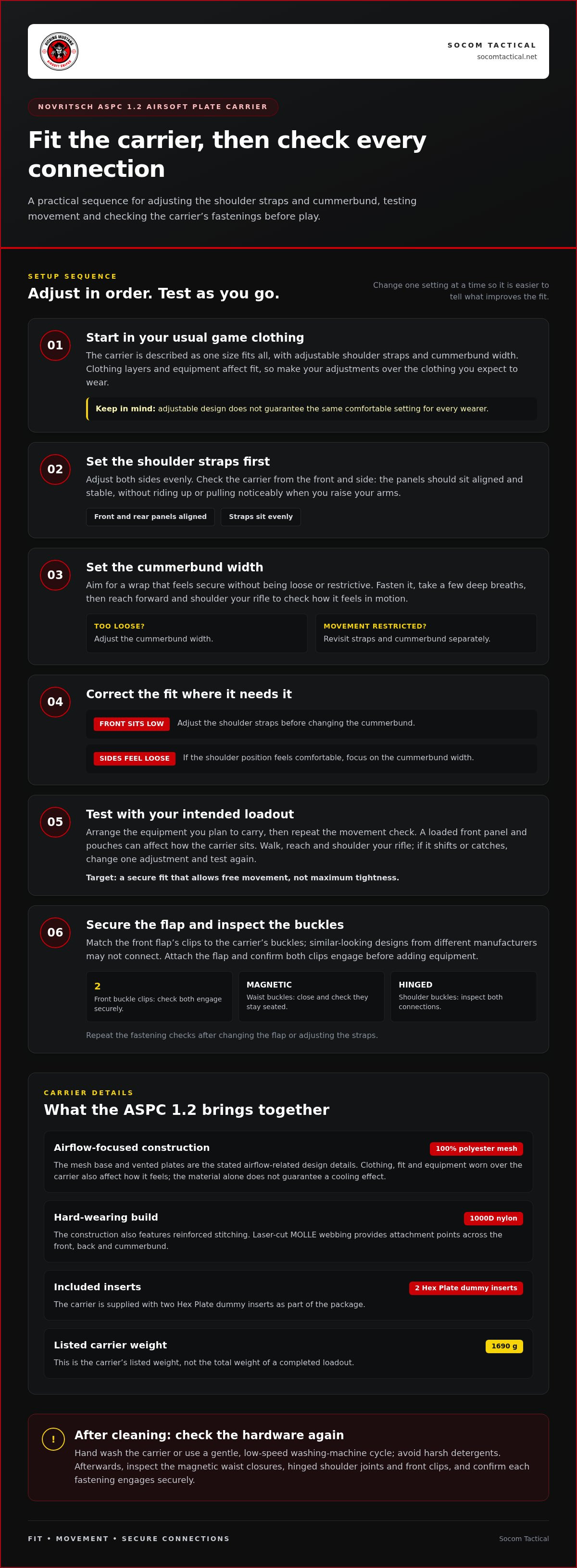
Check every fastening before use. Attach the front flap and confirm both clips engage. Close the magnetic waist buckles and make sure they stay seated, then inspect both hinged shoulder buckles. This catches loose connections before you add pouches or other equipment. Repeat the checks after changing the flap or adjusting the straps.
Care for the buckles as well as the fabric. Hand wash the carrier or use a gentle, low-speed washing-machine cycle, and avoid harsh detergents. After cleaning, inspect the magnetic waist closures, hinged shoulder joints and front clips. Confirm that each fastening engages securely and has not shifted during washing or handling.
Treat the carrier’s components as one system: two front clips, magnetic waist closures and hinged shoulder connections. Don’t assume a buckle-up flap from another brand will fit simply because it uses clips. Check the interface before loading the MOLLE panel, then confirm each buckle is secure before play. This keeps the quick-change design practical while ensuring the fastenings are checked.
Adjustable shoulder straps and cummerbund
The carrier is described as one size fits all and has adjustable shoulder straps and cummerbund width. Adjust these to fit your frame rather than relying on a fixed strap position. Try it over the clothing you expect to wear during a game. A T-shirt and a heavier layer change the fit, so make final adjustments in your usual kit.
Adjust the shoulder straps first. Their length affects how the carrier sits on your torso and whether the front and rear panels stay aligned as you move. Set both sides evenly, then check the carrier from the front and side. It should sit stably and evenly without riding up or pulling noticeably when you raise your arms.
Next, adjust the cummerbund so it wraps around your torso without feeling loose or restrictive. Fasten it, take a few deep breaths and try ordinary movements, such as reaching forward or shouldering your rifle. If the carrier shifts or limits movement, readjust the straps and cummerbund separately instead of tightening everything at once.
Make adjustments in small steps. If the front panel sits too low, adjust the shoulder straps before changing the cummerbund. If the sides feel loose but the shoulder position is comfortable, focus on the cummerbund width. Changing one setting at a time makes it easier to identify what improves the fit.
Test the fit with the equipment you plan to carry. A loaded front panel may sit differently from an empty one, and pouches can affect how the cummerbund rests against your sides. Recheck the straps and width after arranging your loadout. Aim for a secure fit that allows free movement, not maximum tightness.
One size fits all describes the carrier’s adjustable design, not a guarantee that every wearer will find the same setting comfortable. Torso length, clothing layers and equipment all affect the fit. Use the strap and cummerbund adjustments to balance the carrier on your frame, then repeat the movement check after changing your clothing or loadout.
Before a game, confirm that both shoulder straps sit evenly and the cummerbund stays in position. Walk, reach and shoulder your rifle, noting whether the carrier shifts or catches on your kit. If it does, change one adjustment at a time and test again. To coordinate your loadout, explore plate carriers and chest rigs.
Airflow-focused construction and vented plates
The carrier combines a 100% polyester mesh base with airflow-focused plate design. Look at both components together when assessing its construction.
Airflow-focused construction
The mesh base is the key airflow-related construction detail. Unlike a solid backing, mesh has openings throughout its structure. That describes the material, not a guaranteed cooling effect. Clothing, fit and the equipment worn over the carrier also affect how it feels during play.
The carrier’s vented plates are another part of its airflow-focused design. Check how the plates sit inside the carrier, then look at the exposed mesh around them. A close-fitting layer beneath the carrier may feel different from a lighter top. Assess the complete setup rather than judging the mesh alone.
Before use, inspect the front and rear. Note where the plate panels cover the mesh and where it remains exposed. This gives you a practical picture of the carrier’s construction without assuming that airflow is the same across every part of the torso.
Weight and breathability
The carrier weighs 1690 g. Treat that figure as the carrier’s listed weight, not the total weight of a completed loadout. Plates, pouches and carried equipment add to what you wear. If you’re comparing setups, weigh or assess them in the same configuration, with the same items fitted.
The 100% polyester mesh base is relevant to breathability, while the 1690 g figure helps set expectations for the carrier itself. Neither detail alone tells you how the full rig will feel during a game. Fit the carrier over your usual clothing, then add your intended equipment before assessing its balance and comfort.
Assess the configured carrier by moving as you would during play: reach forward, turn your torso and shoulder your rifle. Notice whether it shifts, presses against your clothing or restricts movement. This helps you judge the combined effect of fit, mesh and carried equipment instead of relying on the material description alone.
Keep the comparison consistent. An empty carrier and a loaded carrier are different setups, just as a mesh base beneath a light layer differs from one worn over heavier clothing. Assess the ASPC 1.2 in the configuration you plan to use, and consider its weight alongside the equipment you’ll carry. That gives a more useful view of the breathable construction in practice.
1000D nylon and reinforced stitching
The carrier combines 1000D Nylon with 100% polyester mesh, bringing two materials together in one construction. The nylon forms part of the carrier’s fabric specification, while the mesh provides a different structure. Reinforced stitching is another feature to assess. Together, these details help you understand what the carrier is made from and what to inspect during routine gear checks.
“1000D” identifies the nylon specification, but the label alone doesn’t describe every aspect of field performance. Look at the whole build: fabric panels, seams, attachment areas and how the carrier is assembled. For example, a robust fabric cannot compensate for a damaged seam. Construction is a combination of materials and the joins holding them together.
Reinforced stitching joins fabric sections and helps keep the carrier assembled. Inspect visible seams for loose threads, pulled sections or gaps between panels. Pay particular attention to areas that carry equipment or flex repeatedly. These are useful places to check, not a claim that reinforcement appears in any specific location.
Use a simple inspection routine before wearing the carrier. Lay it flat under good light and follow the visible seams with your eyes. Look for fraying, gaps or thread that has come away from the fabric. Then handle the joins gently. Stop using a section if damage affects the fit or secure attachment.
The 100% polyester mesh should also be considered alongside the 1000D nylon. These materials have different constructions, so examine their joins rather than treating the carrier as one uniform panel. For instance, where mesh meets fabric, check that the seam remains intact and the materials sit together cleanly. That visual check helps you spot wear before adding equipment.
After a game, remove attached equipment and inspect the carrier again. Check seams near loaded pouches, attachment points and panels that flex as you move. Compare them with the rest of the stitching. Loose thread or a small opening is easier to spot when you know what the undamaged seams look like.
Regular care helps you monitor the carrier’s condition. Hand wash it or use a gentle, low-speed cycle, avoiding harsh detergents. Once clean, let the fabric dry and inspect the stitching before refitting your equipment. Don’t pull on a suspect seam; a visual check is safer than stressing potentially damaged thread.
For a practical pre-game check, inspect the 1000D nylon panels, the polyester mesh joins and the reinforced stitching. Then attach your loadout and look again at seams near the equipment. This routine focuses on the actual construction, rather than assuming a material designation alone guarantees durability. Visible fabric and stitching condition are the useful details to monitor over time.
Included Hex Plate dummy inserts
The ASPC 1.2 package includes two Hex Plate dummy inserts. That matters when comparing what arrives with the carrier: the pair is part of the package, rather than an additional item to source separately. The key takeaway is straightforward. You receive two inserts for the carrier, but dummy inserts are not ballistic plates and shouldn’t be treated as protective armour.
Check both Hex Plate inserts against the carrier’s plate spaces. Place each insert as intended and make sure it sits securely without shifting during ordinary movement. Check the front and rear separately. A secure fit keeps the carrier in its intended configuration; a loose insert can move as you walk, turn or shoulder your rifle.
Try the carrier with the inserts fitted, then compare it with the empty setup. Notice how it sits when you stand, reach forward and rotate your torso. This lets you assess the inserted configuration without assuming anything about the inserts’ material or weight. Check the fit again after adjusting the carrier or changing clothing layers.
Hex Plate refers to the supplied dummy inserts, not to ballistic performance. Keep that distinction in mind when planning your loadout. If you use real ballistic plates, choose the proper size and fit them securely. Check that each plate sits correctly before wearing the carrier; don’t treat the dummy inserts as a guide to protection.
Compatibility matters too. The carrier fits Medium E-SAPI and SAPI plates, so use that specification when planning a plate setup. The plate must fit properly and sit securely. Don’t force an unsuitable plate into the carrier or assume the Hex Plate inserts establish compatibility with every plate type.
Before a game, inspect each supplied insert individually. Confirm both are present, seated and stable in the carrier. Move through a few normal actions, then check for shifting. Repeat the inspection after removing and refitting an insert, adjusting the carrier or replacing a dummy insert with a correctly sized real plate.
The included pair lets you set up the carrier with dummy inserts straight away and assess it in an inserted configuration. They remain distinct from real ballistic plates. To build out your wider loadout, explore plate carriers and chest rigs alongside this setup.
Socom Tactical Airsoft: AEG Airsoft Rifles
Socom Tactical Airsoft is a natural next step if you are pairing your carrier with an airsoft platform. Its AEG Airsoft Rifles can anchor a coordinated loadout, while Gas Blowback Pistols, Spring Sniper Rifles and Airsoft Shotguns suit different play styles. Consider how you use your carrier and the role you want your primary platform to fill before choosing.
For example, an AEG can suit a versatile setup, while a Spring Sniper Rifle supports a more deliberate role. Choosing a platform to match your preferred play style helps keep the rest of your kit purposeful.
Explore the airsoft guns range or contact Socom Tactical Airsoft to discuss your next step.
Build your next loadout with purpose
Your next step is to decide what role you want your kit to support. The Novritsch ASPC 1.2 Airsoft Plate Carrier can be one part of that setup, but your choice of primary platform will shape how you organise the rest of your equipment. Think about the style of play you enjoy, the gear you actually carry and the setup you can move comfortably in.
Socom Tactical offers AEG Airsoft Rifles, Gas Blowback Pistols and Spring Sniper Rifles, giving you different platform options to consider alongside your loadout. Decide on your role, then build around equipment that supports it. A purposeful setup is easier to use and refine than one assembled without a clear plan.
Explore the options or contact Socom Tactical Airsoft as you plan your next step. Get your kit working towards the way you want to play, and enjoy the next day on the field.
Frequently Asked Questions
What are the specifications and features of the Novritsch ASPC 1.2 Airsoft Plate Carrier?
The Novritsch ASPC 1.2 Airsoft Plate Carrier weighs 1690 g and combines 1000D Nylon with a 100% polyester mesh base. Its layout includes laser-cut MOLLE webbing across the front, back and cummerbund, plus a removable front flap. Magnetic waist buckles and hinge shoulder buckles support its fastening design. The package also includes two Hex Plate dummy inserts, giving you a defined starting configuration for setting up the carrier.
What sizes, colours and adjustment options are available for the ASPC 1.2?
The ASPC 1.2 is described as one size fits all and listed in Coyote Brown. You can adjust the shoulder straps and cummerbund width to suit your torso and clothing layers. Put it on over the clothes you’ll wear for a game, then alter the fit so the panels sit evenly. Reassess after adding your equipment, as a loaded setup can feel different from an empty carrier.
What pouches and accessories are compatible with the Novritsch ASPC 1.2?
Attach MOLLE pouches to the carrier’s laser-cut webbing across the front, back and cummerbund to arrange equipment around your loadout. The front flap uses two buckle clips, so a replacement buckle-up panel must match that connection. Buckle designs differ between manufacturers; don’t assume another brand’s flap will fit because it looks similar. Check the clip interface before setting up the panel.
Does the ASPC 1.2 include dummy plates, and what plate sizes does it accept?
Yes, the package includes two Hex Plate dummy inserts. The carrier is compatible with Medium E-SAPI and SAPI plates. Dummy inserts are not real ballistic plates or a substitute for protective armour. If you fit real plates, choose the stated compatible size and make sure each sits securely inside the carrier. A plate that shifts or does not fit properly is not ready to wear.
How do you adjust and maintain the Novritsch ASPC 1.2?
Put on the carrier and adjust the shoulder straps and cummerbund width, then move your arms and torso to assess the fit. Before use, check that the waist, shoulder and front-panel buckles are securely fastened. Hand wash the carrier or use a gentle, low-speed cycle without harsh detergents. After cleaning, inspect the fastenings and stitching before refitting pouches or wearing it again.
How much does the Novritsch ASPC 1.2 cost in the UK?
Prices for the Novritsch ASPC 1.2 Airsoft Plate Carrier typically retail around the £150 to £170 mark depending on the supplier and any bundled accessories. For the most up-to-date pricing, stock availability and purchasing options in the UK, it is best to check directly with authorised stockists such as Socom Tactical Airsoft.