Your tactical vest isn't just a piece of kit; it's a mobile workstation that determines whether you're a high-speed operator or a liability on the field. We've all been there, struggling with a mag pouch that won't stay put or dealing with the stifling heat of a bulky, poorly ventilated setup. It's frustrating when your gear hinders your movement or makes reaching for a fresh magazine feel like a chore during a fast-paced engagement. You want to look professional, but true operational readiness requires a balance of accessibility, weight distribution, and comfort.
We're here to help you master your loadout with our expert guide to choosing, organising, and maintaining the perfect tactical vests for any skirmish role. You'll learn how to navigate the technical nuances of MOLLE and PALS systems whilst ensuring your setup remains breathable for those long days at the site. This guide breaks down the essential differences between plate carriers and chest rigs; it provides a clear roadmap to building a rig that offers quick access to your radio, hydration, and ammo without the back pain.
Key Takeaways
- Learn how to choose between the high-profile aesthetics of a plate carrier and the lightweight breathability of a chest rig for humid UK summer skirmishes.
- Master the PALS grid to ensure your pouches are rock-solid, preventing gear from bouncing or failing during high-intensity movements.
- Discover how to tailor tactical vests to your specific role, whether you're clearing rooms in CQB or providing mid-range fire support as a rifleman.
- Ensure all-day comfort by perfecting your vest's fit and height, avoiding back pain whilst keeping your kit secure over seasonal clothing layers.
Understanding Tactical Vests: Why Load Carriage Matters in Airsoft
Think of your tactical vest as the nerve centre of your entire loadout. It isn't just about looking like an operator; it's about functional efficiency in the heat of a skirmish. Whilst cargo pockets might seem like an easy alternative for carrying gear, they're a nightmare when you're under fire. Magazines rattle, weight shifts awkwardly, and finding a fresh reload becomes a frantic fumble. High-quality tactical vests organise your essentials, ensuring that your secondary, comms, and magazines are exactly where you expect them to be. This reliability builds a psychological edge. When you know your gear is secure, your confidence in the field skyrockets, allowing you to focus on the objective rather than your falling kit.
In the varied terrain of UK sites, from dense woodland to tight urban centres, you have to balance protection against BB impacts with the need to move fast. A bulky vest might save you from a few stings, but if you can't shoulder your rifle or climb through a window, it's a hindrance. The goal is to find a platform within our clothing and gear selection that provides enough surface area for your pouches without sacrificing your ability to sprint to cover.
The Evolution of Tactical Load Carriage
Load carriage has come a long way from the heavy, fixed-pouch webbing used in the 90s. Modern airsoft gear mirrors the rapid advancements seen in real-world military units. We've moved toward the MOLLE system, which stands for Modular Lightweight Load-carrying Equipment. This shift allows for a "high-speed, low-drag" configuration where every pouch is placed with intent. Whether you're running a lightweight chest rig for a woodland flank or a full plate carrier for a CQB assault, the modularity ensures you aren't carrying a single gram of unnecessary weight.
Key Features of a High-Quality Tactical Vest
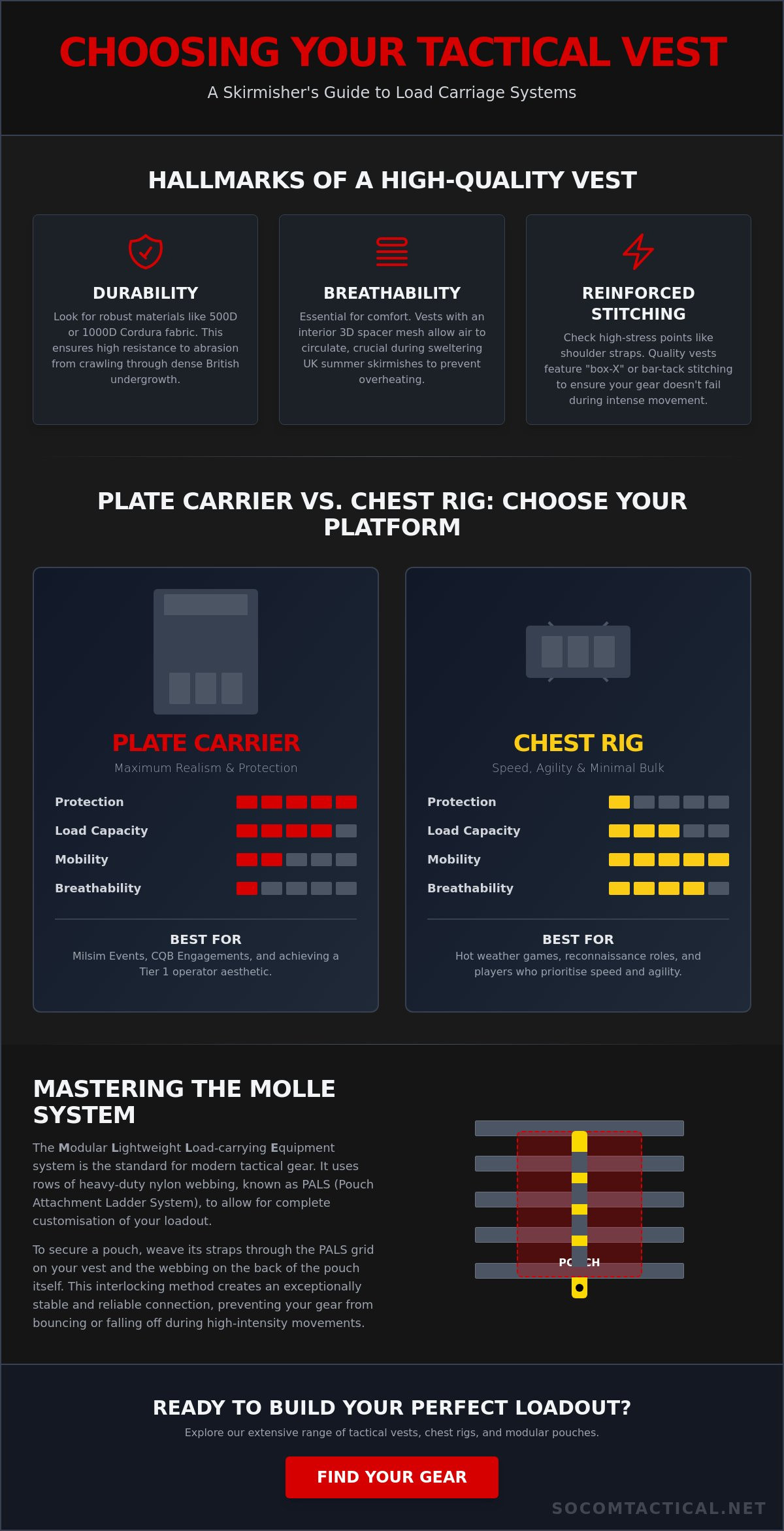
Durability starts with the fabric. You'll often see 500D or 1000D Cordura mentioned. 1000D is incredibly tough but heavy; many modern players prefer 500D because it offers plenty of abrasion resistance whilst keeping the overall weight down. Breathability is another deal-breaker. Look for tactical vests featuring 3D spacer mesh on the interior. This creates a gap between your body and the vest, allowing air to circulate during those sweltering August skirmishes. Finally, check the stitching. High-stress areas like shoulder straps and loops should feature "box-X" or bar-tack stitching. If the thread looks thin or loose, that vest won't survive a single season of crawling through the British undergrowth.
Plate Carriers vs. Chest Rigs: Choosing Your Skirmish Platform
Selecting your base platform is a pivotal decision that dictates your mobility, heat management, and how much kit you can effectively carry into a firefight. Modern tactical vests generally fall into two distinct camps: the high-profile plate carrier and the lightweight chest rig. Each has a specific "gucci" factor, but your choice should be driven by operational needs rather than just aesthetics. During a humid August game in the UK, the extra insulation of a plate carrier can lead to rapid overheating, whilst a chest rig might leave you feeling exposed during a high-intensity CQB engagement where you're trading plastic at close range.
Before diving into modular options, we have to address the "cross-draw" vest. These are common for beginners because they're affordable and come with pre-sewn pouches, but they're often limited. The fixed holster and mag pouches cannot be moved, which becomes a massive frustration once you decide to switch weapon platforms. If you're serious about the hobby, moving toward a modular system is always the better long-term investment for your loadout.
Plate Carriers: Maximum Realism and Protection
If you're aiming for a Tier 1 operator look or attending a dedicated Milsim event, a plate carrier is the standard. These rigs are designed to hold ballistic inserts; whilst we use foam or plastic replicas in airsoft to keep weight down, the designs themselves often mirror National Institute of Justice body armour standards to ensure proper coverage. The primary benefit is the sheer amount of real estate, providing front, back, and side panels to mount everything from multi-tool pouches to hydration bladders. You can find a huge variety of these in our clothing and gear section.
Chest Rigs: Speed, Agility, and Minimal Bulk
For players who value speed above all else, the chest rig is king. Snipers and recon players favour these because they lack a back panel, making them much more comfortable when lying prone or wearing a ghillie suit. They're also significantly easier to put on and take off between rounds. Because they don't trap as much body heat, they're the superior choice for long woodland games where you'll be trekking miles across the site. Many modern rigs can also be integrated directly with backpacks for extra supplies. Check out our new products to see the latest lightweight rigs hitting the UK scene.
Mastering the MOLLE System: Organising Your Tactical Loadout
MOLLE isn't just a buzzword; it's the backbone of modern load carriage. Standing for Modular Lightweight Load-carrying Equipment, it relies on the PALS grid (Pouch Attachment Ladder System) to give you total control over your setup. Many players make the mistake of simply sliding the straps through the webbing. To achieve a rock-solid attachment, you must weave the strap through both the vest and the pouch. If your pouches are sagging or bouncing whilst you sprint, you've done it wrong. Properly mounted gear shouldn't budge, even when fully loaded with heavy airsoft gun magazines.
The "Golden Rule" of pouch placement is simple: prioritise your primary reloads. These should be in your most accessible "high-ready" zone, typically the centre-front or your non-dominant side. Avoid the temptation of the "Christmas Tree" effect. Adding pouches to every available inch of your tactical vests might look impressive in a car park, but it's a liability in the field. Every unnecessary pouch adds bulk, increases snag risks in thick brush, and shifts your weight away from your body.
Weight Distribution and Ergonomics
An 8-hour skirmish is a marathon, not a sprint. If you load six mid-caps on your front without any counterweight, you'll feel it in your lower back by lunchtime. Centring heavy items is essential for preventing strain. A common veteran trick is to use a rear hydration pouch to offset the weight of your magazines. This creates a balanced system that moves with you rather than against you. The "Centre of Gravity" for tactical load carriage is the point where the weight of your kit is evenly distributed around your torso to ensure maximum stability during movement.
Essential Pouch Configurations
Choosing the right pouch type depends on your playstyle. Open-top pouches with plastic inserts offer the fastest reloads, whilst bungee retentions provide a middle ground of speed and security. For those who crawl through the mud, velcro flaps are the safest bet for keeping grit out of your mags. Don't forget your utilities. A small medic pouch is perfect for storing dead rags and multi-tools, whilst a dedicated radio pouch keeps your comms secure. Make sure to route your wires through the shoulder pads of your tactical vests to prevent them from snagging on branches or your rifle sling. You can find all these essential clothing and gear accessories in our shop to fine-tune your rig.
Tactical Vest Loadouts for Every Player Role
The way you configure your tactical vests should be a direct reflection of your specific role on the team. A rifleman requires a balanced setup that supports mid-range engagements; this usually means three or four magazine pouches mounted front-and-centre for rapid indexing. Support gunners, however, face a different challenge. Managing the bulk of heavy box mags and high-capacity LiPo batteries requires a robust plate carrier with reinforced stitching and padded shoulder straps to distribute that weight across the torso. Without proper weight management, a support role becomes a literal drag by the third hour of play.
Snipers need to embrace a "less is more" philosophy. When you're crawling through the British undergrowth at a woodland site, a bulky vest becomes an anchor that snags on every bramble. Many scouts and snipers ditch traditional tactical vests in favour of minimalist chest rigs that allow them to stay low to the ground. This low-profile approach ensures they remain undetected whilst keeping their essential mags and tools within easy reach.
Optimising for CQB (Close Quarters Battle)
In tight urban environments, door frames and narrow corridors are your biggest obstacles. You want a "slick" configuration that minimises your side profile. Avoid mounting thick pouches on your cummerbund that might catch as you "slice the pie" around a corner. Integrating a fast-draw pistol holster directly into your vest or a dedicated belt setup ensures your secondary is always within reach for those sudden transitions. To further sharpen your edge in the dark, consider pairing your slimline rig with our Airsoft Red Dot Sights for lightning-fast target acquisition.
Milsim and Long-Duration Skirmishing
When you're out for a 24-hour event, your vest becomes your life-support system. You aren't just carrying ammo; you're carrying water, snacks, and enough spare BBs to hold a ridge until dawn. Integrating a small rucksack or a "zip-on" back panel to your plate carrier allows you to carry these essentials without losing your combat effectiveness. For a deeper dive into building a rig that survives the weekend, refer to our UK Tactical Gear Guide for expert advice on kit integration. Ready to build your ultimate setup? Explore our full range of clothing and gear to find the perfect foundation for your role.
Buying and Maintaining Your Vest: Expert Tips for Longevity
Investing in high-quality tactical vests is only the first step. To ensure your kit survives years of punishment in the British elements, you must treat it as a piece of precision equipment. Maintenance starts with the perfect fit. A common mistake amongst newer players is wearing a plate carrier far too low. The top of the front plate should sit level with your suprasternal notch, which is the soft "V" where your collarbones meet. If the vest is hanging down near your stomach, it will bounce uncontrollably whilst you sprint and likely interfere with your ability to draw from a tactical belt.
Adjusting your rig for the season is equally vital. A setup that feels snug over a lightweight combat shirt in June will be far too tight when you've layered up for a freezing January morning. Take the time to re-tension your cummerbund and shoulder straps whenever your clothing changes. This prevents the vest from shifting and ensures your weight distribution remains centred, protecting you from unnecessary fatigue during a full day of skirmishing.
Sizing and Adjustability
To test your fit, use the "deep breath" and "toe touch" methods. You should be able to take a full, deep breath without the vest feeling like a corset; however, it should not move when you jump or twist. Next, bend over and touch your toes. If the vest plate hits your chin or pushes your belt down, the ride height is incorrect. Because body shapes vary wildly, we always suggest you visit our Fleet shop to try before you buy. This allows you to feel the difference between different brands and adjustment systems in person.
Care and Maintenance for Tactical Fabrics
UK airsoft sites are notorious for mud, and your gear will eventually bear the scars of a rainy woodland game. Never, under any circumstances, throw your vest in a washing machine. The heat and agitation can warp internal stiffeners and degrade the high-denier nylon. Instead, wait for the mud to dry and use a stiff brush to whisk it away. For sweat and stubborn BB hit marks, use a damp cloth with mild soap for spot cleaning. This approach maintains the colour of your camouflage and prevents the fabric from weakening. Always inspect your buckles and velcro for trapped grit before a big event. Finally, store your rig on a heavy-duty hanger in a cool, dry place. Leaving it compressed at the bottom of a kit bag for weeks will cause the foam to lose its shape and the fabric to perish prematurely.
Dominate the Field with a Professional Setup
Refining your loadout is the ultimate step in moving from a casual player to a dedicated operator. We've explored the structural differences between platforms and the technical necessity of a proper MOLLE weave to ensure your gear stays put. By applying these ergonomic principles and maintenance tips, you ensure your tactical vests remain a functional asset rather than a burden during high-stakes engagements. A well-organised rig does more than just hold your magazines; it streamlines your movements and keeps your focus exactly where it belongs: on the objective.
At Socom Tactical Airsoft, we're committed to getting you field-ready with gear that has been vetted by active participants in the community. Our team provides the technical expertise needed to help you select the right components for your specific role, ensuring every pouch and strap serves a purpose. With UK-based stock ready for immediate dispatch and competitive pricing on industry leaders like Viper and Tokyo Marui, we make it easy to upgrade your kit. Explore our full range of skirmish-ready tactical vests and rigs to find your next essential piece of kit. Take your game to the next level and lead the charge.
Frequently Asked Questions
Do I need a plate carrier or a chest rig for my first airsoft game?
A chest rig is generally the better choice for your first game because it offers a lighter, more breathable platform that is easier to adjust. Whilst plate carriers look impressive, they can be heavy and hot for a newcomer who isn't yet used to the physical demands of a full day on the field. You can always upgrade to more complex tactical vests once you've settled on a specific playstyle and know how much kit you actually need to carry.
What is the difference between MOLLE and PALS on tactical vests?
PALS refers to the physical grid of webbing stitched onto your gear, whilst MOLLE is the overall system of compatible pouches and equipment. People often use the terms interchangeably, but technically, you weave MOLLE straps through the PALS grid to secure your kit. This standardised spacing ensures that any modular pouch will fit onto any compatible vest regardless of the brand, allowing for total customisation of your loadout.
How should a tactical vest fit for maximum comfort?
Your vest should sit high on your chest, with the top edge of the front panel aligned with your collarbone. It needs to be snug enough to prevent shifting during movement but loose enough to allow for a full, deep breath without restriction. Use the side cummerbunds to pull the weight close to your torso; this keeps your centre of gravity stable and prevents the straps from digging into your shoulders during long skirmishes.
Can I wash my tactical vest in the washing machine?
You should never put your tactical gear in a washing machine because the heat and mechanical action can destroy the internal stiffeners and degrade the nylon's integrity. Instead, wait for mud to dry and use a stiff brush to whisk it away. For sweat or stubborn stains, use a damp cloth and a mild detergent to spot-clean the fabric, then air-dry the vest away from direct heat or sunlight to prevent the material from perishing.
Will a tactical vest protect me from BB hits?
Tactical vests provide excellent protection against BB hits by absorbing the impact energy before it reaches your skin. Whilst you'll still hear the "thud" and feel the pressure of the hit, the thick Cordura fabric and internal foam plates significantly reduce the sting and the likelihood of bruising. This is especially beneficial in CQB environments where engagement distances are short and shots are often more painful than in woodland games.
What pouches are essential for a beginner tactical vest loadout?
A basic loadout should focus on three primary magazine pouches, a small utility pouch for multi-tools or dead rags, and a dump pouch for empty magazines. These essentials provide enough capacity for most standard skirmish games without overloading you with unnecessary weight or bulk. As you gain more experience, you can add specialised pouches for radios or hydration bladders based on the specific requirements of your role and site.
Can I use real ballistic plates in an airsoft tactical vest?
You can technically use real ballistic plates in many airsoft-grade carriers, but they are entirely unnecessary and often counterproductive for the hobby. Real plates add between 2kg and 5kg of dead weight, which quickly leads to fatigue and back pain during an 8-hour game day. Most players prefer foam or plastic replica plates; these maintain the vest's shape and professional appearance without the physical toll of carrying real armour.
How do I stop my tactical vest from bouncing when I run?
To stop your vest from bouncing, you must weave the straps correctly through every row of the webbing grid rather than just sliding them through the top and bottom. This creates a rigid bond between the pouch and the vest. Additionally, ensure your shoulder straps and cummerbund are tightened so the vest moves as one with your body. If there is any gap between your chest and the vest, it will bounce and cause discomfort.