What if your favourite RIF owes its existence to a strict ban on firearms rather than a desire for a game? The history of airsoft is a masterclass in Japanese engineering born from necessity, starting when enthusiasts in the 1970s needed a way to collect and shoot realistic models without breaking the law. It's easy to get frustrated when people confuse your precision kit with a paintball marker or an airgun, but the reality is far more technical and steeped in heritage.
You've likely felt that sense of pride when your AEG performs flawlessly on the field, yet understanding the story behind your gear makes the experience even better. Discover the fascinating journey of airsoft from a legal loophole in 1970s Japan to a sophisticated global tactical sport. We're going to break down the 50-year evolution of the tech, explain why brands like Tokyo Marui remain legendary, and look at how UK laws like the VCRA actually helped professionalise our local scene. It's time to see how this hobby evolved into the high-speed, tactical discipline we live for today.
Key Takeaways
- Learn how strict post-war Japanese firearm laws forced enthusiasts to innovate, creating the very first realistic "soft-air" guns for collectors.
- Trace the history of airsoft technology from its humble beginnings to the high-tech AEG and gas blowback systems that dominate modern skirmishes.
- Understand the impact of the UK's Violent Crime Reduction Act 2006 and how it shaped the legal landscape for RIFs and two-tone equipment.
- Discover the engineering milestones that led to modern field-ready gear, including the introduction of MOSFETs and programmable triggers.
- Recognise the vital role of Japanese engineering and Hong Kong manufacturing in making the sport accessible to a global community.
The Birth of Airsoft: Necessity in 1970s Japan
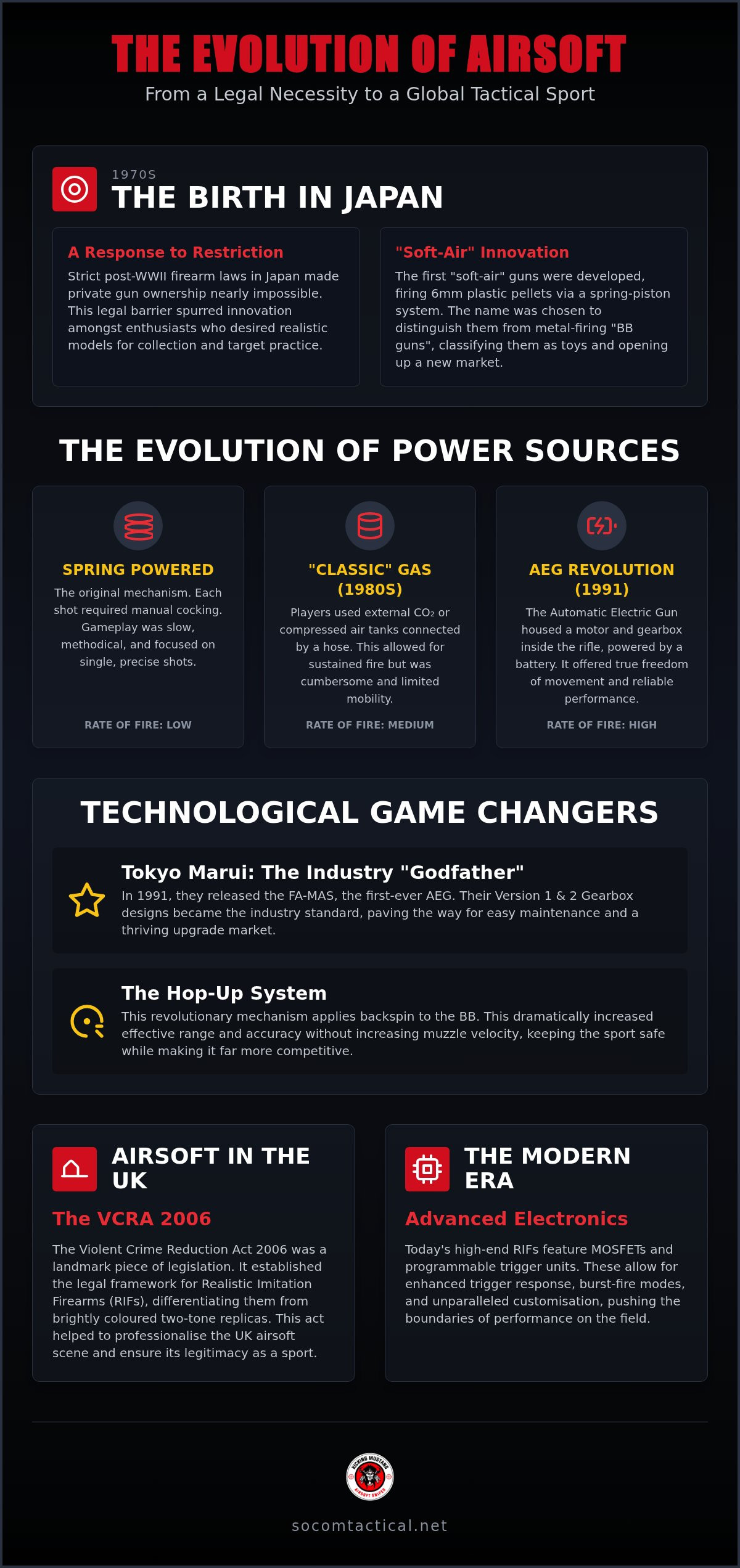
Post-WWII Japan was a difficult place for firearm enthusiasts. With some of the world's strictest gun control laws in place, private ownership of real firearms was effectively impossible for the average citizen. This legal blockade didn't kill the interest in tactical equipment; it just forced it underground and into the hands of innovators. The History of Airsoft begins in this era of restriction, where the desire for realism met the necessity of a legal loophole. These early creators developed "soft-air" guns, designed to fire plastic pellets at velocities that were safe for human contact whilst retaining the 1:1 scale and weight of their real-steel counterparts.
Ichiro Takeya is widely recognised as the visionary who bridged the gap between static displays and functional replicas. Before his influence, most toy guns were either crude plastic shapes or dangerous metal-firing air rifles. Takeya and his contemporaries realised that by using a spring-loaded piston to compress air, they could propel a lightweight 6mm plastic ball with enough accuracy for target practice without the lethality of a traditional weapon. The term "airsoft" was a deliberate marketing choice to distance these items from "BB guns" which were often associated with metal projectiles and higher risks. It was a masterstroke that allowed these replicas to be classified as toys, paving the way for a new recreational category.
The Cultural Context of Realistic Replicas
By the 1960s, Japan already had a thriving subculture obsessed with "Model Guns". These were incredibly detailed, non-firing replicas made from zinc or heavy-weight plastic. They were designed for collectors who valued aesthetics and mechanical accuracy, such as working slides and triggers, but they couldn't actually shoot anything. As the community grew, collectors weren't satisfied with just looking at their gear on a shelf. They wanted operational readiness. This cultural shift saw the first "skirmishes" where enthusiasts used modified model guns to act out tactical scenarios, eventually leading to the demand for functional, projectile-firing tools.
Early Spring-Powered Pioneers
The first generation of functional airsoft gear relied on simple spring-powered mechanics. These were the ancestors of the airsoft guns we use today, but they were far more basic. You had to manually cock the spring for every single shot, meaning fire rates were incredibly low. To maintain the "cool factor", many early pistols featured shell-ejecting mechanisms where a plastic casing would fly out of the port after every shot. Whilst this looked fantastic, it was a nightmare for field use as players had to find and collect their spent shells. These limitations meant early games were slow and methodical, focusing more on the "roleplay" of a tactical engagement than the high-speed exchanges we see at modern sites.
The Evolution of Power: From Classics to the AEG Revolution
The 1980s ushered in the "Classic" era, a period defined by technical experimentation and the first real attempts at sustained fire. Before the convenience of modern batteries, players relied on external CO2 or compressed air tanks connected to their RIFs via high-pressure hoses. These "Classic" rigs were the spiritual ancestors of today's HPA systems, providing impressive power but at the cost of mobility. Lugging a heavy tank on your back wasn't exactly ideal for high-stakes engagements. This era also saw the genius of Tanio Koba, whose work on gas blowback (GBB) mechanisms finally introduced realistic recoil, bridging the gap between a toy and a tactical tool. Understanding this period is vital to appreciating the history of airsoft and how far the equipment has come.
The most significant milestone in the history of airsoft occurred in 1991. This was the year Tokyo Marui changed the landscape forever with the release of the FA-MAS. By housing a motor and a mechanical gearbox within the rifle, they eliminated the need for external tanks and hoses. This self-contained system allowed for a level of operational readiness that hadn't been seen before. Shortly after, the introduction of the "Hop-Up" system revolutionised ballistics. By using a rubber bucking to apply backspin to the BB, players could achieve double the effective range without increasing the muzzle energy, keeping the sport safe whilst making it far more competitive.
The Rise of Tokyo Marui
Tokyo Marui is often called the "Godfather" of the industry, and for good reason. Their engineering team developed the Version 1 and Version 2 Gearbox designs which remain the industry standard today. These gearboxes provided a reliable framework for internal components, allowing for easy maintenance and upgrades. Their commitment to precision over raw FPS (feet per second) set a benchmark for quality that remains unchallenged. You can still see this heritage today when exploring a Tokyo Marui collection, where every piece of kit is built with that original Japanese attention to detail.
The Technical Leap to Automatic Electric Guns (AEGs)
The shift to AEGs transformed how games were played. With the motor, battery, and gears all contained within the shell, skirmishes became faster, more dynamic, and lasted much longer. This reliability made the sport accessible to a wider audience, though it eventually necessitated clearer regulations. In the UK, this journey led to the Violent Crime Reduction Act 2006, which professionalised the community. Modern AEG Airsoft Rifles are the pinnacle of this 30-year evolution. If you need help choosing a platform that matches this legendary performance, our expert team is always ready to talk tech and tactics.
Airsoft Goes Global: The 1980s and 90s Expansion
As the 1980s progressed, the sport began its inevitable march across international borders. Hong Kong emerged as a critical secondary hub for production, offering a gateway for these replicas to reach the Western market. This shift in manufacturing was a turning point in the history of airsoft, as it significantly reduced entry costs and allowed for a surge in "grey market" imports that bypassed traditional toy distribution channels. In the UK, the early 1990s were defined by a grassroots movement. Enthusiasts transitioned from informal backyard skirmishes to the first dedicated commercial sites, often repurposing old paintball woods or disused industrial units to create immersive environments.
Action cinema of the 1980s played a massive role in shaping the aesthetic of the sport. Players weren't just looking for a projectile launcher; they wanted the iconic loadouts seen in Hollywood blockbusters. This desire for authenticity is where airsoft began to outpace paintball. Whilst paintball focused on speed and sport-specific equipment, airsoft leaned into tactical depth and 1:1 realism. This evolution allowed players to feel like they were part of the action, a sentiment echoed in many records of the History of Airsoft Origins. It wasn't long before the hobby moved from a niche interest to a globally recognised tactical discipline.
From Toy to Tactical Training
The incredible realism of these RIFs didn't just attract hobbyists. By the late 90s, police and military units began adopting airsoft for Force-on-Force training. It offered a cost-effective, safe way to practice room clearances and tactical manoeuvres without the risks of live ammunition or the mess of paint. This professional interest birthed the MilSim (Military Simulation) sub-genre, where games could last 24 to 48 hours and required high levels of endurance. This shift necessitated a move towards professional-grade tactical gear, including plate carriers and load-bearing vests that could withstand the rigours of extended field use.
The Emergence of the Aftermarket
As the community grew, so did the demand for better performance. The history of airsoft is as much about the internal components as the external shells. Players began to realise that standard factory performance could be surpassed through precision engineering. This led to the first wave of widespread internal customisation, with enthusiasts installing precision inner barrels and high-torque motors to gain a competitive edge on the field. Today, this culture of technical excellence remains a cornerstone of the hobby. If you're looking to push your own RIF beyond stock limits, our selection of parts and upgrades reflects decades of this mechanical evolution.
Airsoft in the UK: A History of Law and Community
The pre-2006 era in the United Kingdom was something of a "wild west" for enthusiasts. High-end replicas from Japan and Hong Kong were flooding into the country with almost zero oversight. Whilst this was fantastic for collectors, it created a massive legal headache for the government. The most pivotal moment in the history of airsoft on British soil arrived with the Violent Crime Reduction Act (VCRA) 2006. Initially, this legislation threatened to wipe out the hobby entirely by proposing a total ban on the sale and import of Realistic Imitation Firearms (RIFs). It was a moment of genuine crisis that could have ended the UK scene before it truly found its feet.
The community didn't just roll over. Retailers and site owners organised quickly to form the UK Airsoft Retailers Association (UKARA). They successfully argued that active skirmishers needed realistic gear for their hobby, leading to the creation of a specific legal defence. This allowed players to continue purchasing RIFs provided they could prove they were regular participants at insured sites. For those just starting out or without a valid defence, the "Two-Tone" compromise was introduced. This required at least 51% of the gun to be painted a bright, non-military colour, ensuring the sport remained accessible whilst staying within the law.
Understanding the VCRA and UKARA Today
In the modern era, a "skirmisher defence" is the gold standard for any serious player. To get on the UKARA database, you've got to play at least three times at a registered site over a period of no less than 56 days. Retailers play a vital role in this ecosystem, acting as guardians who verify these details before any RIF leaves the shop. It's a system built on trust and shared responsibility amongst the community. If you're confused about the specifics of the law or how to start your registration, our FAQ page breaks down everything you need to know to stay legal and field-ready.
The Evolution of UK Airsoft Sites
The history of airsoft in the UK is also written in the dirt of our game sites. We've moved from basic woodland plots to incredible "urban" environments. Players now skirmish in abandoned shopping centres, Cold War bunkers, and decommissioned military bases. This growth forced the industry to standardise safety, with UK power limits (1.3 joules for automatics and 2.5 joules for single-shot rifles) becoming a benchmark for fair play. The retail scene has been the backbone of this expansion, providing the technical support that keeps these sites running. If you're ready to join the community and need the right kit to get started, check out our full range of airsoft guns today.
Modern Airsoft and the Road Ahead
The history of airsoft has transitioned into a high-tech digital age. We're now seeing the standardisation of MOSFETs and Electronic Trigger Units (ETUs) which provide features like burst fire, pre-cocking, and active braking. These aren't just luxuries; they're essential for maintaining a competitive edge on the field. Brushless motors are also becoming more common, offering incredible efficiency and reduced heat compared to traditional brushed versions. These internal advancements mean that modern RIFs are more responsive and reliable than anything the pioneers of the 1970s could have imagined.
Whilst the electric market is booming, the Gas Blowback Rifle (GBBR) renaissance is in full swing for those who value tactile feedback and mechanical realism. Since Socom Tactical Airsoft was established in 2009, we've seen these gas systems evolve from temperamental novelties into reliable, year-round platforms. The rise of HPA (High Pressure Air) has also introduced "Speedsoft", a fast-paced, tournament-style discipline that challenges traditional MilSim dominance. This diversification proves that the history of airsoft is still being written in real-time, adapting to different playstyles and technical demands.
The Next Generation of Gear
Power management has been transformed by LiPo batteries and smart chargers, providing the operational readiness needed for long skirmish days without the bulk of older NiMh cells. We're also seeing a shift towards high-end peripherals; many players now invest in Vortex Optics for their lifetime warranty and parallax-free performance. Even customisation has changed, with 3D printing allowing for bespoke internal components and external furniture that push a RIF's performance and aesthetics to their absolute limits.
Joining the History: Your First Skirmish
Stepping into the hobby now means benefiting from five decades of engineering and community growth. It's more accessible than ever, but starting with the right gear is crucial for a positive experience. Buying from specialists who live and breathe the sport ensures your kit is field-ready from day one. If you're ready to start your own journey and become part of this evolving story, visit the Socom Tactical Airsoft shop to get equipped and join the local scene.
Gear Up for the Next Chapter of Skirmishing
From the strict legal constraints of 1970s Japan to the sophisticated digital systems of today, the history of airsoft is a journey of persistence and technical brilliance. We've traced the path from manual springers and external gas lines to the reliable, high-performance AEGs that dominate modern British sites. Understanding this evolution helps you appreciate the precision engineering inside your RIF and the importance of the legal framework that keeps our sport thriving.
Socom Tactical Airsoft has been deeply rooted in this community since 2009, acting as a modern guardian of these traditions through our expert technical department. Whether you need a legendary Tokyo Marui build or professional two-tone services to stay compliant with the VCRA, we provide the field-ready solutions you need. Our team of specialists is dedicated to ensuring your equipment reflects the high standards set by decades of innovation. Explore our range of historically inspired and modern Airsoft Guns and start your own story within this global community. We'll see you on the field.
Frequently Asked Questions
Who invented airsoft and when did it start?
Ichiro Takeya is the pioneer credited with developing the first functional replicas in the early 1970s. These early models were designed to satisfy the cravings of collectors who wanted more than just static display pieces. By using spring-powered mechanisms to fire 6mm plastic pellets, Takeya effectively birthed a new recreational category. This period marks the true beginning of the history of airsoft, moving the hobby away from dangerous metal projectiles towards safe, tactical play.
Why was airsoft originally created in Japan?
Airsoft was created in Japan as a direct response to the nation's incredibly strict post-WWII firearm laws. Private ownership of real guns was virtually banned, leaving enthusiasts with no legal way to enjoy shooting sports. Engineers developed these "soft-air" guns as a clever legal loophole, allowing citizens to own 1:1 scale replicas that were functional yet non-lethal. This necessity for realism within legal boundaries shaped the high-quality engineering standards the community still expects today.
What was the first AEG ever made?
The Tokyo Marui FA-MAS, released in 1991, was the world's first Automatic Electric Gun (AEG). It utilised a revolutionary Version 1 Gearbox that housed a motor and gears, powered by an internal battery. This invention eliminated the need for the cumbersome external gas tanks and hoses that defined the "Classic" era. It was a massive technical leap that allowed for sustained, reliable semi and fully automatic fire, completely transforming how skirmishes were played on the field.
How did the VCRA 2006 change airsoft in the UK?
The Violent Crime Reduction Act (VCRA) 2006 introduced strict regulations on the sale, import, and manufacture of Realistic Imitation Firearms (RIFs). It required buyers to have a valid legal defence, such as being a regular skirmisher at an insured site. This led to the birth of UKARA as a database for retailers to verify these defences. It also established the "two-tone" rule, where guns must be 51% a bright colour if the buyer lacks a valid defence.
What is the difference between "Classic" airsoft and modern AEGs?
The primary difference lies in the power source and portability. "Classic" airsoft guns from the 1980s relied on external CO2 or compressed air tanks connected by a hose, similar to modern HPA rigs but far less refined. Modern AEGs are entirely self-contained units. They use an internal motor, a series of gears, and a rechargeable battery to compress air. This shift made the equipment more reliable, easier to transport, and far more practical for high-stakes tactical engagements.
Is airsoft older than paintball?
Yes, airsoft predates paintball by roughly a decade. The history of airsoft began in the early 1970s in Japan, driven by a cultural demand for realistic replicas under strict gun laws. In contrast, the first recorded game of paintball didn't take place until June 1981 in New Hampshire, USA. Whilst both sports evolved into global tactical disciplines, airsoft has always maintained a deeper focus on 1:1 mechanical realism and authentic military aesthetics compared to paintball's sport-centric origins.
Why is Tokyo Marui so important to airsoft history?
Tokyo Marui is the industry's "Godfather" because they established the mechanical blueprints still used today. Beyond inventing the AEG in 1991, they developed the Hop-Up system which revolutionised range and accuracy. Their gearbox designs, specifically Versions 2 and 3, became the universal standard for internal compatibility. Every modern manufacturer owes a debt to their precision engineering, which shifted the hobby from a niche interest into a sophisticated global sport with reliable, field-ready equipment.
How has airsoft technology changed in the last 10 years?
The last decade has seen a massive digital transformation within the industry. We've moved from basic NiMh batteries to high-discharge LiPos and integrated smart electronics like MOSFETs and Electronic Trigger Units (ETUs). These components allow for programmable fire modes, active braking, and faster trigger response times. Additionally, the rise of brushless motors and refined HPA systems has pushed performance limits, providing the grit and precision that experienced practitioners expect from their modern tactical tools.