What if that laser-etched engraving on your receiver is the only thing standing between a successful mission at a European milsim and having your prized AEG seized at the border? For many, an airsoft mark is simply a detail that adds to the immersion of a high-end replica, but the reality is far more operational. You've likely felt the annoyance of a "blank" receiver on a budget build or the genuine stress of wondering if your kit meets strict international legal standards.
We know you want gear that looks authentic and performs under pressure without causing a headache at customs. This guide will show you exactly what every airsoft mark means, from licensed manufacturer trades to the mandatory F-mark requirements for playing abroad. We'll break down the distinction between aesthetic licensing and official proof marks, ensuring you remain legal in the UK whilst maintaining the tactical realism your loadout deserves. We are going to help you organise your technical knowledge so you can focus on the game, not the paperwork.
Key Takeaways
- Learn to distinguish between purely aesthetic manufacturer trades and functional designations to ensure your replica is field-ready and authentic.
- Master military nomenclature by understanding how "MK" designations like the MK18 define the specific version and build of your AEG or gas blowback pistol.
- Understand the legal requirements of the VCRA, including when a two-tone finish is mandatory and how to maintain a RIF whilst staying within UK law.
- Discover exactly what every airsoft mark means on the continent, including the mandatory F-in-a-pentagon required for legal play in Germany.
- Identify professional methods for applying custom laser engravings to your receiver without compromising the integrity of your existing markings during maintenance.
What is an Airsoft Mark? Defining Realism and Legality
In the world of high-end replicas, an airsoft mark is the definitive signature of quality. It encompasses every stamped, laser-etched, or moulded identifier found on the receiver, slide, or frame of your kit. While a newcomer might see these as mere decoration, a seasoned player understands that these markings are a complex language. They represent a blend of historical accuracy, technical specifications, and, most critically, legal compliance. Whether it's a serial number on a gas blowback pistol or a manufacturer's crest on a precision rifle, these details bridge the gap between a toy and a professional tool.
The Three Categories of Airsoft Markings
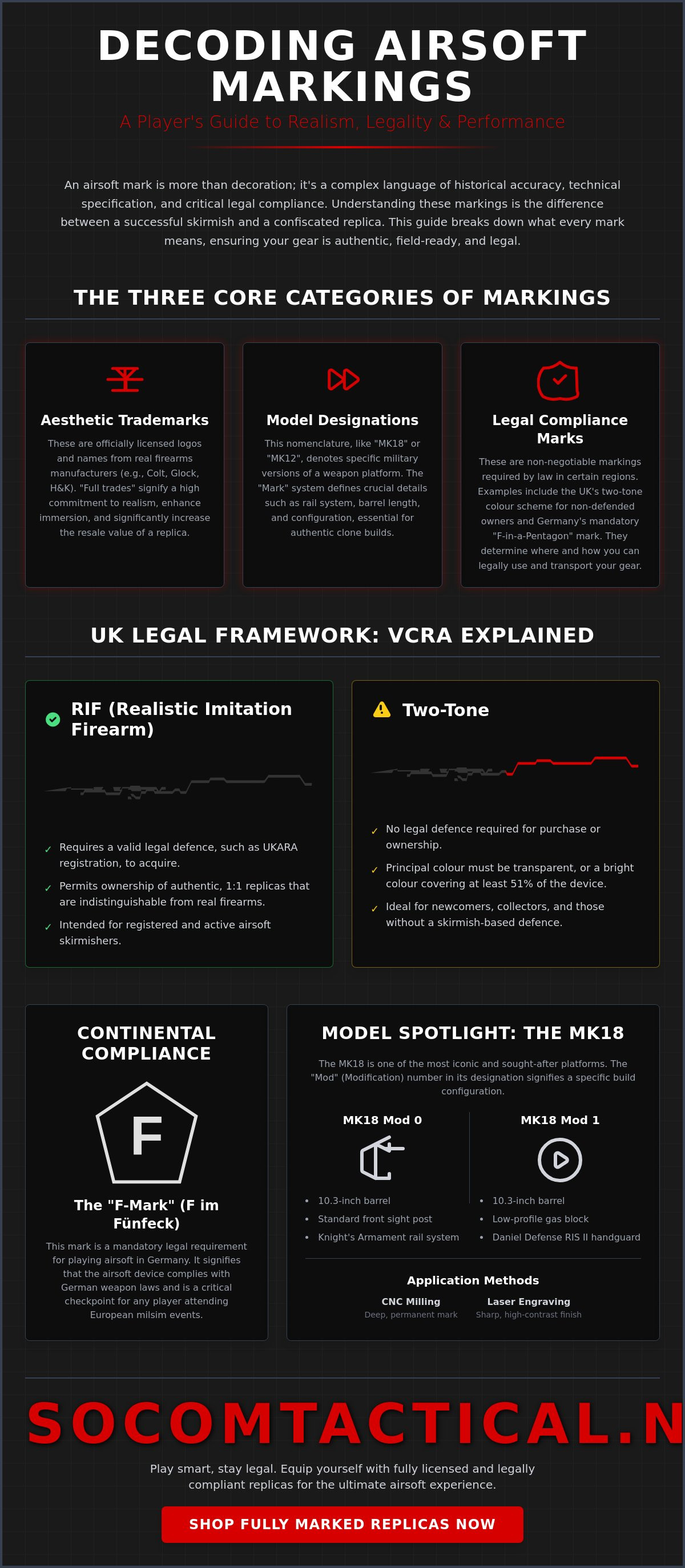
We generally categorise these identifiers into three distinct groups. First, you have Aesthetic Trademarks. These are licensed logos from real-steel giants like Colt, Glock, or Heckler & Koch. When you pick up a high-performance replica, those trades aren't just for show; they signify a commitment to realism. Second are Model Designations. This is where you'll find the "Mark" nomenclature, such as the MK18 or MK12, which denotes specific military iterations of a weapon platform. Finally, there are Legal Compliance Marks. These include the German F-mark, UKARA status indicators, and the bright coatings required for two-tone replicas. Understanding Legal Issues in Airsoft is vital, as these marks often determine where and how you can legally transport your gear across international borders.
Why Realism Enthusiasts Prioritise "Full Trades"
For the milsim veteran, "full trades" are a non-negotiable requirement for an immersive experience. There's a psychological shift that happens when you're looking down the sights of a rifle that mirrors the real-world counterpart in every detail. Authentic markings don't just look better in photos; they significantly increase the resale value of high-end AEGs and GBBPs amongst the community. There's a world of difference between "licensed" trades, which carry the official blessing of the manufacturer, and "accurate but unlicensed" markings. The latter might look the part, but they lack the pedigree of an official partnership. In the UK, whilst we don't have a mandatory airsoft mark for domestic proofing like some European neighbours, the presence of specific identifiers helps establish the provenance of a Realistic Imitation Firearm (RIF) under the Violent Crime Reduction Act (VCRA). This legal framework ensures that players with a valid defence can own kit that looks identical to the real thing, while those without must settle for the two-tone mark.
Model Marks: Understanding the "MK" Designation in Airsoft
When you hear a veteran player mention a "Mark 18" or "MK12," they aren't just using random numbers. In military nomenclature, "MK" is shorthand for "Mark," a system used to categorise specific versions or iterations of hardware. This versioning system is vital for collectors and clone builders because it dictates every detail of the build. A single digit change in an airsoft mark can mean the difference between a standard infantry rifle and a specialised SOF platform. These designations tell you exactly which rail system, barrel length, and internal configuration you need to achieve a field-ready, authentic loadout.
High-end manufacturers apply these identifiers using two primary technical methods: CNC milling and laser engraving. CNC milling is the gold standard for a premium airsoft mark; it involves physically carving the designation deep into the aluminium receiver. This creates a tactile, permanent finish that won't wear down even after a full season of heavy skirmishing. Laser engraving, whilst more common on mid-range kit, offers a sharp, high-contrast look that is ideal for smaller components like outer barrels or buffer tubes. Regardless of the method, these marks must exist alongside compliance with the UK Policing and Crime Act 2017, which sets the strict muzzle energy limits for all replicas in the UK.
The MK18: The Most Iconic Mark in Airsoft
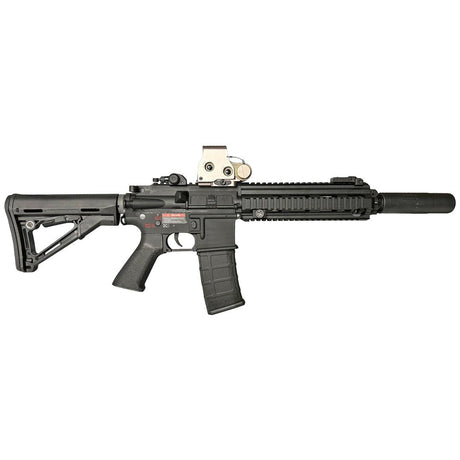
The MK18 is arguably the most sought-after designation in the community. Identifying a true MK18 requires looking closely at the receiver marks and the specific rail system. The MK18 Mod 0 typically features a standard front sight post and a 10.3-inch barrel, whilst the Mod 1 is defined by its Daniel Defense RIS II handguard. These subtle shifts in the "Mark" designation change your entire gear requirement, from the type of optical sights you mount to the internal motor torque needed for a short-barrelled build. If you're looking to start a new project, our latest AEG Airsoft Rifles include several MK18 variants ready for the field.
The MK23 and MK1: Silent Assassins
In the world of sidearms, the MK23 mark represents a legendary status. Known as the "SOCOM" pistol, its designation signifies a platform designed for extreme durability and suppressed performance. Because it's a non-blowback (NBB) system, every bit of gas is utilised for the shot, making it incredibly quiet. Similarly, the MK1 pistol remains a favourite amongst snipers. Its simple, rugged design makes it a reliable backup when your primary reaches its minimum engagement distance. Both platforms require specific maintenance, such as keeping the seals lubricated with high-quality silicone, to ensure the internal components match the reputation of their external markings. If you want to keep your sidearm in top condition, consider browsing our gun maintenance tools to ensure your kit stays operational.
UK Legal Marks: Two-Tone vs. Realistic Imitation Firearms (RIF)
The Violent Crime Reduction Act (VCRA) 2006 redefined the UK airsoft landscape. It created a legal divide based on the visual appearance of your equipment. For those starting their journey, the most prominent airsoft mark is the bright, non-military finish known as "two-tone". This isn't a design choice; it's a strict legal necessity. Without a valid defence, such as being a registered skirmisher, you cannot purchase a Realistic Imitation Firearm (RIF). Instead, your replica must be clearly marked to ensure it cannot be mistaken for a live-fire weapon in a public space.
These UK-specific regulations are quite distinct from other European territories. For example, the requirements found in the German Weapons Act (Waffengesetz) focus on technical proof marks rather than external colour. In the UK, the law prioritises immediate visual identification to protect both the public and the players themselves.
What Makes a Mark "Two-Tone" Legal?
To meet the legal threshold, at least 51% of the replica must bear a high-visibility colour. Acceptable identifiers include bright blue, green, red, or orange. This visual airsoft mark must be permanent and covers the principal parts of the receiver, slide, or frame. We provide a professional Two-Tone Painting Service to help new players stay compliant whilst they build their game history. You must never attempt to "mark over" or spray-paint a two-tone gun to look realistic until you have a verified legal defence. Doing so is a criminal offence under the VCRA, as it constitutes "manufacturing" a RIF without authorisation.
Transitioning to RIF Status
Once you've established yourself within the community, your UKARA number becomes your "legal mark" for all future acquisitions. This isn't a physical stamp on the gun but a digital identifier in a national database that proves you are a regular player at an insured site. To organise this defence, you need to play at least three games at the same site over a period of no less than two months. This transition is a milestone for any player. It allows you to move away from bright colours and invest in replicas with authentic military finishes. Maintaining this status requires consistent participation. Keep your site membership active and your skirmish frequency high to ensure your purchase history remains valid and your defence stays current.
The F-Mark: Essential Guidance for Playing Airsoft in Germany
If you're planning to join a major European milsim, the most critical airsoft mark you need to understand is the "F im Fünfeck"—the F-in-a-pentagon. In Germany, this isn't just a badge of quality; it's a mandatory legal requirement for any replica with a muzzle energy exceeding 0.5 Joules. For UK players, this presents a significant operational hurdle. Most standard AEGs sold in the UK are capable of fully automatic fire, which makes them illegal under German law if they exceed that 0.5 Joule limit. To be field-ready in Germany, your RIF must be locked to semi-automatic only and bear the official F-mark alongside the authorised importer's identifier.
This regulation applies to all high-end kit, including premium Tokyo Marui replicas. Whilst these Japanese-made platforms are world-renowned for their precision, a standard out-of-the-box model rarely carries the German proof mark unless it was specifically processed by a German-based distributor. Before you book your ferry, you must verify that your equipment meets these technical standards. Taking an unmarked, full-auto AEG across the border is a gamble that could result in heavy fines or the permanent destruction of your gear by customs officials.
Technical Requirements for the F-Mark
The "Semi-Auto Only" rule is the most common point of failure for international players. If your replica produces more than 0.5 Joules, the internal firing mechanism must be physically or electronically restricted. For many modern AEGs, this involves a MOSFET adjustment or a specific selector plate modification to ensure the trigger cannot engage the motor for multiple cycles. Additionally, whilst the German legal threshold for airsoft muzzle energy is 7.5 Joules, most event organisers will expect you to stay within standard skirmish limits. The F-mark must be accompanied by the mark of the importer who took legal responsibility for the replica's compliance, creating a dual-identifier system that proves the gun's legality.
Travelling with Your Marked Gear
Logistics for international events require discipline. German law dictates that all airsoft guns must be transported in a locked container, with the BBs and gas or batteries stored in a separate compartment. This ensures the equipment is not "ready for immediate use" during transit. You should never attempt to "fake" an airsoft mark by engraving a pentagon onto your receiver yourself. Official marks are recorded and tied to specific importers; a fraudulent mark is a serious criminal offence that will be spotted by any experienced inspector. UK teams attending events like Dark Emergency or Border War should always carry their UKARA documentation and a copy of the event invitation to clarify their status as sports participants. If you're unsure if your current setup meets these rigorous standards, check our FAQ page for expert advice on preparing your kit for international deployment.
Custom Markings and Maintenance: Personalising Your RIF
Personalising your kit is where the hobby truly becomes an obsession. Adding a custom airsoft mark to your receiver or slide is the final step in turning a factory-fresh replica into a unique piece of field-ready equipment. Most players choose between laser engraving and CNC milling to achieve this. Laser engraving is fast and precise; it offers a crisp, high-contrast finish that sits on the surface of the metal. In contrast, CNC milling is a more aggressive process that carves the mark deep into the material. This mirrors the heavy-duty production methods of real-steel manufacturers and ensures the identifier remains visible even after years of hard use in the mud and rain.
Every airsoft mark on your RIF represents an investment in your loadout's identity. Whether you're adding a unit insignia or a personalised serial number, the quality of the application matters. Shallow engravings can easily be obscured by thick paint or Cerakote finishes, whilst deep-milled marks maintain their definition. If you're planning a complete overhaul, our team at Socom Tactical Airsoft is the primary centre for parts and upgrades, providing the technical expertise needed to ensure your external customisation doesn't interfere with your internal performance.
Preserving Your RIF’s Aesthetic Value
Once you've secured a replica with authentic trades or custom engravings, you must protect that finish. Harsh chemicals are the enemy of etched markings. Avoid using aggressive solvents or acetone-based cleaners on your receiver, as these can strip the fill from engraved marks or dull the contrast of laser work. Instead, stick to high-quality Consumables designed for the hobby. When cleaning your inner barrel, we recommend using ethyl alcohol rather than silicone oil to prevent residue build-up that can attract dirt. A light wipe-down with a lint-free cloth will keep your factory-applied proof marks looking sharp whilst preventing the corrosion that can plague metal components after a wet weekend at a woodland site.
Final Checklist Before You Skirmish
Before you deploy to your next event, run through this final operational check to ensure your gear is both legal and functional. A missing identifier or an incompatible component can end your day before the first whistle blows.
- Verify Legal Status: Ensure your UKARA defence is current or that your two-tone finish meets the 51% visibility requirement.
- Magazine Compatibility: Check that your "Mark" specific magazines are correct for your platform; for example, ensure your MK17 (SCAR-H) mags aren't mixed up with standard 5.56 variants.
- Battery Health: Confirm your LiPos are balanced and charged for a full day of high-torque engagement.
- Eye Pro Integrity: Inspect your ballistic eye protection for any cracks or pitting from previous hits.
Don't leave your performance to chance. If you've noticed a drop in FPS or your selector switch feels sluggish after a long season, visit Socom Tactical Airsoft for a final technical check-up. We'll ensure every component, from the hop-up rubber to the motor height, is tuned for maximum reliability on the skirmish field.
Master Your Loadout: From Marks to Mission Success
Understanding the technical nuances of an airsoft mark is what separates a casual player from a dedicated practitioner. You now have the intel required to navigate the complexities of manufacturer trademarks, military versioning, and the strict legal identifiers needed for international play. From the specific build requirements of an MK18 to the mandatory semi-auto restrictions of the German F-mark, your kit is no longer just a collection of parts; it's a professionally maintained tool for the field.
At Socom Tactical Airsoft, we pride ourselves on being more than just a storefront. We offer expert UK-based technical support and VCRA-compliant two-tone services to ensure every player remains legal whilst pursuing peak realism. As an authorised dealer for Tokyo Marui and other leading global brands, we are committed to providing equipment that meets the highest standards of the community. Ready to elevate your game? Explore our range of Skirmish-Ready Airsoft Guns at Socom Tactical Airsoft and find a platform that matches your tactical ambition. Gear up, stay compliant, and dominate the mission.
Frequently Asked Questions
What is an F-mark on an airsoft gun?
The F-mark is a mandatory legal identifier required for any airsoft gun in Germany with a muzzle energy exceeding 0.5 Joules. It consists of an "F" inside a pentagon; it signifies that the replica is restricted to semi-automatic fire only. Without this specific airsoft mark, your gear is classified as an illegal firearm under German law, which makes it essential for international travel to European milsim events.
Is it legal to remove the two-tone paint mark from my airsoft gun?
You can only legally remove two-tone paint if you have a valid defence under the VCRA, such as a verified UKARA registration. Modifying a two-tone replica to look like a Realistic Imitation Firearm (RIF) without this defence is considered "manufacturing" an imitation firearm. This is a criminal offence. Always ensure your skirmish history is fully recorded before you start any external restoration or repainting projects.
Do I need a UKARA number to buy a gun with realistic marks?
Yes, a UKARA number or an equivalent legal defence is required to purchase any airsoft gun that features realistic colours and manufacturer markings. Without this, retailers are legally bound to sell you a two-toned version where 51% of the surface is a bright, non-military colour. This system ensures that realistic replicas are only in the hands of active, insured participants within the community.
What does "MK18" or "MK12" actually mean in airsoft?
These designations refer to specific "Mark" versions of weapon platforms used by military forces, primarily the US Navy. In airsoft, an MK18 indicates a short-barrelled carbine designed for close-quarters battle. An MK12 refers to a Special Purpose Rifle used for designated marksman roles. These marks tell you exactly which rail systems and external components are needed to build a historically accurate "clone" loadout.
Can I get custom laser marks engraved on my RIF?
Custom laser engraving is a popular way to personalise your receiver with unit logos, serial numbers, or unique identifiers. This type of airsoft mark is applied by high-intensity light that etches the design into the metal or polymer surface. It's a permanent modification that adds significant character to your kit. Just ensure it doesn't interfere with mandatory legal markings or manufacturer trademarks.
Are licensed trademarks better than "blank" receivers?
Licensed trademarks are superior for collectors and milsim players because they provide the highest level of realism and typically hold a better resale value. A "blank" receiver might function identically on the field, but it lacks the authentic aesthetic that brings a loadout to life. High-end brands often pay licensing fees to real-steel companies to ensure every crest and logo is perfectly replicated for the end user.
What happens if I take a gun without an F-mark to Germany?
Taking a replica without an F-mark to Germany will likely result in the immediate seizure and destruction of your equipment by customs or police. Since most UK AEGs are capable of full-auto fire, they are viewed as prohibited weapons if they exceed the 0.5 Joule limit without the semi-auto proof mark. You could also face significant fines or criminal prosecution under the German Weapons Act (Waffengesetz).
Does the mark on my BBs matter for performance?
The markings on your BB packaging indicate the precise weight and manufacturing tolerance, which are critical for consistency. Using high-quality, polished BBs from trusted brands ensures that your precision inner barrel stays clean and your hop-up performs predictably. Always match the BB weight to your rifle's power output. Heavy-weight marks like 0.30g or 0.40g are essential for snipers seeking maximum range and stability.