Slapping an 11.1v LiPo battery into your AEG is the quickest way to transform a sluggish rifle into a high-speed primary, provided you don't melt your trigger contacts in the process. We've all been there, stuck behind cover with a semi-auto response that feels like wading through mud whilst your opponent rains plastic with clinical precision. You want that instantaneous trigger snap and a rate of fire that commands respect on the field, but the fear of a mechanical meltdown often holds players back from making the switch.
It's a common frustration amongst the community, and you're right to be cautious about the jump in voltage. This guide eliminates the guesswork, showing you exactly how to transition to higher power without compromising your gearbox's longevity. We'll demystify C-ratings and mAh, explain why a MOSFET is a non-negotiable requirement for high-voltage setups, and ensure you pick a cell that actually fits your battery compartment. From understanding internal compatibility to optimising your ROF, you're about to turn your stock AEG into a precision tool ready for the most intense skirmish.
Key Takeaways
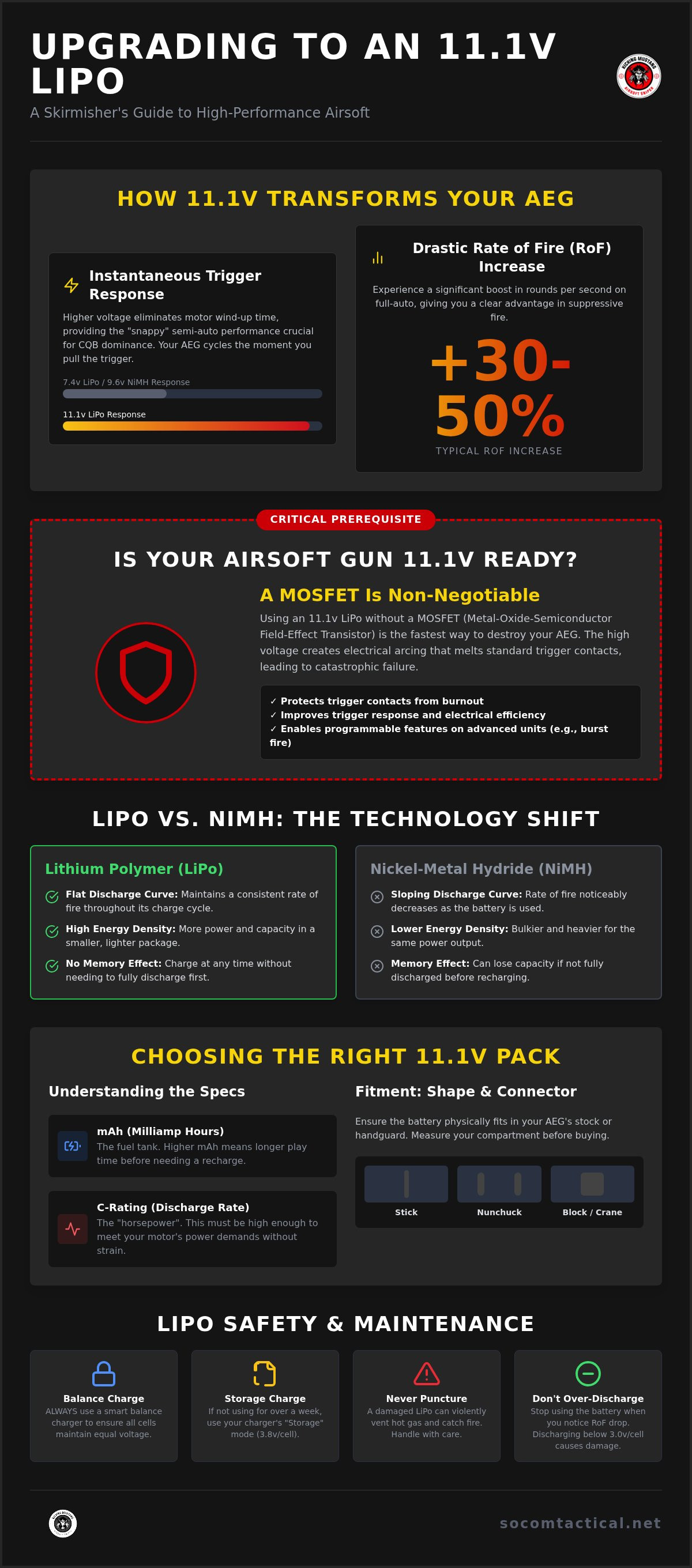
- Understand how increased voltage directly boosts your rate of fire and provides an instantaneous trigger response for a competitive edge.
- Learn why a MOSFET is a non-negotiable requirement when using an 11.1v LiPo battery to prevent arcing and protect your internal components.
- Master the technical nuances of C-ratings and mAh to select a power pack that matches your motor's demands and skirmish duration.
- Discover essential maintenance habits, such as storage charging and voltage monitoring, to maximise the lifespan and safety of your cells.
- Identify the ideal battery dimensions and connector types to ensure seamless fitment within your AEG's stock or handguard.
What is an 11.1v LiPo Battery? Technical Basics for Skirmishers
Your AEG is only as good as the juice you feed it. Stepping up to an 11.1v LiPo battery is a rite of passage for any airsofter looking to push their rifle to its mechanical limits. Unlike the bulky Nickel-Metal Hydride (NiMH) batteries of the past, Lithium Polymer technology offers incredible energy density in a compact form factor. This means you get more power and longer run times without needing a massive fixed stock to house your power source. An 11.1v pack is a high-performance tool designed for rapid energy discharge, delivering the current your motor needs to cycle the gearbox at breakneck speeds.
Whilst we call it an 11.1v battery, that number is actually the nominal voltage. When your smart charger finishes its cycle, each cell sits at 4.2v, meaning a fully charged 3S pack is actually pushing 12.6v into your system. This extra punch is what provides that legendary snappy trigger response, but it also places significantly more strain on your internal components than a standard 7.4v LiPo or a 9.6v NiMH. Understanding this voltage gap is the first step in mastering your high-speed setup and avoiding a costly gearbox failure on the field.
The 3S Configuration: Why Three Cells Matter
Inside every 11.1v LiPo battery, you will find three individual 3.7v cells wired in series. This is known as a 3S configuration. By linking them this way, the voltage accumulates while the capacity remains consistent across the pack. Adding that third cell inevitably increases the physical footprint of the battery. This is why choosing between stick, crane, or nunchuck styles is vital for a clean fitment in your RIF. Nominal voltage is the standard average voltage assigned to a battery cell to indicate its operating level during a typical discharge cycle.
LiPo vs NiMH: The Performance Shift
The shift from NiMH to LiPo isn't just about size; it's about how the power is delivered. NiMH batteries suffer from a sloping discharge curve, meaning your rate of fire noticeably drops as the day goes on. LiPos maintain a much flatter curve, providing consistent performance until the very end of the charge. They also lack the memory effect that plagued older batteries, so you don't need to fully discharge them before plugging them back in. However, this chemistry requires respect. You must use a dedicated balance charger to ensure each cell remains at the same voltage, preventing instability. You can find the necessary consumables and smart chargers at Socom Tactical to manage these high-output cells safely and keep your kit in peak condition.
Performance Gains: How 11.1v Transforms Your AEG
Swapping your standard power source for an 11.1v LiPo battery is the single most effective way to overhaul your rifle's performance without stripping the gearbox. The most immediate change isn't just a number on a chronograph; it's a visceral shift in how your RIF handles. By providing a higher electrical pressure to the motor, the internal components reach their peak operating speed almost instantly. This eliminates the sluggish wind-up time common with lower voltage packs, ensuring your AEG is ready to cycle the moment you exert pressure on the trigger.
This boost in voltage directly translates to motor efficiency. High-torque motors, which are designed to pull heavy springs, require a significant initial draw to overcome mechanical resistance. An 11.1v setup provides the necessary punch to get these motors to peak RPM faster than a 7.4v equivalent. In some specialised builds, you might even notice a negligible increase in FPS. This isn't because the battery is stronger, but because the faster cycle ensures the piston assembly achieves a more consistent and complete compression stroke every time you fire.
Trigger Response and Semi-Auto Dominance
For CQB specialists, semi-auto performance is everything. The "snappy" feel everyone chases is actually a reduction in cycle time. When you pull the trigger, the 11.1v current forces the motor to snap the sector gear around, releasing the piston in a fraction of the time it takes on a standard setup. This near-instantaneous release allows you to track moving targets with much higher confidence. To truly capitalise on this speed, pairing your high-voltage battery with Precision Inner Barrels ensures that your rapid follow-up shots remain grouped tightly on target. If you find your current setup feels like it's lagging behind your trigger finger, upgrading to one of our high torque motors alongside a LiPo switch can provide that elite-level response.
Full-Auto Rate of Fire (RoF)
When you flip the selector to full-auto, the difference becomes even more dramatic. Players typically report a 30% to 50% increase in Rounds Per Second (RPS) when moving from a 7.4v to an 11.1v pack. A rifle that previously chugged along at 15 RPS can easily jump to 22 RPS or higher. This provides a massive tactical advantage for suppressive fire, allowing you to pin down opponents with a wall of plastic. However, this speed comes with a caveat. If your magazine springs aren't up to the task, you may encounter "mid-cap syndrome" where the rifle cycles faster than the BBs can feed. Ensuring your magazines are clean and high-quality is essential when pushing these higher rates of fire.
Compatibility: Is Your Airsoft Gun 11.1v Ready?
Before you plug in that high-voltage pack, you need to understand that an 11.1v LiPo battery is a double-edged sword. Whilst the performance gains are undeniable, the increased electrical and mechanical load can turn a stock gearbox into a pile of shredded metal and burnt plastic if you aren't careful. It isn't just about whether the battery fits in the stock; it's about whether the internal architecture can handle the aggressive cycle speeds and high current flow. If your RIF wasn't built with high-voltage usage in mind, you're essentially putting a racing engine into a family hatchback without upgrading the brakes.
The most immediate threat is electrical arcing. Every time you pull a traditional trigger, a physical connection is made between two copper plates. With an 11.1v battery, the voltage is high enough to cause a spark to jump across the gap just before the plates touch. This "arc" creates carbon deposits and intense heat, eventually pitting the metal and causing your trigger to fail completely. Without the right protection, you might find your rifle firing on its own or refusing to fire at all after just a few skirmishes.
The Role of the MOSFET
The absolute number one requirement for safe 11.1v usage is a MOSFET. This small electronic component acts as a high-speed switch, redirecting the heavy current directly from the battery to the motor, bypassing the delicate trigger contacts entirely. In this setup, the trigger only sends a tiny signal to the MOSFET to tell it when to fire. Many modern high-end platforms come with built-in Electronic Trigger Units (ETUs) that perform this function out of the box. A MOSFET is an essential electronic shield for your gearbox, ensuring your trigger contacts remain pristine regardless of how fast you're spamming the semi-auto. For those looking to upgrade an older RIF, our team provides expert Airsoft Parts and Upgrades to get your system high-voltage ready.
Mechanical Reliability: Gears and Pistons
Once the electronics are sorted, you must consider the physical toll of a high-speed cycle. When the gearbox is moving 50% faster, the timing of every component becomes critical. We often see the following issues in unprepared setups:
- Piston Stripping: If the sector gear rotates too quickly, it can strike the piston before it has fully returned, shearing off the teeth.
- Over-spin: The motor has so much momentum that it continues to rotate after the cycle is complete, occasionally firing a second shot or leaving the spring under tension.
- Gear Failure: Poorly shimmed gears will vibrate more violently at high speeds, leading to snapped teeth or cracked gearbox shells.
Correcting the Angle of Engagement (AoE) and ensuring your gears are perfectly shimmed are vital steps for longevity. You can learn more about choosing a platform that can handle these demands in The Ultimate Guide to Airsoft Guns, which covers everything from entry-level AEGs to skirmish-ready beasts.
Choosing the Right Pack: Connectors, Shapes, and Specs
Selecting the perfect 11.1v LiPo battery requires more than just looking for the biggest numbers on the label. You need to balance the electrical output with the physical limitations of your rifle's battery compartment. High-performance setups demand a high current draw, but if the pack doesn't fit in your buffer tube or crane stock, it's useless on the field. Ensuring the right configuration keeps your rifle field-ready without cables being pinched or stocks failing to close.
The same principles of balancing power output and device compatibility are essential in other high-drain electronics; you can learn more about VapeShop.bh to see how they handle technical specifications for their advanced hardware.
mAh and C-Rating: Balancing Power and Longevity
Capacity is measured in milliampere-hours (mAh). A rough rule of thumb in the community is that 1mAh equals approximately one shot on an 11.1v setup, though high-stress builds may consume more. If you're playing a full day at a large woodland site, you'll likely need at least 1450mAh or multiple smaller packs. C-rating is equally vital; it determines how quickly the battery can dump its energy. A higher C-rating ensures a more consistent trigger response because the motor isn't starved of current during the initial start-up. To calculate the true continuous discharge of an 11.1v LiPo battery, multiply the mAh by the C-rating. For example, a 1200mAh 25C pack provides 30 Amps of continuous current.
Connector Types: Tamiya vs Deans
The industry is rapidly moving away from the legacy Mini-Tamiya connector in favour of Deans, also known as T-Connectors. Mini-Tamiya plugs were never designed for the high-amperage demands of modern airsoft; they have high electrical resistance and can even melt under extreme use. Deans connectors offer a much larger surface area for contact, significantly reducing resistance and improving efficiency. This leads to a cooler-running system and a slight boost in rate of fire. At Socom Tactical, we recommend converting your RIF to Deans to truly unlock the potential of high-voltage cells. You can find all the necessary Magazines and Consumables to support your upgraded platform on our store.
Physical fitment is the final hurdle. Stick batteries are perfect for AK top covers or M4 buffer tubes. Crane configurations, often called nunchuck packs, are designed to split the cells into the side tubes of a crane stock. For tight handguards or PDW stocks, triple stick packs offer the most flexibility. If you're unsure about fitment or need a professional connector swap, browse our range of LiPo batteries and chargers to ensure your setup is optimised for the next engagement.
LiPo Safety and Maintenance: Protecting Your Investment
Mastering the use of an 11.1v LiPo battery requires a disciplined approach to maintenance that goes beyond simple charging. These high-performance cells are chemically volatile compared to older NiMH technology, meaning they require specific care to remain stable and effective. Neglecting these protocols doesn't just shorten the lifespan of your battery; it can lead to catastrophic failure on the field or at home. Respect the chemistry, and your power packs will provide years of reliable service.
The golden rule of Lithium Polymer care is never to fully discharge the cells. Each individual cell has a nominal voltage of 3.7v, but you must never let them drop below 3.0v. For your 3S 11.1v pack, this means the total voltage should never dip below 9.0v. If you push past this limit, the internal resistance spikes, often making the battery impossible to recharge. Many veteran skirmishers use small plug-in voltage alarms that beep when the battery reaches a critical level, ensuring you know exactly when it's time to swap packs during an intense engagement.
You must also learn to identify physical signs of distress, specifically "puffing." If your battery pack looks swollen or feels soft rather than firm, it indicates that gas has built up between the internal layers due to misuse or age. A puffed battery is a fire hazard and should never be used or charged. If you spot this, take the pack to a dedicated battery recycling centre for safe disposal; never toss these into your domestic rubbish bins.
The Importance of a Smart Balance Charger
Balance charging is the only way to safely replenish an 11.1v LiPo battery. A smart charger monitors each of the three cells individually, ensuring they all reach 4.2v at exactly the same time. Cheap, "dumb" wall chargers often overcharge one cell whilst undercharging others, leading to instability and reduced performance. Investing in high-quality LiPo Batteries and Smart Chargers is the best way to protect your gearbox and your home. A proper charger will also feature a "Storage Mode," which is essential for the health of your cells.
Safe Storage and Transport
Leaving your batteries fully charged for long periods is a surefire way to kill their capacity. If you aren't planning to play for more than a few days, you must use your charger's storage function to bring each cell to approximately 3.8v to 3.85v. This is the chemically stable "sweet spot" for long-term storage. Temperature control is equally vital. Never leave your batteries in a hot car or a damp garage, as extreme heat can trigger thermal runaway. Always transport and store your cells in a fire-retardant LiPo bag. It’s a small but essential piece of Tactical Gear that every serious player should own to ensure operational readiness and safety.
Optimise Your Gear for the Next Engagement
Mastering your 11.1v LiPo battery setup is the definitive way to gain a competitive edge whilst ensuring your rifle stays in the fight. By prioritising a professional MOSFET installation and adhering to strict charging protocols, you've moved beyond basic skirmishing into the territory of high-performance airsoft. You now understand that voltage is a tool to be managed, requiring the right connectors and internal shimming to truly shine.
Socom Tactical has been trusted by UK skirmishers since 2009 to provide the grit and technical expertise needed for these advanced setups. Whether you need expert technical support for a complex MOSFET fitting or simply require reliable UK-wide delivery on your next batch of power cells, we've got your back. For precision maintenance of your other high-end hardware, you can discover TekStore and their specialist repair services. It's time to stop settling for sluggish response times and start dominating your local site with a RIF that reacts as fast as you do.
Upgrade your power with our range of 11.1v LiPo Batteries and experience the difference of a truly responsive primary. See you on the field, ready for action.
Frequently Asked Questions
Can I use an 11.1v LiPo in a stock airsoft gun?
You can use an 11.1v LiPo in a stock airsoft gun, but it's risky if the rifle hasn't been specifically designed for high-voltage power. Most entry-level AEGs lack the necessary MOSFET to protect trigger contacts from arcing. Without this protection, you'll likely burn out the electronics within a few skirmishes. Always check your manufacturer's manual to see if the gearbox internals are LiPo ready before making the switch.
What is the difference between 7.4v and 11.1v LiPo batteries?
The primary difference is the electrical pressure and cell configuration. A 7.4v LiPo contains two 3.7v cells, whereas an 11.1v LiPo battery uses three cells to deliver significantly more power to the motor. This higher voltage results in a faster rate of fire and much snappier trigger response, but it places considerably more mechanical stress on your gearbox components compared to the lower voltage alternative.
Do I need a MOSFET to use an 11.1v LiPo?
You absolutely need a MOSFET to use an 11.1v battery safely over the long term. This electronic switch prevents high-voltage current from passing through your mechanical trigger contacts, which would otherwise cause pitting and carbon build-up through electrical arcing. Whilst some high-end RIFs come with pre-installed units, older or basic models require an aftermarket MOSFET to handle the increased power without failing or causing a fire risk.
How long does an 11.1v LiPo battery take to charge?
Most 11.1v batteries take between 30 and 90 minutes to charge when using a dedicated smart balance charger. The exact time depends on the battery's capacity and the charge current set on your device. Charging at 1C is the safest method for longevity. Never rush the process with high-amp settings, as this can destabilise the cells and reduce their overall lifespan or lead to overheating during the cycle.
Why is my 11.1v LiPo battery swelling or puffing up?
Swelling occurs when gas builds up inside the battery casing due to chemical decomposition. This is typically caused by over-discharging the cells below 3.0v, overheating during a heavy skirmish, or using an incompatible charger. If your pack feels soft or looks like a balloon, it's a significant fire risk. Stop using it immediately and follow safe disposal procedures at a local recycling centre to avoid any accidents.
Which connector is better for 11.1v: Deans or Mini-Tamiya?
Deans connectors are significantly better for high-voltage setups due to their lower electrical resistance and higher surface area. Mini-Tamiya plugs are a legacy design that can struggle with the high current draw of an 11.1v system, sometimes leading to heat build-up or melted plastic. Switching to Deans ensures more efficient power delivery to your motor, which can slightly improve your rifle's overall cycle speed and long-term electrical reliability.
How do I store my LiPo batteries when not at a skirmish?
You should store your batteries at a partial charge of 3.8v to 3.85v per cell in a cool, dry place. Leaving them fully charged or completely flat for more than a few days causes internal degradation and permanent capacity loss. Always use a fire-retardant LiPo bag for storage and keep them away from flammable materials. This disciplined routine ensures your gear is ready for the next engagement without losing its punch.
Can I charge an 11.1v LiPo with a standard NiMH charger?
You must never charge a LiPo battery with a standard NiMH charger. NiMH chargers use a different charging method that doesn't account for individual cell balancing or the specific voltage limits of lithium chemistry. Attempting this will almost certainly result in the 11.1v LiPo battery catching fire or exploding. Always use a dedicated LiPo balance charger that monitors the voltage of each cell through the white balance lead for total safety.