What if you could eliminate the inconsistent muzzle velocity and cold-weather performance drops that plague every British skirmish? Most players have experienced the frustration of a Green Gas magazine venting in the autumn chill or an AEG gearbox failing at the worst possible moment. It's a common hurdle that stops many hobbyists from reaching their full potential on the field. If you're tired of gear that fluctuates as much as the weather, moving to an hpa system is the definitive solution for operational readiness.
We've built this guide to give you total confidence in high pressure airsoft, ensuring you can make the leap without the technical anxiety. You'll learn how to select the right engine for your playstyle, understand the latest Rho-marked tank regulations, and master the maintenance required for a silent, reliable setup. We're breaking down everything from initial regulator settings to advanced field repairs so you can focus on the mission instead of your equipment. From achieving perfect shot-to-shot consistency to customising your rate of fire, this is your roadmap to mastering the most versatile platform in the game.
Key Takeaways
- Discover how high-pressure systems deliver unmatched shot consistency and reliability in any UK weather condition, overcoming the limitations of traditional gas or AEG platforms.
- Learn to navigate the hardware requirements of a high-performance hpa setup, from selecting the right engine to choosing between aluminium and lightweight carbon fibre tanks.
- Master the art of performance tuning by adjusting your FPS and rate of fire in seconds to meet specific skirmish site requirements without opening your gearbox.
- Understand essential UK safety regulations and maintenance protocols, including how to identify Rho and Pi marks on your pressure vessels for legal field use.
- Find out why professional technical installation and bespoke builds ensure your rig is operationally ready for the most demanding competitive environments.
What is HPA in Airsoft? High Pressure Air Explained
If you've spent any time at a UK skirmish site, you've likely heard the distinctive, muffled "pop" of a high-end rifle that seems to outperform everything else on the field. That's the sound of a pneumatic powerhouse. To get a baseline understanding, one might ask: What is HPA in Airsoft? Essentially, it is a system that replaces internal springs or liquid gases with a regulated supply of compressed atmospheric air. We aren't discussing air source heat pumps or a trendy craft pale ale; in our world, hpa stands for High Pressure Air, the ultimate fuel for high-performance RIFs. By moving the power source to an external tank, players gain a level of control and durability that traditional platforms struggle to provide.
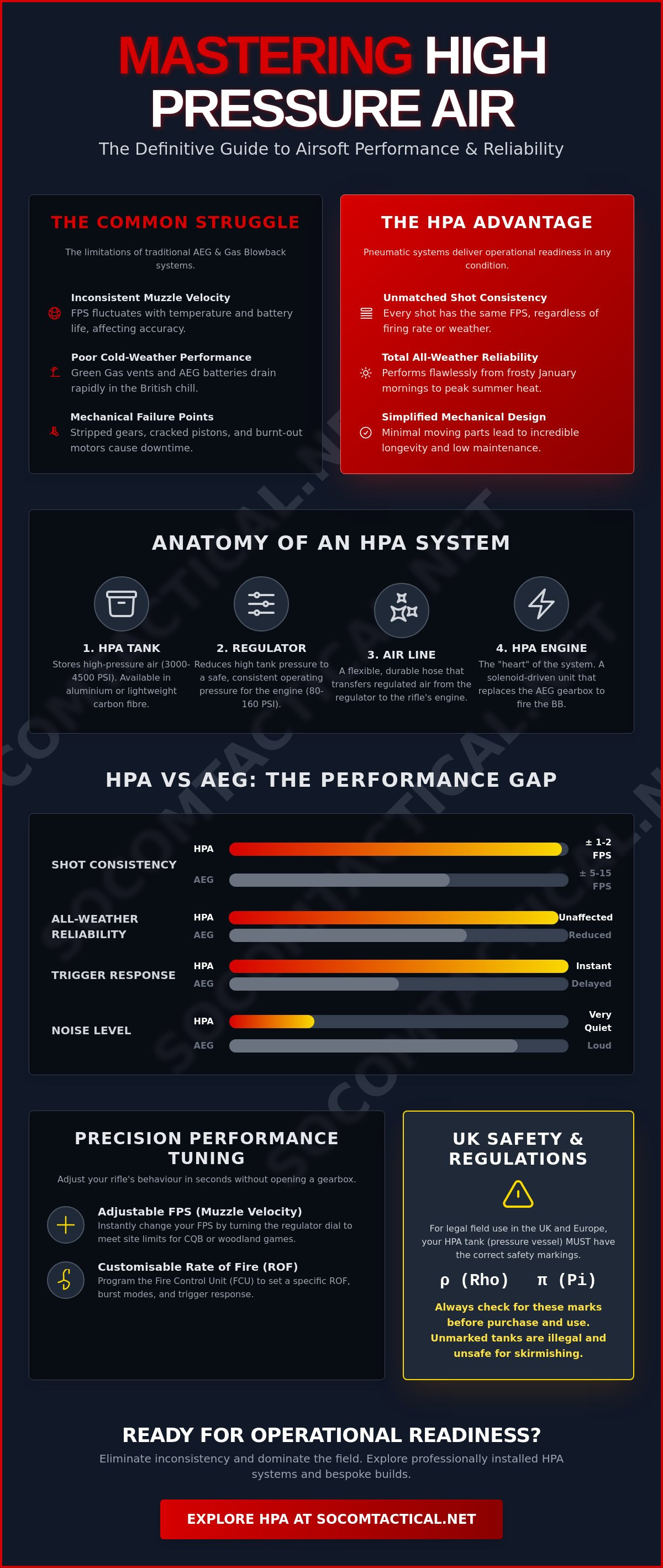
The core appeal lies in the transition from mechanical complexity to pneumatic precision. Most systems consist of three main components: a high-pressure tank, a regulator to drop that pressure to usable levels, and a solenoid-driven engine inside the gun. This setup allows for near-silent operation, making it a favourite for stealth-focused players and marksmen who don't want to give away their position with the mechanical clatter of a motor and gears. It's about operational readiness and the confidence that your kit will perform exactly the same way every time you pull the trigger.
HPA vs AEG: The Performance Gap
Choosing between a traditional AEG and an hpa rig often comes down to a desire for consistency. A standard AEG gearbox is a marvel of engineering, but it's also a collection of potential failure points. Gears can strip, pistons can crack, and motors can burn out over time. In contrast, an HPA engine has minimal moving parts. This mechanical simplicity translates to incredible longevity and a reduction in maintenance downtime. For players in the UK, the biggest advantage is all-weather reliability. Whilst Green Gas systems suffer from the "cool-down" effect and AEGs can struggle with battery drain in the cold, HPA remains unaffected by freezing temperatures. You get the same FPS on a frosty January morning as you do in the height of summer, ensuring your hop-up remains consistent and your shots stay on target.
The Evolution of the HPA Engine
The technology has evolved from the cumbersome "classic" rigs of the 1980s into the sleek, drop-in cylinder replacements we use today. Modern engines from brands like Polarstar and Wolverine have revolutionised the market. You can find these modern engines in our parts and upgrades range if you're planning a bespoke conversion. The heart of these modern builds is the Fire Control Unit (FCU). This programmable microchip allows you to customise your rifle's behaviour with surgical precision. You can adjust the "dwell" to match your barrel length or set a specific rate of fire to suit your local site's rules. This tech enables an instant trigger response. Because there's no motor to spin up or piston to reset, the shot breaks the moment the trigger is pulled. It's a crisp, reactive experience that changes how you engage targets in fast-paced CQB scenarios.
The Anatomy of a High Pressure Air Setup
Understanding the hardware is the first step toward achieving operational readiness on the field. An hpa setup is a modular ecosystem where each component must work in perfect harmony to deliver that signature pneumatic precision. Unlike a standard AEG where the power source is tucked inside the handguard or stock, these systems rely on a chain of high-quality external parts to manage air flow from your back to your barrel. It's a setup built for the grit and demands of competitive play, offering a level of reliability that self-contained systems often lack.
The system begins with the storage vessel and ends at the nozzle of the engine. In between, you have a series of regulators and lines that ensure the air reaching your BB is stable, consistent, and safe. Getting to grips with this anatomy allows you to troubleshoot issues instantly and customise your rig for specific mission requirements, whether you're clearing rooms in a tight CQB centre or providing overwatch in a vast woodland environment.
Choosing Your HPA Engine
The engine is the primary mechanical component that replaces your traditional gearbox. You can choose a drop-in unit to convert an existing rifle or opt for a purpose-built hpa RIF that is ready for action straight out of the box. Single solenoid designs are popular amongst players who value efficiency and straightforward maintenance. However, dual solenoid engines provide independent control over the nozzle and poppet, allowing for meticulous tuning of the firing cycle. If you are planning a bespoke build, you can find the latest solenoids and control units in our parts and upgrades range.
Tanks and Regulators: Powering the System
Your air tank is your fuel source. Beginners often start with aluminium vessels because they are incredibly rugged and cost-effective. For those engaging in long-form milsim events, carbon fibre tanks are the preferred choice. They are significantly lighter and typically rated for 4,500 PSI, providing a much higher shot count than the 3,000 PSI limit of most aluminium tanks. The regulator is the unsung hero of the setup, stepping down the massive pressure from the tank to a stable, low PSI that the engine can handle. This stability is governed by strict safety protocols, and staying informed on HPA Safety and Maintenance ensures your kit remains reliable and field-legal at all times.
Remote Lines and Fittings
The remote line serves as the umbilical cord between your tank and your rifle. Standard coiled lines are flexible and stay close to the body, whilst wide-bore braided lines offer a more tactical aesthetic and improved air flow for high-speed builds. These lines use Quick Disconnect (QD) fittings to ensure a secure, leak-free seal that can be detached in a second. Properly integrating these lines into your clothing and gear, such as a dedicated tank pouch or a plate carrier, is essential for maintaining mobility during high-intensity engagements. If you want to see the latest innovations in pneumatic technology, feel free to browse our new products for the newest line and fitting options.
Performance Tuning: Adjusting FPS and Rate of Fire
The true power of an hpa system lies in its unparalleled level of on-the-fly adjustability. For those used to the mechanical constraints of an AEG, where changing your muzzle velocity requires a complete gearbox strip-down and a spring swap, the pneumatic alternative is a revelation. You can adjust your power output in seconds by simply turning the adjustment screw on your regulator. This allows you to transition from a tight CQB site with lower power limits to a wide-open woodland environment without ever leaving the staging area. It's about total control over your RIF's output, ensuring you're always optimised for the specific engagement at hand.
Beyond muzzle velocity, the Fire Control Unit (FCU) acts as the brain of your build, allowing you to customise the rate of fire and trigger response. Whether you want a realistic 10 rounds per second for a milsim event or a blistering 35 rounds per second for competitive speedsoft, a few clicks on the FCU is all it takes. Tuning your "dwell" is equally vital. Dwell dictates how long the solenoid remains open to release air. Setting this correctly ensures you aren't wasting air after the BB has already left the barrel, which significantly improves your shots per tank and keeps your setup running efficiently throughout a long skirmish day.
Field-Legal Adjustments and Tournament Locks
With great power comes the responsibility of staying within UK legal limits and site-specific rules. Most sites require a tournament lock, which is a physical barrier like a cable tie or a dedicated cap that prevents you from adjusting your regulator once you've passed the chronograph. This builds trust amongst the community and ensures a fair game for everyone. It is vital to remember that FPS must be checked with the BB weight you intend to use to account for "Joule creep," where heavier rounds can retain more energy than lighter ones at the same pressure settings.
Optimising for Stealth and Range
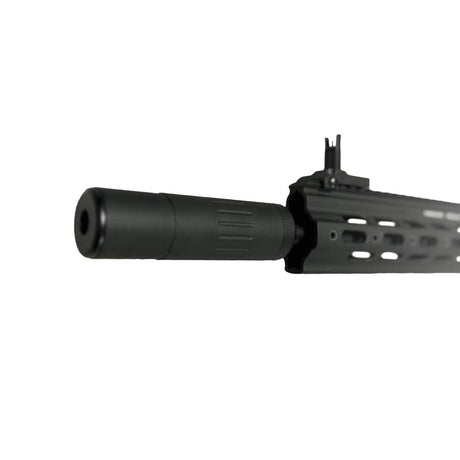
Because there is no mechanical clatter from gears or motors, an HPA rifle is inherently quieter than its counterparts. When paired with a foam-filled suppressor, the muzzle report becomes a dull thud that is nearly impossible to track from more than a few metres away. This stealth is a massive advantage for marksmen. To truly capitalise on this consistency, we recommend pairing your engine with precision inner barrels to ensure every shot follows the exact same flight path. This synergy between stable air pressure and high-quality internals is why the platform has become the gold standard for dedicated airsoft snipers who demand absolute precision under pressure.
HPA Safety and Maintenance in the UK
High pressure air is an incredible tool for any serious player, but it demands a level of respect that goes beyond standard AEG care. When you're carrying 4,500 PSI on your back, safety isn't just a suggestion; it's the foundation of your operational readiness. Understanding the technical nuances of your pressure vessels ensures that your hpa rig remains a high-performance asset rather than a liability. In the UK, we have specific legal standards that distinguish a field-ready tank from a dangerous one. You must look for the "Rho" (ρ) symbol on any new tanks purchased in Great Britain post-Brexit, or the "Pi" (π) mark on older vessels. These certifications, alongside UN markings, prove the tank has met the rigorous manufacturing standards required for our skirmish sites.
Hydrostatic testing, commonly known as hydro-testing, is the non-negotiable process of checking a tank's structural integrity under pressure. For carbon fibre tanks, you must organise a test every 5 years, and these vessels typically have a total lifespan of 15 years before they must be decommissioned. Aluminium tanks are more rugged and generally require testing every 10 years in the UK. Neglecting these dates doesn't just risk a site marshal turning you away; it compromises your safety. Beyond the tank, basic maintenance involves keeping your O-rings lubricated with 100% silicone oil. You must avoid petroleum-based lubes at all costs, as they can cause seals to degrade or even lead to combustion under extreme pressure.
Where to Refill Your HPA Tank
Finding a reliable air source is a core part of the lifestyle. Most dedicated airsoft sites and paintball centres now offer refill stations, often included in your walk-on fee or for a small nominal charge. If you're far from a site, local dive shops are excellent hubs for high-quality, moisture-filtered air. Some players invest in personal stirrup pumps or portable compressors for home use. Whilst these offer independence, stirrup pumps require a significant physical effort to reach even 3,000 PSI, and home compressors need high-end filtration to protect your engine from internal corrosion. When travelling to the field, always ensure your regulator is turned off and the tank is secured in a padded bag to prevent knocks to the valve assembly.
Daily Maintenance Checklist
Success on the field starts before you even reach the car. A quick pre-game inspection can save your day from being cancelled by a gear failure. Check your remote lines for any kinks, abrasions, or exposed braiding that might indicate a weak point in the line. Ensure the engine nozzle is clean and free from debris; even a small amount of grit can cause feeding issues or damage the internal seals of your engine. After the skirmish, store your system with a small amount of "storage pressure" (around 500 PSI) to keep the seals seated, but never store a tank at its maximum capacity for months on end. If you have any concerns about your setup's integrity, get in touch with our technical team through our contact us page for expert advice.
Starting Your HPA Journey with Socom Tactical Airsoft
Entering the world of hpa shouldn't feel like a solo mission. Whilst the performance gains discussed in previous sections are undeniable, the transition from an AEG to a pneumatic platform involves precise technical nuances that can be daunting for the uninitiated. This is where we come in. At Socom Tactical Airsoft, we don't just shift boxes; we are a team of active skirmishers who understand the grit and demands of the UK airsoft scene. We've spent years testing these systems in every condition, from rain-soaked woodland sites to dusty CQB centres, ensuring that every piece of kit we recommend is operationally ready for your next engagement.
Whether you're looking for a complete out-of-the-box solution or want to breathe new life into an old favourite, our curated selection of HPA-compatible airsoft guns offers something for every playstyle. We prioritise reliability and functional utility, stocking only the brands that we'd trust in our own holsters and rigs. Choosing the right engine is just the start; having it expertly tuned to your specific barrel and hop-up setup is what separates a standard build from a high-performance tool. We understand that your gear is an investment in your experience, and we're here to ensure that investment pays off with every trigger pull.
Custom Builds and Installations
Precision is everything in a pneumatic build. Even a minor misalignment in the nozzle or a tiny air leak in the line can compromise your consistency on the field. That's why we recommend our professional Technical Labour and Repair services for all engine conversions. Our technicians handle the heavy lifting, from milling gearboxes to fine-tuning FCU settings, ensuring your rig is field-ready from the moment you pick it up. We consult with you to match the perfect engine to your favourite RIF, balancing air efficiency with the rate of fire you need to dominate.
Join the HPA Community
If you're still on the fence about making the switch, visit our retail outlet for a hands-on demonstration. There's no substitute for feeling the instant trigger response and hearing the near-silent operation of a tuned hpa rifle in person. Our staff are always on hand to talk through internal component compatibility or help you integrate a tank into your existing plate carrier. To stay ahead of the game, sign up for our newsletter to get a first look at the latest HPA arrivals and exclusive community tips. Don't settle for gear that fluctuates with the weather; upgrade your arsenal and master the field today with Socom Tactical Airsoft.
Master the Field with Pneumatic Precision
Transitioning to an hpa setup is more than just a gear upgrade; it's a commitment to total shot consistency and operational readiness. You've seen how these systems bypass the mechanical limits of AEGs and the temperature sensitivity of Green Gas, offering a platform that thrives in the unpredictable UK climate. From the silent operation of a suppressed engine to the surgical precision of FCU tuning, you now have the knowledge to build a rig that matches your tactical ambition.
Since 2009, our team of UK airsoft veterans has been providing the expert advice needed to navigate these complex builds. We stock a comprehensive range of industry-leading components from Polarstar, Wolverine, and Gate, ensuring you have access to the best tech available. If the technical install feels daunting, our professional technical installation services are here to ensure your build is field-ready from day one. Upgrade to HPA: Explore our Engines and Tanks at socomtactical.net today. Your journey toward a more reliable and adjustable loadout starts here. We'll see you on the field.
Frequently Asked Questions
Is HPA better than AEG for airsoft?
HPA offers superior consistency and reliability compared to a standard AEG gearbox. Whilst AEGs are excellent entry-level tools, an hpa engine has fewer moving parts to fail and isn't affected by the mechanical wear of gears or motors. This makes it the better choice for players who prioritise long-term durability and the ability to play in freezing UK winters without performance drops.
How many shots do I get from a standard 48/3000 HPA tank?
A standard 48/3000 aluminium tank typically provides between 2,500 and 4,000 shots per fill. This figure varies based on your engine's air efficiency and how precisely you've tuned your dwell settings. If you're a heavy-handed support gunner, you might find yourself refilling more often than a marksman who makes every shot count during a long skirmish.
Can I convert any airsoft gun to HPA?
Most airsoft RIFs with a standard V2 or V3 gearbox can be converted using a drop-in engine. We also see many gas blowback pistols and rifles converted using dedicated magazine adapters. While some niche or proprietary models require custom technical work, the vast majority of popular platforms are ready for a pneumatic transformation into a high-performance hpa rig.
Is an HPA tank dangerous to carry on my back?
Carrying a certified tank is perfectly safe as long as you follow basic handling protocols. Modern vessels are engineered to withstand extreme pressures and impacts far beyond what you'll encounter on a skirmish field. Ensure your tank has the correct Rho or Pi markings and is within its hydro-test date to maintain total peace of mind during high-intensity engagements.
What is the "umbilical cord" and does it get in the way?
The "umbilical cord" is the remote line that connects your tank to your rifle. When routed correctly through a plate carrier or chest rig, it doesn't hinder your movement at all. Many veterans find that the slight trade-off in having a line is well worth the massive increase in shot consistency and the instant trigger response provided by the system.
Do I need a special battery for my HPA engine?
You will need a small 7.4v LiPo battery with a JST connector to power the Fire Control Unit (FCU). Unlike an AEG battery, which has to turn a heavy motor, this battery only powers a microchip and a solenoid. This means a tiny 300mAh or 500mAh pack can easily last for an entire weekend of gaming without needing a recharge.
How much does it cost to refill an HPA tank in the UK?
Refill costs vary across the UK, but many sites include air as part of your walk-on fee. If a site does charge, it's usually a nominal amount per fill to cover their compressor maintenance. Dive shops typically charge a small fee for high-quality, filtered air, making them a reliable option for mid-week testing and operational prep.
Is HPA allowed at all UK airsoft sites?
High pressure air systems are welcomed at almost every UK site, provided they meet legal Joule limits. You'll be required to pass a chronograph test using the BB weight you intend to play with. Once your power is set, marshals will apply a tournament lock to your regulator to ensure the game remains fair and safe for all participants.