You’ve invested in a high-spec RIF and a precision inner barrel, yet your shots are still drifting off-target like a leaf in the breeze. It's a common frustration amongst even the most seasoned players; you have the perfect line of sight, but your ammunition simply won't cooperate at range. If you're constantly asking yourself, "What airsoft weight bb?" will finally stop that inconsistent grouping, you aren't alone. Most players focus entirely on FPS, whilst overlooking the fact that the weight of your pellet is what actually dictates your performance in the field.
We understand that finding the right balance between velocity and stability is a challenge. This guide is designed to help you choose the perfect BB weight to maximise your range, accuracy, and consistency during every engagement. We'll break down the technical "sweet spot" for different platforms, from standard AEGs to high-powered snipers. You'll learn how to properly utilise your hop-up unit to lift heavier weights and why switching from standard 0.20g pellets to premium BLS ammunition could be the most cost-effective upgrade you ever make for your kit.
Key Takeaways
- Master the science of kinetic energy to understand why heavier BBs maintain momentum and resist air resistance better than lighter alternatives.
- Identify the "sweet spot" for your AEG, GBB, or sniper rifle by learning exactly what airsoft weight bb? provides the best balance of accuracy and velocity.
- Protect your internal components and precision inner barrel by choosing high-quality, polished ammunition that prevents jams and shatters.
- Discover how to adapt your loadout for different environments, ensuring your shots stay on target whether you're in a windy woodland or a tight CQB arena.
- Follow our practical "Step-Up" testing guide to perfectly calibrate your hop-up unit for maximum field effectiveness.
The Science of BB Weight: Why Grams Matter More Than FPS
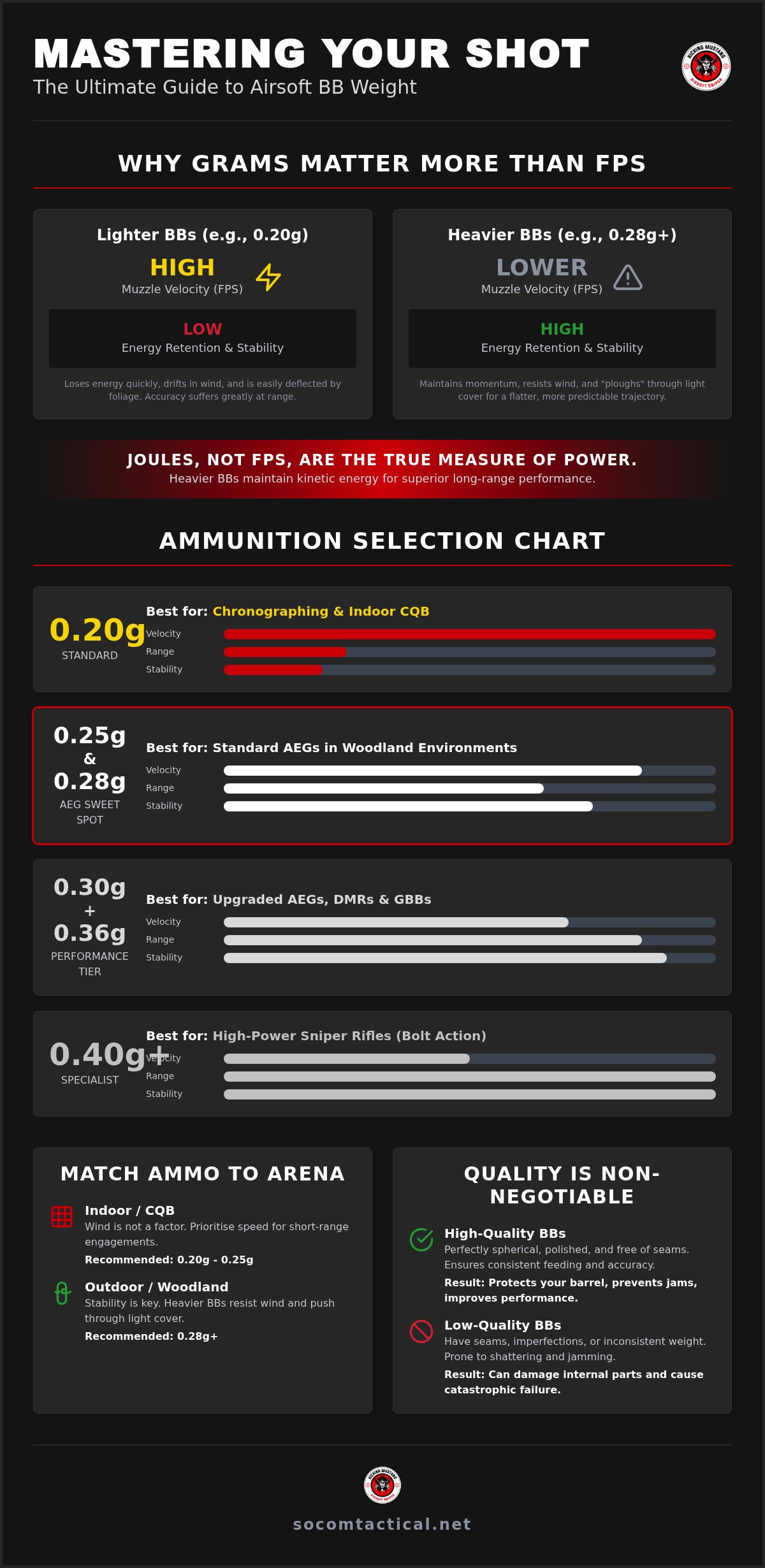
Muzzle velocity is the metric most players obsess over, but FPS is only half the story. To truly understand how your RIF performs, you need to look at kinetic energy, measured in Joules. Determining what airsoft weight bb? suits your setup requires moving beyond simple muzzle velocity and into the physics of energy retention. Whilst a lighter 0.20g pellet leaves the barrel faster, it lacks the mass to maintain that energy over distance. Air resistance acts on the surface area of Airsoft pellets immediately, causing lighter rounds to decelerate rapidly and drift off-course.
The Magnus effect plays a massive role here too. This is the physical phenomenon where backspin, applied by your hop-up unit, creates lift. Heavier BBs require more friction from the hop-up bucking to generate this spin, but once they're flying, their increased inertia makes them far more stable. They resist the chaotic influence of crosswinds and maintain a flatter trajectory for longer. If your internal components aren't up to the task of lifting heavy ammo, you might need to look into parts and upgrades like high-tension nubs or precision barrels to compensate.
Joule Creep refers to the phenomenon where an airsoft gun produces higher muzzle energy when using heavier BBs compared to the lighter ones used during initial chronograph testing. This is a vital safety consideration for any player looking to push the limits of their RIF's performance.
Velocity vs. Stability: The Great Trade-off
High FPS might look impressive on a chrono screen, but it often leads to poor long-range accuracy if you're using 0.20g ammo. These light BBs are easily deflected by the slightest breeze or even a single leaf. Heavier pellets, such as 0.28g or 0.30g, "plough" through the air with much greater authority. They take longer to reach the target, but they arrive with more energy and a tighter grouping. When deciding what airsoft weight bb? to load, you're essentially choosing between the speed of the shot and the reliability of the hit. In a woodland environment, stability wins every time.
Joules: The True Measure of Airsoft Power
UK airsoft sites have largely moved away from FPS-only limits in favour of Joule-based testing. Under the Policing and Crime Act 2017, the legal limit for fully automatic or semi-automatic RIFs is 1.3 Joules, whilst single-shot replicas like snipers can reach 2.5 Joules. Because heavier BBs stay in the barrel longer, they can sometimes absorb more energy from the expanding air or gas, leading to higher Joule readings than 0.20g equivalents. Always check your local site's specific rules. Staying within these limits ensures you're playing safely whilst maximising the effectiveness of your gear.
Airsoft BB Weight Chart: Choosing Your Ammunition
Selecting the right ammunition is as critical as choosing your RIF itself. When you're standing in the safe zone wondering, "What airsoft weight bb?" should I actually be loading, the answer depends on your platform's muzzle energy and where you're playing. Using the wrong weight can lead to poor groupings or, in the case of heavyweight snipers, BBs that simply won't hop. We categorise BB weights into four primary brackets to help you dial in your performance.
- 0.20g BBs: The absolute industry standard. These are used for chronograph testing at almost every UK site to ensure a fair baseline. They're also perfect for budget-conscious CQB players where engagement distances are short and wind is non-existent.
- 0.25g - 0.28g BBs: Often called the "sweet spot," this range is the go-to for standard AEGs. They offer a significant jump in stability over 0.20g without breaking the bank.
- 0.30g - 0.36g BBs: These are ideal for upgraded AEGs, DMRs, and Gas Blowback (GBB) platforms. They carry more momentum and are much harder for the wind to push around.
- 0.40g+ BBs: Reserved for high-powered spring snipers and precision long-range builds. These require specialised hop-up setups to lift effectively.
The 0.25g and 0.28g Standard
For outdoor skirmishing, 0.25g is the bare minimum we recommend. Whilst 0.20g BBs are cheaper, they're too light to maintain a predictable path through the air. However, 0.28g has rapidly become the favourite amongst experienced UK players. It strikes a perfect balance; it's heavy enough to "plough" through light brush and resist crosswinds, yet light enough to maintain a decent travel time to the target. When you consider the cost-to-performance ratio, 0.28g pellets often provide the best value for players who want to stay competitive without spending a fortune on every trigger pull.
Heavyweight BBs for Snipers and DMRs
If you're running a precision build, 0.40g or heavier is mandatory. At the distances a sniper operates, even a microscopic weight inconsistency can cause a miss. These heavy rounds require a high-quality hop-up bucking with enough friction to generate the necessary backspin. Without a precision inner barrel and a proper hop-up nub, you'll struggle to get these heavyweights to fly true. It's about ensuring every component in your RIF is synchronised to handle the extra mass.
If you're ready to see what your RIF is truly capable of, take a look at our selection of premium BLS airsoft BBs to find your perfect match.
Matching BB Weight to Your Airsoft Gun and Environment
Your choice of ammunition should be as tactical as your movement on the field. It isn't just about the power of your RIF; it's about the specific mechanics of your system and the terrain you're fighting in. When deciding what airsoft weight bb? to run, you must first assess your platform's hop-up capability. A standard AEG with a stock bucking might struggle to lift anything over 0.28g, whilst a Gas Blowback (GBB) pistol often benefits from the added stability of a 0.25g round to counteract the erratic nature of expanding gas. If your bucking is worn or too soft, it won't "grab" a heavy BB effectively, leading to a nose-diving trajectory regardless of your FPS.
To truly "dial in" your setup, start with your hop-up completely off. Fire a few rounds and slowly increase the pressure on the bucking until the BB travels in a straight line before gently rising at the end of its path. If you find yourself at the maximum setting and the BB is still dropping early, you've reached the mechanical limit of your current hop-up unit. At this stage, you either need to drop to a lighter weight or invest in a high-torque motor and a reinforced bucking to handle the extra mass. It's a delicate balance of mechanical friction and kinetic energy.
CQB and Indoor Environments
In the high-intensity world of indoor CQB, engagement distances are rarely more than 15 metres. Here, 0.20g or 0.25g BBs are often the superior choice. The primary advantage is travel time. In tight corridors, a faster projectile gives your opponent less time to react and dive behind cover. Many players at indoor centres also opt for tracer BBs. These require a dedicated tracer unit to "charge" the phosphorescent material, making your shots visible in low-light environments and helping you track your stream of fire in real-time.
Woodland and Long-Range Skirmishing
Moving to a woodland skirmish changes the game entirely. You're no longer just fighting players; you're fighting the elements. Wind, humidity, and even light foliage will effortlessly deflect a 0.20g BB. For outdoor play, 0.28g is widely considered the baseline for effective performance. Heavier rounds maintain a flatter trajectory at the end of their flight path because they retain their rotational energy more efficiently. For a deeper dive into the different varieties available, check out our guide on Airsoft BBs to see how speciality rounds can change your playstyle.
Quality Over Quantity: Why BB Brand and Finish Matter
Selecting a specific mass is only the first hurdle. Even after you've determined what airsoft weight bb? fits your specific RIF, the brand you choose can be the difference between a confirmed hit and a jammed gearbox. Quality is not just about the weight; it's about the manufacturing tolerances of the sphere itself. Cheap, unpolished ammunition often features visible seams or internal air bubbles. These imperfections shift the centre of gravity, causing your shots to spiral unpredictably once they leave the barrel. A seam is a death sentence for accuracy. It acts like a rudder, catching the air and pulling your shot away from the target regardless of how well your hop-up is set.
Using sub-standard pellets poses a genuine risk to your hardware. If a low-quality BB shatters inside your precision inner barrel, the resulting debris can scratch the internal bore or tear your hop-up bucking. This leads to a permanent loss of consistency that requires a full teardown to fix. High-polish finishes are essential because they ensure the bucking grabs the BB with the exact same amount of friction every time. Technicians at Socom Tactical Airsoft exclusively recommend BLS BBs because their superior manufacturing process ensures a perfectly spherical shape and zero internal air bubbles.
Biodegradable vs. Standard BBs
Current field regulations across the UK have made biodegradable BBs the mandatory standard for almost all woodland sites. There is a persistent myth that Bio BBs are softer or will melt inside your gun. This simply isn't true for modern, high-quality Bio rounds. They're designed to break down over time when exposed to the elements, not whilst sitting in your mid-cap magazine. However, you must store them correctly. Keep your Bio BBs in a cool, dry place and ensure the bag is sealed. Exposure to high humidity can cause them to swell slightly, which is a leading cause of feeding issues during a skirmish.
The Impact of Internal Upgrades
Pushing for heavier weights often requires more than just a setting change on your hop-up dial. As you move towards 0.30g and beyond, the physical strain on your internal components increases. A standard motor might struggle with the resistance of a high-tension bucking needed to lift heavy ammo. Upgrading to a high-torque motor allows your gearbox to cycle these heavier setups more efficiently, providing a snappier trigger response. If you're unsure if your RIF can handle the jump to heavyweight ammunition, our team at Socom Tactical Airsoft Technical Services can help you select and install the right internal components for the job.
Ready to upgrade your accuracy? Stop settling for inconsistent groupings and browse our range of premium BLS ammunition to find the perfect match for your loadout.
Finding Your Perfect Weight: A Practical Testing Guide
Before you head to your next skirmish, you need a data-driven approach to your loadout. Determining what airsoft weight bb? is right for your RIF isn't a guessing game; it's a process of elimination. Every effective test begins with a baseline. Chrono your gun using 0.20g BBs to establish your muzzle energy in Joules. This ensures you're playing within UK site limits and gives you a reference point for how much air volume your cylinder is pushing. Once you know your power level, you can begin the "Step-Up" test.
Load your magazines with 0.25g, 0.28g, and 0.30g BBs in sequence. Fire ten rounds of each weight at a fixed target. You aren't just looking for range; you're looking for the flight path's behaviour. An over-hopped BB will sky-rocket mid-flight, whilst an under-hopped round will drop prematurely. The ideal weight is the heaviest one your system can lift to a flat trajectory whilst maintaining a competitive velocity. To verify this, measure your group sizes at 30 and 50 metres. If your 0.30g groupings are wider than your 0.28g groupings, the lighter weight is your "sweet spot" for consistency.
Dialling in the Hop-Up
Adjusting your hop-up for heavier ammunition requires patience. Move the dial in tiny increments, as heavy pellets are far more sensitive to pressure changes. If you've reached the maximum setting and the BB still won't lift, it's a clear signal that the weight is too much for your current bucking or nub. Before you start any accuracy testing, ensure you've thoroughly cleaned your inner barrel. Even a microscopic layer of dust or old silicone oil will skew your results and make a high-quality BB perform like a budget alternative.
Stocking Your Ammo Pouch
Experienced players rarely stick to a single weight for their entire kit. It's common practice to carry 0.25g BBs for sidearms to ensure a snappy trigger response in CQB, whilst reserving 0.28g or 0.30g for the primary rifle. This allows you to tailor your performance to the specific engagement. When you've found your perfect match, ensure you're using consistent, high-grade ammunition from our BLS BBs Collection to maintain those tight groupings. Don't let poor consumables ruin a high-end build; shop our full range of high-performance consumables today and get your kit field-ready.
Master Your Accuracy and Own the Engagement
Finding the perfect ammunition is the final step in turning a standard RIF into a precision tool. We've explored how kinetic energy retention keeps your shots flat and why the environment dictates whether you reach for a 0.25g or a heavyweight 0.32g round. If you've spent your skirmishes asking, "What airsoft weight bb?" is going to stop those erratic groupings, you now have the technical knowledge to make an informed choice.
High-quality polishing and consistent manufacturing are what separate a reliable hit from a frustrating jam. As UK specialists since 2009, our team of active skirmishers knows that premium brands like BLS and 4uantum are the industry standard for a reason. Don't let sub-standard consumables hold back your performance on game day. It's time to stop guessing and start hitting your targets with total confidence.
Browse our full range of precision-grade Airsoft BBs to find your perfect match. We're here to provide the expert advice and field-ready gear you need to stay competitive. We'll see you in the safe zone, ready for the next high-stakes engagement.
Frequently Asked Questions
Can I reuse airsoft BBs that I have already fired?
You should never reuse fired airsoft BBs. Even if they look intact, the impact against a surface creates microscopic fractures and picks up grit or debris. Loading these back into your magazine is a fast way to scratch your precision inner barrel or cause a catastrophic jam in your gearbox. Always use fresh, high-quality ammunition to protect your RIF's internal components and maintain consistent accuracy during every skirmish.
Will using heavier BBs lower my FPS too much for competitive play?
Whilst heavier pellets do result in a lower FPS reading, they don't necessarily reduce your effectiveness in competitive play. In fact, the increased stability and energy retention often make you more lethal at range. When players ask, "What airsoft weight bb?" is best for competition, we usually suggest finding the heaviest weight your hop-up can lift. You'll sacrifice a bit of muzzle velocity for significantly better hit probability and superior wind resistance.
Are biodegradable BBs less accurate than standard plastic ones?
Modern biodegradable BBs from premium brands like BLS are just as accurate as their standard plastic counterparts. The manufacturing process for high-end Bio rounds involves the same rigorous polishing and quality control as non-bio versions. As long as you keep them sealed in a dry environment to prevent moisture absorption, you won't notice any difference in flight path or consistency. Most UK woodland sites now require them as a mandatory environmental standard.
What is the best BB weight for a stock Tokyo Marui AEG?
For a stock Tokyo Marui AEG, 0.25g BBs are widely considered the ideal choice. Marui replicas are engineered for precision rather than raw power, typically firing around the 0.9 Joule mark. Using a 0.25g weight allows the legendary TM hop-up unit to work its magic, providing a remarkably flat trajectory and surprising range without over-stressing the internal components or significantly slowing down the travel time to your target.
Does BB colour affect accuracy or visibility during a game?
BB colour has no direct impact on the physics of the flight path, but it dramatically affects your ability to track shots. White BBs are the industry standard because they're easiest to see against most backgrounds, allowing you to adjust your aim mid-engagement. Stealth colours like dark green or black are harder for opponents to spot, but they also make it nearly impossible for you to see where your rounds are actually landing.
What happens if I use a BB that is too heavy for my gun?
Using a BB that is too heavy for your RIF will result in a significant loss of effective range. If your hop-up unit cannot apply enough backspin to "lift" the mass, the pellet will simply nose-dive shortly after leaving the barrel. Cranking your hop-up to the maximum setting to compensate can cause feeding issues, increased wear on the bucking, and extra strain on your motor as it struggles to push air behind the heavy projectile.
Is there a legal limit on BB weight in the UK?
There is no specific legal limit on BB weight in the UK, but there are strict limits on muzzle energy. Under the Policing and Crime Act 2017, fully automatic RIFs must not exceed 1.3 Joules, whilst single-shot replicas are capped at 2.5 Joules. When determining what airsoft weight bb? to use, you must ensure that the resulting energy stays within these legal boundaries, especially as heavier weights can sometimes lead to increased Joule readings.
Should I use different weights for my primary and sidearm?
Many experienced players choose to run different weights for their primary and sidearm to suit different engagement distances. A rifle or DMR often needs 0.28g or heavier to maintain accuracy over long distances in the wind. Conversely, a gas blowback pistol used for close-quarters backup might benefit from 0.25g pellets. This provides a faster travel time at short range, ensuring your target has less time to react in tight CQB environments.