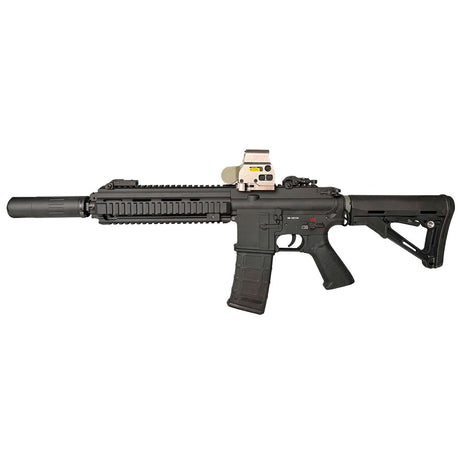
What if you could finally stop worrying about your gearbox locking up in the cold or your trigger response lagging behind your reflexes? If you're tired of inconsistent FPS during winter skirmishes or the complex internal maintenance of a standard AEG, it's time to consider the raw performance of High Pressure Air. This HPA beginner guide is designed to strip away the mystery surrounding these systems, proving that achieving a reliable, high-performance rifle is more accessible than you might think.
We understand that the jump to HPA can feel daunting when you're first faced with tanks, regulators, and lines. The benefits of instant trigger response and the ability to easily adjust your power levels for different UK sites are absolute game-changers for any serious player. We'll show you exactly how to choose your first engine, explain the vital hydrostatic testing rules for your tanks, and provide the technical expertise needed to keep your gear operational. From initial conversion to mastering field maintenance, you'll gain the confidence to dominate the engagement with a system built for precision and longevity.
Key Takeaways
- Learn how HPA eliminates cold-weather performance drops and delivers the instant trigger response needed for high-stakes skirmishes.
- Understand the critical differences between carbon fibre and aluminium tanks, including UK-specific hydrostatic testing requirements for long-term safety.
- This HPA beginner guide helps you decide between a purpose-built rifle or a "drop-in" engine conversion for your favourite AEG platform.
- Master the art of fine-tuning your regulator and FCU settings to ensure your RIF remains fully compliant with UK site FPS and Joule limits.
- Discover why HPA maintenance is actually simpler than traditional gearboxes, requiring only basic O-ring lubrication to maintain peak field-readiness.
What is HPA Airsoft? Understanding the Mechanics
High Pressure Air (HPA) is a sophisticated power source that replaces the mechanical gearbox of a traditional rifle with a streamlined pneumatic engine. Instead of a battery driving a motor to pull back a piston, an external tank provides a consistent stream of compressed air to propel your BBs. This transition is a core topic in any HPA beginner guide because it fundamentally alters how your RIF functions. By removing the stress of spinning gears and spring tension, you eliminate the most common points of mechanical failure found in standard electric builds.
At the heart of the system is the solenoid, an electromagnetic valve that opens and closes with surgical precision. When you pull the trigger, the solenoid releases a measured pulse of air. Unlike Green Gas or CO2, which are subject to the "cool-down effect" as the liquid expands into gas, HPA remains stable regardless of how fast you fire. This results in superior shot-to-shot consistency, ensuring your muzzle velocity doesn't drop during a heavy engagement. Understanding these Airsoft gun mechanics is essential for anyone looking to move beyond the limitations of standard platforms and achieve professional-grade reliability.
HPA vs AEG: Why Skirmishers are Switching
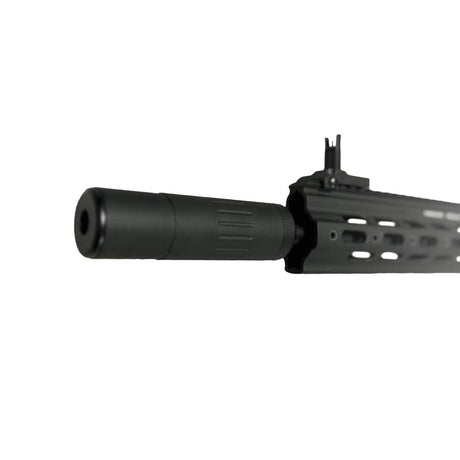
The most immediate difference you'll feel is the trigger response. In an AEG, there's a slight delay whilst the motor winds the gears; in an HPA build, the shot is instantaneous. This speed allows for faster follow-up shots and a more reactive playstyle. Additionally, because there's no clattering gearbox, HPA rifles can be incredibly quiet. When paired with a suppressor, your position becomes much harder to pinpoint on the field. Reliability in the British winter is another major draw. Whilst gas systems often fail as temperatures drop, HPA systems remain unaffected by the cold, providing peak performance year-round.
The Electropneumatic Engine Explained
Modern HPA setups rely on an electropneumatic engine controlled by a Fire Control Unit (FCU). The Fire Control Unit (FCU) serves as the "brain" of the HPA system. By using this interface, you can programme specific parameters such as poppet dwell and nozzle timing to suit your exact build requirements.
You'll typically choose between single and dual solenoid engines. Single solenoid versions are often more air-efficient and easier to install, whilst dual solenoid engines offer independent control over the nozzle and poppet. This allows for finer tuning of the feeding cycle and air volume, making this HPA beginner guide a vital resource for those seeking total control over their parts and upgrades. It's about total control.
The Essential HPA Gear Checklist: What You Need
Transitioning to a pneumatic platform requires more than just a drop-in engine. You're building an ecosystem where every component must work in harmony to deliver that promised performance. This HPA beginner guide breaks down the hardware you'll need to carry on your back and inside your RIF to ensure you're operational from the first whistle. It isn't just about the air; it's about the delivery system.
Choosing Your HPA Tank: Capacity and Material
Your air bottle is your lifeline on the field. You'll encounter two main specs: cubic inches (ci) for volume and PSI for pressure. A standard 48ci 3000 PSI aluminium tank is a solid, cost-effective starting point, but it's noticeably heavy during long stalks. Carbon fibre tanks are the premium alternative, offering higher pressure capacities (up to 4500 PSI) at a fraction of the weight. Weight matters when you're three hours into a milsim. Remember that UK regulations are strict; carbon fibre bottles must undergo hydrostatic testing every five years, whereas aluminium tanks usually have a ten-year cycle. Adhering to official safety standards when handling these high-pressure vessels is non-negotiable for safe skirmishing.
Regulators and Lines: The Vital Connection
The regulator is the gatekeeper. It takes the thousands of PSI from your tank and steps it down to a manageable output, typically between 80 and 120 PSI. For the most demanding builds, a dual-stage regulator is the gold standard. It provides a more stable flow of air, which is the secret behind those laser-accurate follow-up shots. You'll also need a high-pressure line to bridge the gap between your rig and your RIF. While standard lines work, many veterans prefer an Integral Grip Line (IGL). This replaces the standard plastic macro-line with a robust, braided lead that's far more resistant to the rigours of woodland play. Ensure your line is long enough to move freely but short enough to stay tucked against your clothing and gear to avoid snagging on branches.
Powering the Brain
Don't overlook the power source for your Fire Control Unit. While HPA provides the propulsion, the FCU still requires a small 7.4v LiPo battery to cycle the solenoids. These batteries are incredibly compact, easily fitting into a pistol grip or stock tube. It's a small but vital link in the chain that keeps your system firing. If you're unsure which connectors you need, checking our FAQ can help clarify common compatibility questions. Every piece of the puzzle counts when you're aiming for total reliability.
AEG Conversion vs Purpose-Built HPA Rifles
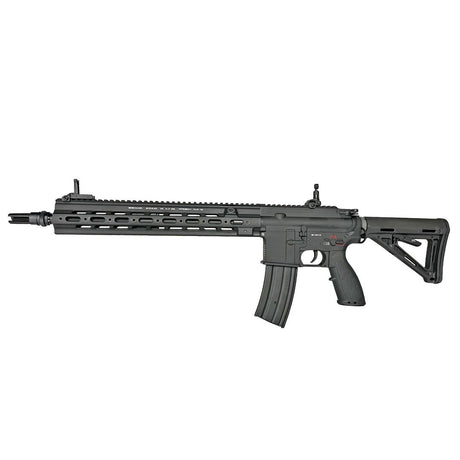
Deciding between gutting your favourite rifle or investing in a dedicated platform is the most significant fork in the road for any new player. For many, the appeal of a conversion lies in familiarity. If you already own a RIF with perfect ergonomics and a solid external build, dropping in an engine can feel like a natural evolution. Many Tokyo Marui compatible platforms are ideal candidates for this process, allowing you to retain your preferred aesthetic whilst completely overhauling the performance. However, this HPA beginner guide must emphasise that a successful conversion requires more than just basic tools; it demands precision.
Purpose-built rifles represent the other side of the coin. These are designed from the ground up to run on air, bypassing the limitations of modified AEG components. Whilst the initial investment for a dedicated platform is higher than a standalone engine, you're paying for perfect factory alignment and a system that's ready to skirmish from the moment you leave the shop. It's a choice between the satisfaction of a custom build and the out-the-box reliability of a specialised tool.
Converting Your AEG: What to Consider
The biggest hurdle in any DIY conversion is nozzle alignment. Standard AEG gearbox shells weren't designed for pneumatic engines, meaning even a tiny deviation in how the engine sits can lead to inconsistent feeding or mid-cap syndrome. You'll often need to modify your motor grip to allow the high-pressure line to pass through, and you might find that certain parts and upgrades are necessary to get the hop-up unit and nozzle to play nicely together. It's a rewarding process, but one that often requires a seasoned veteran's touch to ensure the rifle remains competitive on the field.
The Out-the-Box HPA Experience
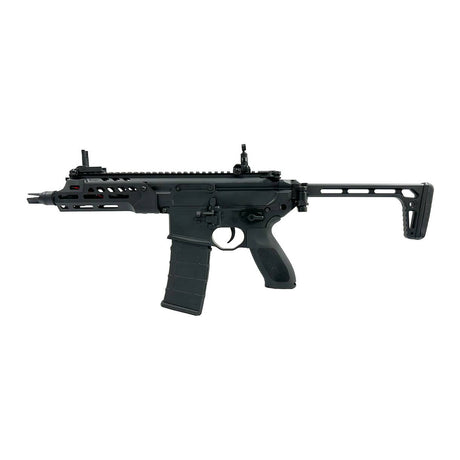
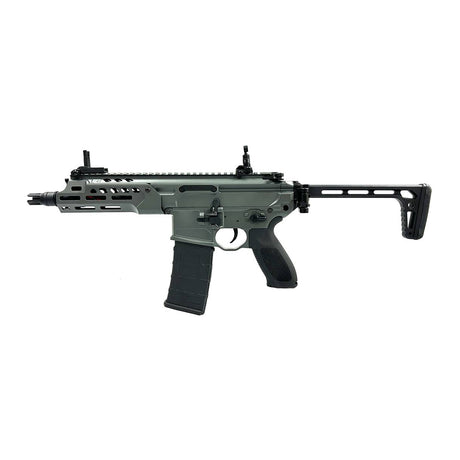
Dedicated HPA rifles like the Wolverine MTW series offer a level of structural integrity that conversions struggle to match. Because the engine is an integral part of the design, the alignment between the nozzle, hop-up, and barrel is fixed. This eliminates the "Frankenstein" build issues that can plague converted rifles. Maintenance is also simplified; there are fewer proprietary parts to worry about, and the entire system is streamlined for performance. If you want to avoid technical headaches and focus purely on the game, a purpose-built rifle is the gold standard. It delivers the grit and precision that experienced practitioners expect without the trial-and-error of a manual installation.
Once your kit is assembled, the transition from the workshop to the staging area requires a solid understanding of field compliance. The real advantage of HPA is its adaptability; unlike an AEG where you're swapping springs to change power, HPA allows you to dial in your performance at the chronograph using your regulator. This HPA beginner guide emphasises that whilst most UK sites talk in Feet Per Second (FPS), the law is defined in Joules. For fully automatic RIFs, the legal limit is 1.3 Joules, whilst semi-automatic or single-shot rifles can go up to 2.5 Joules. Exceeding these figures classifies the device as a Section 5 firearm, so precision during setup is paramount. To maintain this consistency, you must use high-quality BLS Airsoft BBs. Because HPA engines are incredibly stable, any variation in shot placement is usually down to the ammunition. Cheaper BBs with internal air bubbles or inconsistent diameters will negate the performance gains of your engine. By using premium consumables, you ensure that every pulse of air from your regulator translates into a predictable, accurate shot.Tournament Locks and Fair Play
Integrity is the backbone of the UK airsoft scene. Sites require a "tournament lock" on your regulator to prevent on-the-fly power adjustments after you've passed the chronograph. This is usually a simple zip-tie through the regulator cap or a dedicated 3D-printed cover that prevents the adjustment screw from being turned. Securing your rig shows you're a professional player who respects site safety and your fellow skirmishers. Maintaining a positive reputation amongst the community is vital; nobody wants to play against someone who "cranks the tank" mid-game.Dwell Tuning for Efficiency
Dwell is the setting that defines your air efficiency and is managed through your Fire Control Unit (FCU). Dwell controls how long the solenoid stays open. If the dwell is too high, you're wasting air after the BB has already left the barrel; if it's too low, you'll see a drop in velocity and consistency. Finding that sweet spot ensures your tank lasts through a full day of heavy engagement without needing a refill. If you're ready to hit the field with a fully optimised setup, make sure you stock up on essential HPA consumables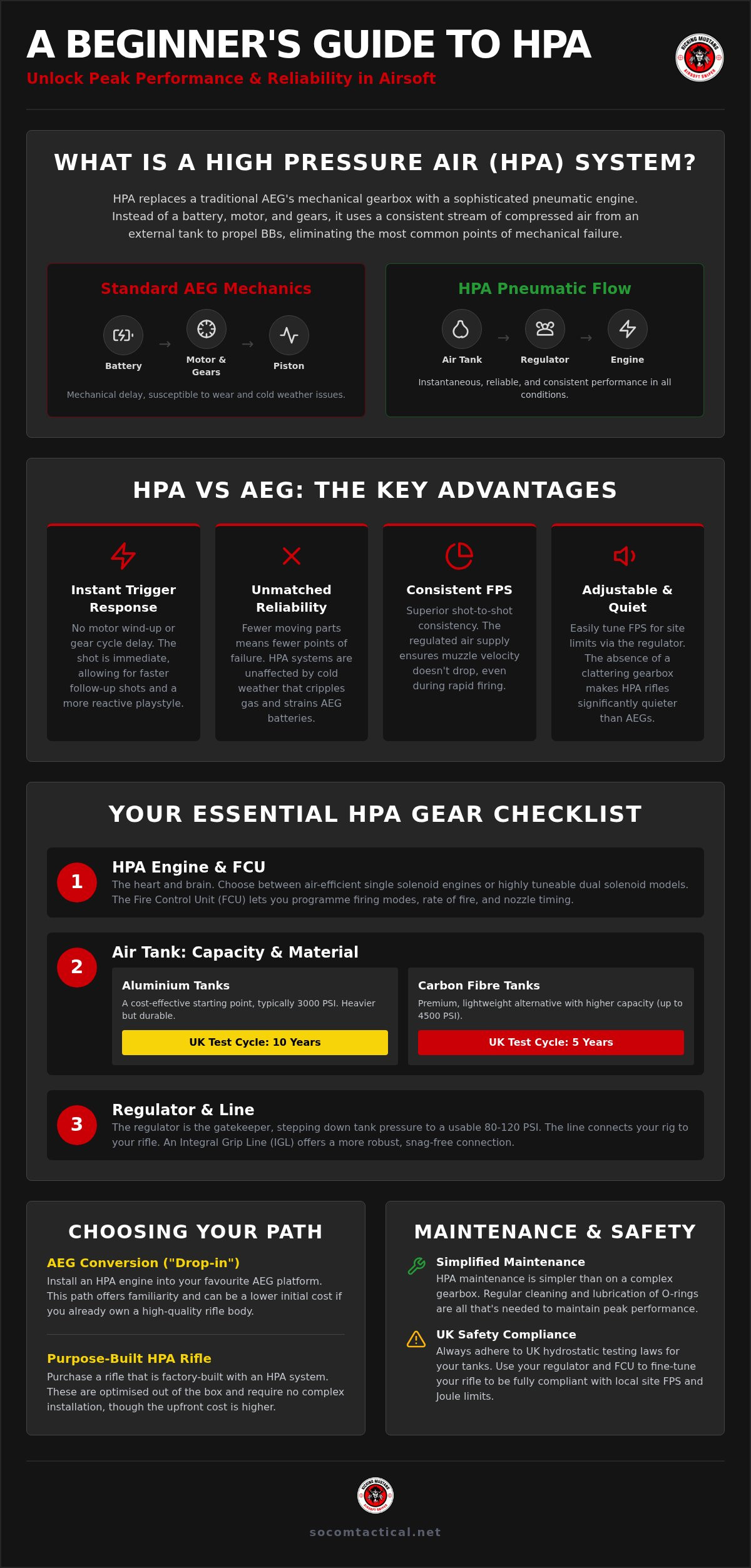
Maintenance and Expert Support for HPA Systems
While pneumatic systems are renowned for their ruggedness, they aren't entirely "set and forget". A common misconception debunked by any reliable HPA beginner guide is that air systems require zero upkeep. In reality, the maintenance is simply different. You've traded a complex gearbox full of grease-caked gears for a precision-engineered engine that relies on airtight seals. Keeping those seals in peak condition is the difference between a rifle that lasts a season and one that remains field-ready for years of hard skirmishing.
The HPA Maintenance Ritual
Your primary focus should be O-ring health. These small rubber rings are the only moving parts in many engines, and they require high-quality silicone grease to prevent drying out or cracking. Never use petroleum-based lubricants; these will degrade the rubber and cause catastrophic leaks. After a dusty skirmish, ensure you clean your precision inner barrel and the engine nozzle to prevent debris from entering the solenoid. Electronics also need care. Whilst the FCU is tucked away, it's vital to protect it from moisture during wet UK game days. When storing your gear, always leave a small amount of pressure in your tank to keep the seals seated, but never store a fully pressurised bottle in direct sunlight or extreme heat.
Professional Servicing at Socom Tactical Airsoft
There comes a point where DIY maintenance isn't enough. If you're experiencing inconsistent velocity or feeding issues that a simple clean can't fix, it's time to seek professional technical labour. Our technicians specialise in advanced fault diagnosis, ensuring your engine alignment is perfect and your dwell settings are fully optimised for your specific barrel length. Whether you're building a high-speed CQB monster or a silent marksman rifle, expert intervention from Socom Tactical Airsoft provides the peace of mind that your kit won't fail when the pressure is on. We also stock the latest consumables and accessories to ensure your maintenance kit is as ready as your rifle. High performance is a shared identity here; we don't just sell gear, we ensure it's a reliable tool for your broader experience.
Elevate Your Game with High Pressure Precision
Transitioning to pneumatic power is more than a simple upgrade; it's a fundamental shift in how you engage on the field. By mastering the mechanics of solenoids and ensuring your gear meets UK site compliance with proper tournament locks, you've already bypassed the most common hurdles new players face. This HPA beginner guide has laid the essential groundwork, from choosing between a rugged conversion and a purpose-built rifle to establishing a reliable maintenance ritual.
As a skirmisher-founded business established in 2009, Socom Tactical Airsoft has seen the hobby evolve first-hand. We provide UK-based expert technical support and a huge range of HPA brands and parts to keep your kit operational. Whether you're chasing instant trigger response or winter-proof reliability, we have the specialised tools you need to stay competitive. Every component we stock is chosen for its functional utility, ensuring you're always field-ready.
Explore our full range of HPA-ready Airsoft Guns and Accessories at Socom Tactical Airsoft and take the first step towards total field dominance. The next skirmish is calling; make sure your rifle is as ready as you are.
Frequently Asked Questions
Is HPA airsoft legal in the UK?
HPA airsoft RIFs are entirely legal in the UK provided they adhere to the muzzle energy limits defined by the Policing and Crime Act 2017. For fully automatic rifles, the legal limit is 1.3 Joules; for semi-automatic or single-shot rifles, the limit is 2.5 Joules. Exceeding these thresholds reclassifies the device as a Section 5 firearm. Always ensure your regulator is tournament-locked to remain compliant with site-specific safety rules and national legislation.
How many shots do I get from a standard HPA tank?
A standard 48ci 3000 PSI aluminium tank typically provides between 1,500 and 3,000 shots, depending on your engine's efficiency and dwell settings. High-pressure carbon fibre tanks rated at 4500 PSI can offer significantly more capacity, often exceeding 4,000 shots. Factors such as barrel length, BB weight, and the ambient temperature of your engine's internal components will also influence your total air consumption during a full day of skirmishing at your local site.
Can I fill my HPA tank with a standard bicycle pump?
You cannot use a standard bicycle pump to fill an HPA tank because they aren't designed to reach the extreme pressures required. Most airsoft tanks operate at 3000 or 4500 PSI, whereas a high-quality bike pump might only reach 120 PSI. Attempting this is impossible and dangerous. You must use a dedicated high-pressure compressor, a scuba diving tank with a fill station, or a specialised high-pressure stirrup pump designed for PCP air rifles.
Do HPA guns require a battery to operate?
Most modern HPA systems are electropneumatic and require a small 7.4v LiPo battery to power the Fire Control Unit and cycle the solenoids. This battery is much smaller than a standard AEG pack and usually lasts for several game days. However, fully mechanical engines like the Wolverine Kythera operate entirely on air pressure without any electronics. This HPA beginner guide highlights that choosing between electronic and mechanical systems depends on your preference for realism.
Where can I get my HPA tank filled in the UK?
Most dedicated airsoft skirmish sites in the UK now offer high-pressure air fill stations as part of their facility fees. If your local site doesn't provide air, you can visit scuba diving centres or specialised paintball shops that have the necessary compressors. Some players also invest in their own 300-bar scuba diving bottles to act as a mobile fill station, allowing them to top up their tanks between games at the staging area.
Is HPA better than a Gas Blowback (GBBR) rifle?
HPA offers superior consistency and cold-weather reliability compared to GBBR systems, which often suffer from the "cool-down effect" during rapid fire. While GBBRs provide a more realistic recoil impulse and mechanical feel, HPA engines excel in precision and shot-to-shot velocity stability. For players who prioritise performance and easy power adjustment across different UK sites, HPA is typically the more effective choice, whereas GBBRs remain the favourite for pure military simulation and immersion.
What happens if my HPA line gets snagged during a game?
Snagging a line on thick brush or tactical gear can lead to damaged fittings or disconnected leads if you aren't using robust equipment. To mitigate this risk, many practitioners upgrade to braided Integral Grip Lines (IGLs) that are more resistant to abrasion and tension. If a line does pull loose, the regulator's quick-disconnect fitting should safely seal the air. Properly routing your line through your plate carrier or chest rig is essential for maintaining operational readiness.
How much does a basic HPA setup cost to get started?
A basic setup involves either a purpose-built rifle, which typically starts around £550, or a conversion engine ranging from approximately £345 to £410. You will also need a tank, line, and regulator bundle, with entry-level options starting at roughly £120. While the initial investment is higher than a standard AEG, the long-term reliability and reduced mechanical wear often make it a cost-effective choice for serious players seeking to move beyond traditional gearbox limitations.