That heavy aluminium cylinder hanging off your back isn't just a burden; it's a tactical liability that drains your stamina long before the final whistle. We've all experienced the fatigue of a bulky setup during a weekend-long event, whilst the nagging worry about regulator compatibility or safety testing lingers in the back of your mind. You deserve an HPA Tank that provides a lightweight, reliable air source that keeps your FPS consistent regardless of the British weather. It's about finding that perfect balance between high-capacity endurance and operational agility on the field.
This guide will help you master the technical nuances of High Pressure Air systems to ensure your airsoft platform delivers maximum consistency and field-ready reliability. We'll cut through the confusion surrounding PSI ratings and provide a clear breakdown of the latest UK "Rho" mark regulations and hydro-testing laws. From understanding the 15-year lifespan of carbon fibre to selecting a regulator that won't let you down in the heat of a high-stakes engagement, you're about to gain the insider knowledge needed to build a truly professional-grade HPA setup that lasts all day.
Key Takeaways
- Learn why switching to a high-quality HPA Tank provides unparalleled FPS consistency and reliability regardless of the temperature on the field.
- Compare the benefits of budget-friendly aluminium against the lightweight, high-capacity performance of carbon fibre cylinders for long-duration events.
- Understand the critical relationship between tank volume and PSI ratings to ensure you have enough air to last through every skirmish.
- Stay legal and safe by mastering UK hydro-testing requirements and the essential daily maintenance steps for your pressure vessels.
- Discover how to build a leak-free setup using expert-approved components and technical support from a specialist UK retail centre.
Understanding High Pressure Air: Why Switch to an HPA Tank?
High Pressure Air (HPA) systems utilise a regulated, compressed air source to drive an airsoft engine. This technology relies on sophisticated Pressure vessel design and safety standards to contain thousands of pounds per square inch safely. Unlike traditional gas systems that rely on liquid-to-gas expansion, an HPA Tank provides a stable, dry pressure source that remains unaffected by the physical state of the propellant. It's the ultimate solution for players who want to eliminate the variables that plague standard builds.
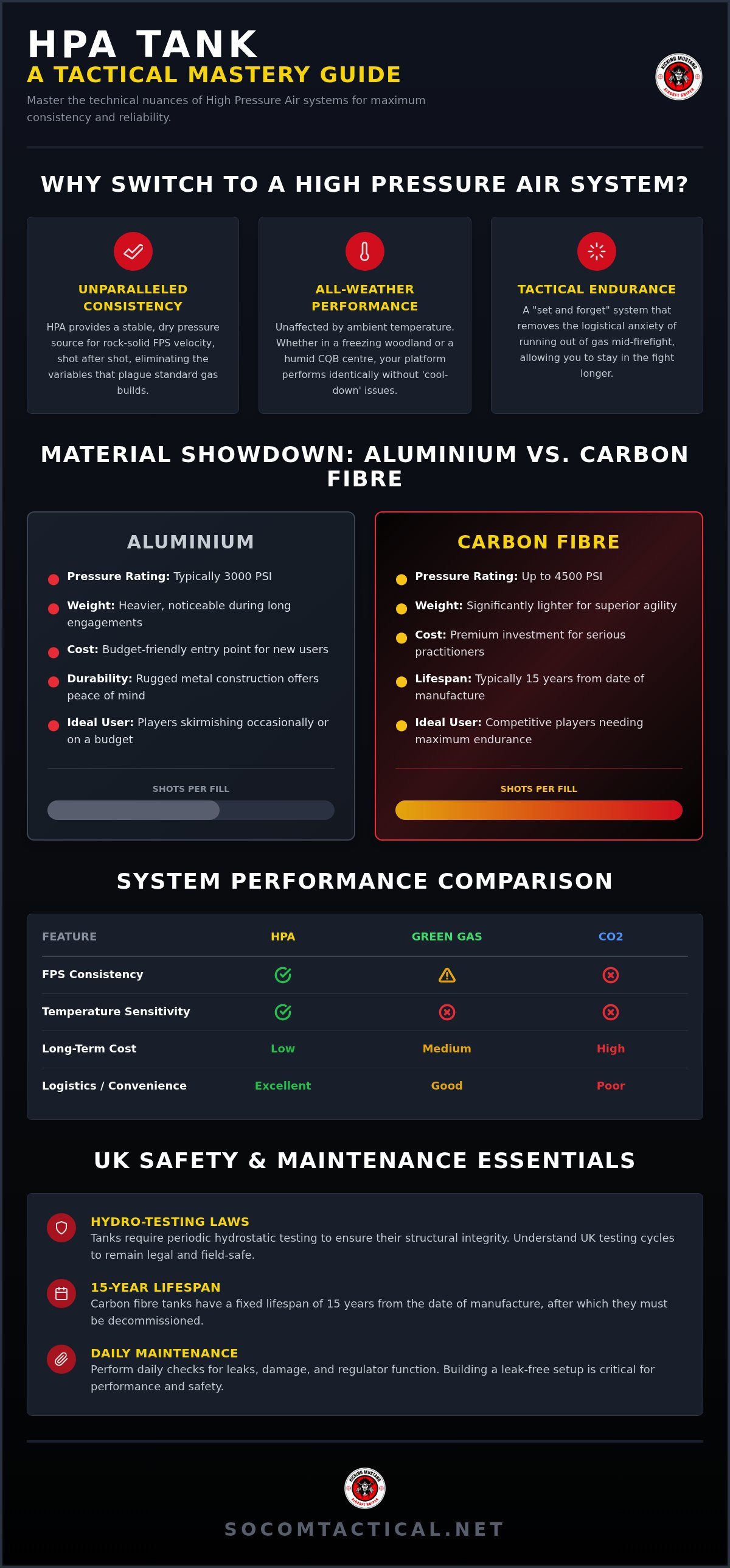
The primary advantage of this system is incredible FPS consistency regardless of the ambient temperature. Green gas and CO2 are notoriously fickle; they're susceptible to the "cool-down" effect where rapid fire causes the liquid gas to chill, leading to a massive drop in muzzle velocity. HPA doesn't suffer from this thermal volatility. Whether you're playing in a freezing Midlands woodland or a humid indoor CQB centre, your airsoft platform will deliver the exact same power on every single shot. This level of predictability is essential for competitive play where every millimetre of accuracy counts.
Forget faffing with gas cans or proprietary magazines between rounds. Once your tank is filled and your regulator is locked in, you can focus entirely on the mission. It's a "set and forget" system that removes the logistical anxiety of running dry mid-firefight. Whilst some purists argue that the airline breaks the immersion of a realistic loadout, the performance gains and operational readiness are undeniable for any serious practitioner. You aren't just buying air; you're buying the confidence that your kit will perform exactly as expected under pressure.
The Performance Benefits of HPA Systems
HPA systems completely eliminate the erratic behaviour often found in Gas Blowback (GBB) platforms. Because the air is already in a gaseous state, there is no thermal shock to internal seals or components, which significantly increases the longevity of your engine. You also gain the ability to fine-tune your rate of fire and muzzle velocity instantly via the regulator, allowing you to adapt to different site limits in seconds. HPA is the gold standard for high-performance airsoft platforms in 2026.
HPA vs Green Gas and CO2: A Tactical Comparison
When you look at long-term costs, HPA wins on efficiency every time. Disposable CO2 bulbs are expensive and generate significant waste. By contrast, refilling an HPA Tank at a specialist consumables centre costs significantly less per shot over the life of the vessel. This reliability is exactly why HPA is favoured amongst snipers and DMR players who need absolute shot-to-shot certainty to hit targets at long range.
Logistically, carrying one large air source on your back is far simpler than carrying multiple gas cans or dozens of CO2 capsules in your tactical rig. It streamlines your loadout and ensures you have enough air to last for an entire skirmish without needing to return to the safe zone. This tactical endurance allows you to stay in the fight longer and maintain pressure on the opposition without interruption.
Aluminium vs Carbon Fibre HPA Tanks: Which Material Wins?
Choosing your first HPA Tank is a pivotal moment in your airsoft career. It's the point where you decide between the rugged, cost-effective reliability of aluminium and the high-performance, lightweight agility of carbon fibre. Both materials serve a specific purpose on the field; your choice ultimately dictates how much kit you can carry and how long you can stay in the fight before fatigue sets in. It isn't just about the price tag; it's about how the weight affects your operational readiness during a long day of skirmishing.
Aluminium Tanks: The Rugged Entry-Level Standard
Aluminium bottles are the budget-friendly entry point for new users. These cylinders are typically rated for 3000 PSI, providing enough air for several intense rounds. They're built for punishment. If you're a player who thrives in dense woodland or crawls through rough terrain, the solid metal construction offers peace of mind. They're ideal for those who skirmish once a month or aren't ready to invest in a premium setup just yet. However, that durability comes with a weight penalty that becomes very apparent during a six-hour engagement.
Carbon Fibre Systems: Lightweight Tactical Performance
For the serious practitioner, carbon fibre systems represent the gold standard. These tanks are rated for 4500 PSI, allowing for significantly more shots per fill than aluminium. The construction is a marvel of engineering, using a multi-layer design that wraps a lightweight liner in high-strength carbon filaments. This allows for a massive reduction in weight without compromising on safety. Carrying a carbon fibre tank feels like cheating; you get more air with less strain on your back, keeping your movements sharp and your aim steady.
It's a common misconception that smaller tanks are always lighter. In reality, a large carbon fibre HPA Tank often weighs less than a much smaller aluminium bottle. This weight reduction is crucial for maintaining mobility whilst wearing a full plate carrier or chest rig. Because you're dealing with immense pressure, adhering to standards for HPA tank safety and handling is vital for every player. Proper storage and transport ensure your kit remains field-ready for years to come.
Selecting the right vessel is just the start of your journey. You'll also need the right clothing and gear to carry your air source comfortably during long events. If you're still torn between the two materials, come down to our shop in Fleet to feel the weight difference for yourself before making your final decision.
Sizing and Pressure: Navigating 3000 PSI vs 4500 PSI
Understanding the relationship between tank volume and pressure is the key to managing your field endurance. Your HPA Tank capacity is a product of its physical size, measured in cubic inches or litres, and the pressure it can safely hold, measured in PSI. A 4500 PSI tank squeezed into the same physical footprint as a 3000 PSI bottle will hold roughly 50% more air. This isn't just a technical detail; it's the difference between retreating to the safe zone for a refill mid-game or holding the line during a final objective push.
Your shot count is also heavily influenced by your specific airsoft engine. Polarstar engines offer incredible tunability for those who love to tinker with dwell settings, whilst Wolverine systems are often praised for their out-of-the-box air efficiency. As a general rule of thumb, a standard 48ci 3000 PSI aluminium tank provides between 1,500 and 2,000 shots. If you move up to a 68ci 4500 PSI carbon fibre vessel, you can expect well over 3,000 shots. For snipers or those using a tank-on-stock configuration, a compact 13ci bottle offers roughly 500 shots, which is plenty for a low-profile, high-precision role.
Capacity and Volume Explained (ci and Litres)
UK players often find themselves caught between American "ci" (cubic inch) measurements and the European Litre standard. A standard 48ci bottle is roughly equivalent to 0.8L, whilst the larger 68ci tanks equate to approximately 1.1L. When selecting your size, consider your tactical gear. A 48ci 3000 PSI setup is the most common starting point for UK players because it fits comfortably in most standard hydration carriers. If you prefer a minimalist approach, smaller 13ci bottles can be mounted directly to your stock, though you'll need to monitor your air levels more closely during intense firefights.
Selecting the Right Regulator for Your Tank
A tank is only as good as the regulator that controls it. The internal pressure of your HPA Tank is far too high for an airsoft engine, so it must be stepped down. The tank's primary regulator drops the pressure to a standard output, usually around 800 PSI. You then require a secondary regulator to bring that down to a usable 80-120 PSI. Look for regulators with high refresh rates; this ensures that even during rapid-fire strings, your FPS remains rock-solid. With your air delivery perfected, you can focus on target acquisition by pairing your setup with precision Airsoft Red Dot & Holo Sights for a complete, field-ready platform.
HPA Tank Safety, Maintenance, and Hydro-Testing
Operating a High Pressure Air system brings immense performance benefits, but it also carries the responsibility of managing a high-energy pressure vessel. An HPA Tank must be treated with absolute respect. A structural failure at 4500 PSI is not just a gear malfunction; it is a significant safety hazard. You must integrate a rigorous inspection routine into your pre-game kit prep to ensure your equipment remains field-ready and safe for everyone at the site.
Perform a daily visual inspection before every skirmish. Check the outer shell for deep gouges, cracks, or fraying in the carbon fibre weave. Pay close attention to the regulator threads; any signs of cross-threading or metal fatigue mean the tank is compromised. Crucially, never allow oils, greases, or petroleum-based lubricants anywhere near the fill nipple or regulator intake. Under high pressure, these substances can spontaneously combust, leading to a catastrophic "diesel effect" explosion. If you need to lubricate your system, use only specialised, manufacturer-approved silicone oils on the low-pressure side.
Proper storage is equally vital for longevity. Store your cylinders in a cool, dry environment away from direct sunlight, which can degrade the outer resin over time. Always leave a small amount of residual air, roughly 500 PSI, inside the bottle. This positive pressure prevents moisture and contaminants from entering the vessel, protecting the internal walls from corrosion.
Understanding Hydrostatic Testing Requirements
In the UK, it is a legal and safety requirement for HPA tanks to undergo hydrostatic testing every 5 years. Carbon fibre tanks have a fixed service life of 15 years from their date of manufacture. You can find the "born on" date stamped on the bottle or printed on the label under the clear coat. Any tank manufactured after 1st January 2023 must display the UK "Rho" (ρ) mark to be legally placed on the Great Britain market; older tanks bearing the EU "Pi" (π) mark remain valid for use until their next test date. Never attempt to fill a tank that is out of test or shows structural damage.
Field Safety and Refilling Best Practices
Always use clean, dry air from a specialised source. Standard workshop compressors often introduce moisture and oil vapour that will destroy your engine's internal seals. We recommend using a dedicated divers pump or visiting a professional shop. For guaranteed purity and expert handling, you can utilise our in-store HPA refill services at our Fleet retail outlet to keep your system running at peak efficiency. Finally, never exceed the maximum PSI rating stamped on your bottle. If it says 3000 PSI, do not let a field tech "over-clock" it to 4500 PSI just for a few extra shots. Safety always overrides performance.
Building Your Perfect HPA Setup with Socom Tactical Airsoft
Transitioning to High Pressure Air is a significant upgrade that demands more than just a premium HPA Tank. To truly master the field, you must view your setup as a cohesive ecosystem where every component, from the engine to the smallest QD fitting, plays a vital role. Using substandard air lines or cheap, generic fittings is the quickest way to ruin a weekend with persistent leaks. Socom Tactical Airsoft prioritises field-readiness by stocking only the most reliable connectors and high-flow macrolines that can handle the rigours of aggressive movement and high-stakes engagements.
If you're looking to push your platform to its absolute limit, our extensive range of parts and upgrades provides the precision components needed for peak efficiency. Whether you're installing a new FCU or fine-tuning your nozzle alignment, having the right internal parts ensures your system doesn't just work, but dominates. We encourage all players to visit our retail shop in Fleet. There's no substitute for hands-on advice and the ability to test your system with the Socom Tactical Airsoft team before heading to your next major event.
Expert Advice and Technical Support
Our team isn't just a group of retailers; we're passionate participants who understand the grit and precision required for competitive play. Socom Tactical Airsoft offers a dedicated technical labour and repair centre specifically for HPA engines and regulators. If your tank seals are failing or your regulator's refresh rate seems sluggish, our experts can diagnose and resolve the issue quickly. Don't let technical gremlins sideline you during a crucial mission. You can contact us today for bespoke advice on your next HPA build or to book your kit in for a professional service.
The Socom Tactical Airsoft Advantage
Choosing a UK-based specialist with a physical presence gives you a layer of security that anonymous online storefronts simply can't match. Socom Tactical Airsoft has built its reputation on community camaraderie and technical authority, ensuring every piece of gear we sell is fit for purpose. For those new to the system, our FAQ page offers quick answers to common questions about gassing, maintenance, and site-specific rules. It's time to stop compromising on your equipment. Browse our latest HPA arrivals and back-in-stock items to complete your ultimate tactical loadout today.
Ready Your Platform for the Next Engagement
Mastering the technical nuances of your air source is the final step in achieving professional-grade field performance. By opting for a carbon fibre HPA Tank, you've prioritised mobility and consistency, ensuring your platform delivers rock-solid FPS from the first whistle to the final objective. Understanding the safety requirements and UK hydro-testing cycles isn't just about compliance; it's about maintaining a reliable system that responds with precision in every high-stakes engagement.
As an authorised dealer for Polarstar and Wolverine, Socom Tactical Airsoft provides the expert support needed to transition from traditional gas systems with total confidence. Our on-site expert HPA technical centre is ready to fine-tune your engine, whilst our UK-wide shipping ensures your gear arrives ready for the next skirmish. Socom Tactical Airsoft doesn't just provide equipment; we offer the technical grit and community expertise that experienced practitioners expect from a specialist retail partner.
Upgrade your loadout with our professional HPA Tank collection and experience the tactical endurance of a truly optimised setup. It's time to leave the limitations of green gas behind and embrace the gold standard of airsoft performance. We'll see you on the field, fully equipped and ready for action.
Frequently Asked Questions
How long does a 48ci 3000 PSI HPA tank last in an airsoft game?
A standard 48ci 3000 PSI HPA Tank typically provides between 1,500 and 2,000 shots. This varies based on your engine efficiency and dwell settings. For most UK players, this capacity is sufficient for a full morning or afternoon session at a skirmish site. If you're heavy on the trigger in a high-intensity CQB environment, you may find yourself needing a refill sooner than a marksman would.
Can I fill my HPA tank with a standard bike pump?
No, a standard bike pump cannot reach the immense pressures required for an HPA Tank. Bike pumps usually max out at around 100 to 150 PSI, whereas these cylinders require 3,000 to 4,500 PSI. Attempting to use one is physically impossible and could damage the fill valve. You must use a specialised high-pressure stirrup pump, a divers bottle, or a professional compressor at a dedicated airsoft centre.
What is hydrostatic testing and how often do I need it in the UK?
Hydrostatic testing is a mandatory safety inspection required every 5 years in the UK. A qualified technician pressurises the vessel with water to check for structural expansion or leaks. This ensures the cylinder can safely hold its rated pressure without failing. Using a tank that is out of test is dangerous; many UK sites will refuse to fill it to protect their staff and other players from harm.
Is an HPA tank safe to carry on my back during a skirmish?
Yes, these tanks are incredibly safe when handled correctly and stored in a proper tactical carrier. They are designed to withstand significant impacts and are much tougher than they look. Carbon fibre models use a multi-layer wrap that provides immense structural integrity. As long as you perform your daily visual inspections for gouges and keep the regulator protected, carrying a tank in a hydration pouch is standard practice.
What is the difference between a 3000 PSI and a 4500 PSI regulator?
The primary difference is the maximum input pressure the regulator can safely manage. A 4500 PSI regulator is built with stronger internal components to handle the higher energy of a carbon fibre tank. Whilst some regulators are cross-compatible, you must always verify the rating before fitting. Using a 3000 PSI rated regulator on a 4500 PSI bottle will likely cause a burst disk to fail or cause catastrophic internal damage.
Do HPA tanks expire and how can I check the date?
Yes, carbon fibre cylinders have a 15-year total lifespan from the date of manufacture. You can check the "born on" date stamped directly onto the aluminium neck or printed on the label beneath the clear resin coat. In the UK, you must also look for the Rho or Pi marks to ensure compliance. Once the 15-year limit is reached, the tank must be decommissioned and cannot be re-certified for use.
Can I use a paintball HPA tank for my airsoft gun?
Yes, paintball tanks are physically compatible with airsoft systems as they use the same standard threads. The cylinders themselves are identical in terms of pressure ratings and safety standards. However, you will still need a secondary airsoft-specific regulator to drop the output pressure down to the 80 to 120 PSI range required by your engine. Most paintball tanks output at 800 PSI, which would instantly destroy airsoft internal seals.
What happens if I overfill my HPA tank?
Overfilling triggers a safety mechanism called a burst disk, which safely vents the air. If the pressure exceeds the safe limit, the copper disk inside the regulator will rupture to prevent the cylinder from exploding. This results in a very loud, sudden release of all stored air. If this happens, you'll need to replace the burst disk before the tank can be used again. Never attempt to bypass these safety features.