Your airsoft eye protection is the most critical piece of kit in your loadout, but if it's constantly fogging up, it's actually your biggest tactical liability. We've all been there; pinned down in a CQB corridor, ready to move, only for a wall of condensation to turn your world opaque. It's frustrating, it's dangerous, and it completely breaks your immersion in the game. You deserve gear that feels like a natural extension of your kit, not a barrier to your performance.
This guide helps you master the technical standards and field-tested gear needed to protect your vision whilst maintaining peak operational performance. You'll gain full confidence in your ballistic safety and learn how to achieve a seamless, fog-free integration with your helmets and masks. We'll break down the shift from EN 166 to the new EN ISO 16321-1:2022 standards, explain why ANSI/ISEA Z87.1-2025 ratings matter, and provide the methodology for choosing frames that actually fit.
Key Takeaways
- Understand the physics of high-velocity BB impacts and why high-street sunglasses are a dangerous liability that cannot withstand a single point of failure.
- Identify the essential markings for EN 166 and the new EN ISO 16321-1:2022 standards to guarantee your lenses provide the necessary ballistic resistance for UK sites.
- Determine whether full-seal goggles or low-profile ballistic glasses best suit your specific role, balancing maximum CQB safety with long-range visibility.
- Combat lens fogging by utilising thermal dual-pane technology and professional-grade anti-fog coatings to keep your vision clear in the heat of an engagement.
- Learn how to correctly fit and integrate your airsoft eye protection with tactical helmets and mesh masks for a comfortable, field-ready setup.
Why Quality Airsoft Eye Protection is Non-Negotiable
A single BB carries enough kinetic energy to cause permanent sight loss in a fraction of a second. Whilst high-street sunglasses might look the part for a photo op, they're built for UV protection, not ballistic impact. When a 0.20g or 0.25g projectile strikes a non-rated lens at 350 feet per second, the material doesn't just crack; it often shatters, sending shards directly into the eye. This is why professional-grade airsoft eye protection is the most vital investment you'll ever make. It's the difference between a great day out and a life-changing injury.
The "one shot" rule is a sobering reality in our community. You can replace a stripped piston or a burnt-out motor, but you can't replace your vision. Achieving safe participation in airsoft requires gear that meets stringent impact standards. Most UK sites now mandate a minimum of EN 166 B rating, which signifies resistance to medium energy impacts. Without this certification, you aren't just risking a site ban; you're gambling with your health. We've seen too many players turn up with unrated kit, only to be sent home before the first game starts.
The Risks of Substandard Gear
Choosing "budget" eye pro is a false economy. Cheap frames often use brittle plastics that fail under the stress of a close-range engagement. Even more concerning is the rise of mesh eye protection. Whilst it won't fog, mesh is increasingly banned at reputable UK sites because BBs can shatter upon impact, sending fragments through the gaps. We always recommend solid, polycarbonate lenses that provide a total seal. A frame failure is just as dangerous as a lens failure, so look for high-tier brands like Vortex Optics that prioritise structural integrity and meet the latest safety benchmarks.
Operational Confidence on the Field
High-quality airsoft eye protection does more than just stop projectiles; it enhances your tactical awareness. When you trust your kit, you eliminate "gear fear." You'll find yourself leaning into corners and holding aggressive angles because you aren't flinching at the thought of an incoming shot. Clear, wide-angle lenses maintain your peripheral vision, allowing you to spot movement in the treeline that cheaper, distorted lenses would miss. This operational readiness transforms eye pro from a safety requirement into an essential tool for a broader, more successful skirmish experience.
Understanding Ballistic Ratings: EN 166, ANSI, and MIL-SPEC
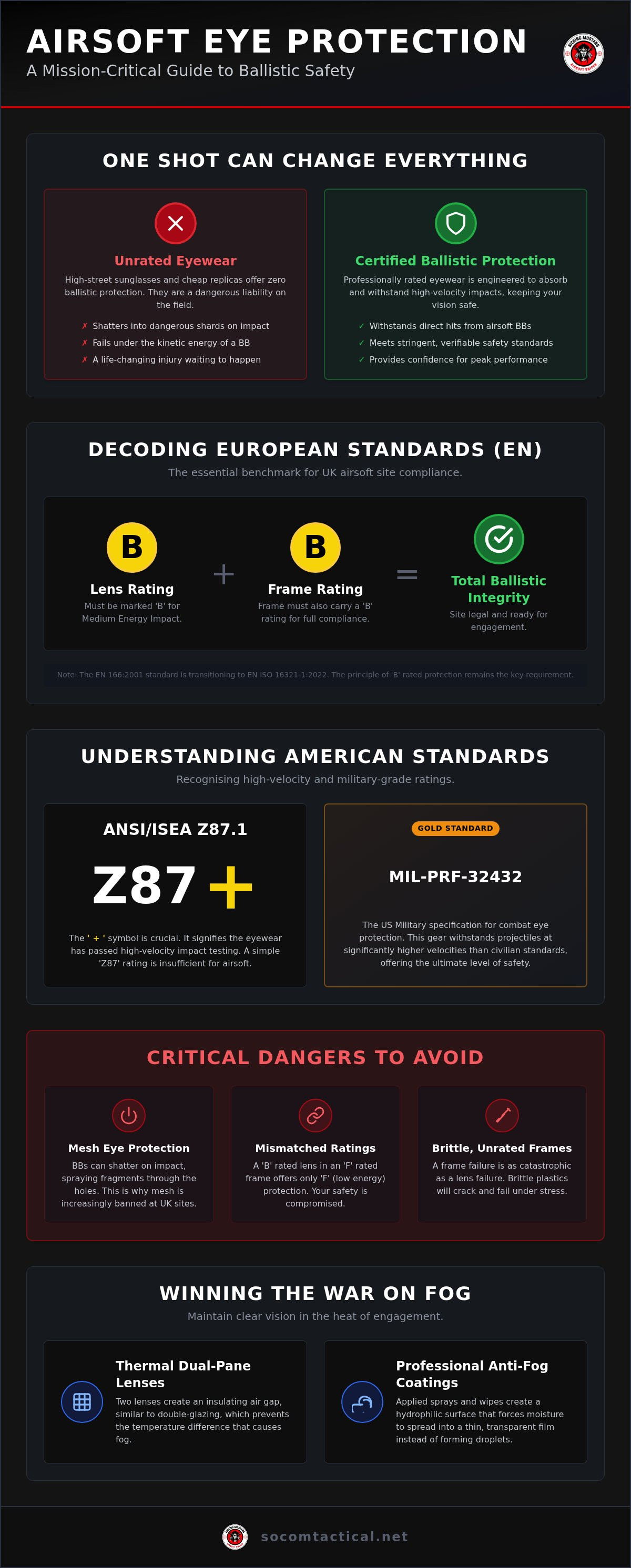
Standards aren't just red tape; they're the technical proof that your airsoft eye protection will survive the skirmish. Knowing how to read the codes on your lenses is as important as knowing your RIF's effective range. For UK players, the baseline has long been EN 166, but the landscape is shifting. As of April 2026, the harmonised EN 166:2001 standard was withdrawn, replaced by EN ISO 16321-1:2022. Whilst you'll still see EN 166 on plenty of current gear, understanding the nuances of these ratings is what keeps you safe in the line of fire.
The most common pitfall for new players is confusing "safety" with "ballistic." Across the pond, the ANSI/ISEA Z87.1 eye protection standard was updated to the 2025 version in January. For our hobby, a generic Z87 rating isn't enough. You must look for the "Z87+" marking. That plus sign indicates high-velocity impact testing, which is the civilian benchmark for tactical use. If you want the gold standard, look for MIL-PRF-32432. This US military specification requires eyewear to withstand projectiles at velocities significantly higher than civilian standards, ensuring your kit is truly field-ready for high-stakes engagements.
Decoding the EN 166 Stamp
For airsoft use, the EN 166 B rating is the essential benchmark to ensure your lenses can withstand medium energy impacts from high-velocity BBs. You'll typically find these markings etched into the corner of the lens or printed on the inside of the frame arms. It's a common mistake to overlook the frame rating. If your lenses are rated 'B' but the frames are only rated 'F' (low energy), the entire unit is technically only certified to the lower 'F' level. Always verify that both components meet the 'B' requirement for total ballistic integrity.
Impact Energy vs. BB Velocity
Ballistic testing often uses steel bearings to measure joules, but the physics of a 6mm plastic BB are different. A standard pair of DIY safety glasses might stop a slow-moving wood chip, but they lack the structural longevity to handle the concentrated kinetic energy of a sniper shot at 500 FPS. High-mass impact testing ensures the lens doesn't just stop the projectile but stays firmly seated in the frame. If you're unsure if your current setup is up to the task, check out our latest arrivals to find fully certified airsoft eye protection that meets these rigorous modern standards.
Goggles vs. Glasses: Choosing Your Tactical Vision
Deciding between goggles and glasses isn't just about aesthetics; it's about matching your gear to your specific playstyle and environment. If you're kicking down doors in a CQB site, your needs differ wildly from a marksman holding a treeline for four hours. Your airsoft eye protection must integrate with your existing loadout, specifically your helmet and comms, without creating dangerous gaps or painful pressure points. Choosing the wrong form factor can lead to "gear fatigue" halfway through a Sunday skirmish, forcing you to adjust your kit when you should be focused on the objective.
Full Seal Goggles for Maximum Protection
Goggles provide a complete rubber or foam seal around the orbital socket, offering the highest level of security against BBs entering at extreme angles. This is vital in high-intensity urban environments where fire can come from above or below. They also act as a barrier against dust and debris in wooded areas. For new players, goggles are the gold standard for safety. They integrate perfectly with lower face mesh masks to provide full-face coverage. Whilst they offer maximum protection, they do have a larger footprint on the face, which can sometimes interfere with the rim of a tactical helmet if not adjusted correctly. We recommend these for aggressive front-line skirmishers who prioritise safety above all else.
Low Profile Glasses for Mobility
Ballistic glasses offer superior airflow, making them a top-tier choice for reducing lens fogging in humid conditions. Because they lack the bulky foam surround of goggles, they allow for a much closer cheek weld when using optical sights and red dots. This is a massive advantage for snipers and marksmen who need a consistent sight picture. They also play better with FAST-style tactical helmets and active ear protection, as the thin arms don't break the acoustic seal of your ear cups. If you operate in high-heat environments or prefer a minimalist, lightweight setup, glasses are the way to go. Just ensure they're fitted with a retention strap to keep them secure during a sprint.
Many modern systems now utilise a "gasket" system. This is a removable clip-in seal that turns low-profile glasses into a hybrid goggle, offering the best of both worlds for the multi-role player. For those requiring corrective lenses, look for frames that support RX inserts. These sit securely behind the ballistic lens, ensuring you don't have to compromise on clarity or safety. Whether you're looking for a full-seal setup or a lightweight pair of glasses, check out our clothing and gear section to find the right fit for your next operation.
The War on Fog: Keeping Your Vision Clear
Fogging isn't just a nuisance; it's a tactical blindfold that can turn a winning flank into a walk back to the respawn point. In the humid UK climate, moisture management is just as critical as ballistic integrity. The battle against condensation starts with understanding the physics of your airsoft eye protection. Standard single-pane lenses often fail because the temperature difference between your face and the outside air causes water vapour to settle instantly. Thermal dual-pane lenses are the gold standard for high-intensity play because they create a sealed air gap that acts as a thermal barrier, much like double glazing in a house.
Whilst factory anti-fog coatings provide a solid baseline, they aren't permanent. Over time, sweat, oils, and improper cleaning will degrade these layers. Many players find success by supplementing their kit with active ventilation systems, such as ExFog units or micro-fans. These devices pull humid air away from the orbital socket, ensuring that even during a frantic sprint in a plate carrier, your vision remains crystal clear. If you're struggling to maintain clarity, it might be time to upgrade your setup by browsing our latest tactical gear arrivals.
Pro-Tips for Fog-Free Skirmishing
One of the most common causes of fogging is the "buff problem." When you pull a snood or face covering too high, your warm breath is redirected upwards, straight into the bottom of your goggles. To combat this, ensure there's a clear path for air to circulate. When cleaning your lenses, never use harsh household chemicals or abrasive cloths that can strip the factory anti-fog layer. Instead, use a dedicated microfibre cloth and specialised lens cleaners. Dual-pane lenses are the gold standard for preventing fogging because they equalise the temperature between the inner and outer surfaces of the lens.
Maintenance and Longevity
Your eye pro is a life-critical tool, so don't treat it like a disposable accessory. Inspect your lenses after every game day for micro-fissures or deep scratches. Even a small chip from a high-velocity BB can compromise the structural integrity of the polycarbonate, making it unsafe for future use. Sweat and dirt are also silent killers of gear; salt from perspiration can rot foam gaskets and weaken elastic straps if left uncleaned. Store your kit in a breathable pouch away from direct sunlight to prevent the coating from breaking down. To keep your headgear setup performing at its peak, check out our full range of clothing and gear for professional maintenance solutions.
Optimise Your Loadout at Socom Tactical
Socom Tactical isn't just another faceless storefront. Since 2009, we've been deeply rooted in the UK airsoft community, and every piece of airsoft eye protection we stock has been vetted by active skirmishers who know the grit of the field. We understand that your gear needs to survive more than just a single Sunday. It needs to endure season after season of hard use in the mud, rain, and heat of the British landscape. Our curated selection caters to every budget, from entry-level certified goggles to premium Vortex Optics. These high-tier lenses offer lifetime reliability, ensuring that your most critical piece of safety kit is a permanent fixture in your loadout.
Your eye protection is a vital component of a much larger tactical ecosystem. It must sit flush with your helmet, clear your mesh mask without creating pressure points, and stay secure whilst you're transitioning between your primary and secondary weapon. We prioritise seamless integration across our entire range of clothing and gear. This focus on functional utility means you can focus on the mission, confident that your equipment won't fail when the engagement intensifies.
Why Order from Socom Tactical?
We know the frustration of waiting for kit when a big game is on the horizon. That's why we prioritise fast national shipping to ensure you're field-ready before the weekend briefing. You'll always find the latest new products in tactical safety on our shelves, keeping you ahead of the curve with the latest ballistic innovations. If you're unsure about compatibility or specific safety ratings, our technical team is standing by to offer expert advice. You can also find quick answers to common equipment queries in our FAQ section.
Complete Your Tactical Setup
True performance comes from a balanced and reliable loadout. Once you've secured your vision, it's time to focus on your offensive capabilities. Pairing your eye pro with one of our high-performance AEG Airsoft Rifles ensures you have the range and accuracy to match your newfound clarity. Don't forget to stock up on consumables like high-grade BBs and gas to keep your platform running throughout the day. For a deeper dive into building a professional-tier kit, check out our UK Tactical Gear Guide for more essential tips on modern equipment.
Secure Your Vision for the Next Operation
Mastering the technical nuances of ballistic ratings and moisture management is what separates a seasoned operator from a casual participant. By prioritising the EN 166 B standard and investing in dual-pane thermal technology, you ensure that your airsoft eye protection remains a tactical asset rather than a liability. Whether you're clearing rooms in a high-intensity CQB site or holding a long-range angle in the woods, your focus should always be on the objective, not on clearing a fogged lens or worrying about impact integrity.
Socom Tactical has supported the UK community since 2009, providing the expert technical support you need to build a field-ready loadout. As a leading UK stockist of high-tier brands like Vortex Optics, we're dedicated to helping you find gear that survives the toughest engagements. Don't leave your safety to chance when you can rely on equipment tested by active skirmishers. Upgrade your protection at Socom Tactical today and experience the difference that professional-grade gear makes. We'll see you in the briefing room, ready for the next round.
Frequently Asked Questions
What is the best airsoft eye protection for players with glasses?
Players who wear corrective lenses should opt for high-volume OTG goggles or frames that accept RX inserts. OTG models provide enough internal clearance to house your everyday spectacles comfortably. However, RX inserts are the superior choice for high-intensity movement because they stay fixed to the frame. This prevents your glasses from slipping or rattling during a sprint, ensuring your vision remains stable whilst maintaining full ballistic safety on the field.
Is mesh eye protection safe for UK airsoft sites?
Mesh eye protection is increasingly banned at UK sites because it cannot prevent BB fragmentation. When a high-velocity projectile strikes wire mesh, it can shatter into tiny plastic shards that pass through the gaps. To ensure your safety and site compliance, always choose polycarbonate lenses. These provide a solid barrier against both the BB and any debris, protecting your sight from the catastrophic risks associated with fragmented projectiles in close-quarters engagements.
What does the EN 166 B rating actually mean for airsoft?
The EN 166 B rating signifies that the lens and frame can withstand a medium energy impact from a 6mm steel ball travelling at 120 metres per second. This is the minimum benchmark for reliable airsoft eye protection at UK skirmish sites. Whilst 'F' rated glasses are common in DIY shops, they only resist low-energy impacts. Always verify the 'B' stamp on your kit to ensure it can handle the kinetic energy of high-velocity airsoft rounds.
How do I stop my airsoft goggles from fogging up?
Preventing fogging requires a combination of dual-pane thermal lenses and active airflow management. You can also utilise aftermarket anti-fog sprays or install an ExFog system to pull humid air away from your face. Managing your headgear is just as important; avoid blocking the top vents of your goggles with a helmet or hat. This allows heat to escape naturally, keeping your vision clear even during the most demanding phases of a game.
Can I use standard safety glasses for airsoft?
Most standard safety glasses designed for DIY or laboratory work are not suitable for airsoft because they lack high-velocity ballistic ratings. Unless the frames and lenses are explicitly marked with EN 166 B or ANSI Z87+, they may shatter upon impact. Tactical eyewear is engineered specifically for high-mass, high-speed projectiles. Using unrated hardware is a dangerous gamble that isn't worth the risk to your vision when certified gear is readily available.
How often should I replace my airsoft goggle lenses?
You should replace your lenses immediately if they sustain a heavy direct hit or show signs of micro-fissures, deep scratches, or pitting. Even if the lens didn't break, the structural integrity of the polycarbonate is compromised after a significant impact. We also recommend refreshing your lenses every 12 to 24 months if you're a regular player. This ensures the factory anti-fog coatings and the material's flexibility remain at peak performance levels for every skirmish.
What is the difference between thermal and dual-pane lenses?
There is no functional difference; both terms refer to a lens system consisting of two separate layers with a sealed air gap between them. This construction acts as a thermal buffer, preventing the inner lens from cooling down too quickly and causing condensation. It's the most effective passive solution for maintaining clear vision. Investing in this technology is essential for UK players who frequently transition between cold woodland air and high-heat indoor environments.
Do I need full-seal goggles for CQB airsoft?
Full-seal goggles are highly recommended for CQB because fire often comes from unpredictable, close-range angles. In tight corridors or multi-level buildings, a BB can easily find the gap in low-profile glasses. A complete rubber or foam seal ensures that no projectile or fragment can reach your eyes. Many indoor sites mandate full-seal airsoft eye protection as part of their insurance requirements, so it's a vital addition to your urban loadout.