What if the best move in an airsoft game isn’t pushing forward, but pausing long enough to make a better decision together? When the route to cover is unclear, calls get muddled or the objective changes, a squad can lose momentum fast. Tactical Gameplay Tips & Strategy is about making the next move count, not charging in and hoping for the best.
If you’ve ever wondered where to position yourself, how to get a clear message across or what to do when your plan stops working, you’re not alone. Effective play doesn’t depend on expensive kit. Clear communication, awareness of your teammates and a shared focus on the objective can make a real difference.
This guide covers practical decisions on the field: positioning, concise calls, using cover thoughtfully and adjusting your approach when opponents or objectives shift. It also explains how to keep your choices in line with site rules and safety guidance. The aim is simple: play with purpose, support your teammates and stay ready for the next change.
Key Takeaways
- Define your team’s objective, agree roles and choose a fallback plan before the skirmish begins.
- Use concise, relevant call-outs so teammates can act on useful information. Agree shared terms rather than relying on a universal code.
- Decide whether to move, hold position or support a teammate based on the situation, not simply on your rifle or loadout.
- Use these Tactical Gameplay Tips & Strategy to stay focused on the objective and adapt when the game changes.
- Follow a simple routine before, during and after play, and choose equipment that suits your role, comfort and venue requirements.
Tactical gameplay tips and strategy: what effective play really means
Effective tactics aren’t about charging first or chasing the highest number of eliminations. They’re coordinated decisions that help your team achieve its objective while responding to what’s happening around you. Good Tactical Gameplay Tips & Strategy start with a simple question: what does the team need to do next, and how can you help?
You don’t need years of experience to contribute. Staying aware, sharing a useful update or supporting a teammate’s move can all help the group make better decisions. Tactics should fit the game mode, site layout and event instructions. A plan that works in one setting may not suit another. Copying a tactic without understanding its purpose can leave teammates exposed or draw attention away from the objective.
What does good airsoft strategy look like in practice?
Good play combines communication, awareness and follow-through. Players share what they can see, listen to teammates and act towards the same goal. For example, if a teammate spots activity near a route your group intended to use, a brief update gives everyone a chance to reconsider. The right response depends on the situation. The important thing is to make a shared decision rather than press ahead in isolation.
This is a team sport, not a solo score chase. A player who keeps a teammate informed or helps maintain the group’s focus may be making a more valuable contribution than someone seeking individual eliminations. For context on the distinct format of military simulation (MilSim), see its focus on military-inspired simulation. Not every airsoft event follows the same style or level of realism.
Why the game mode and site rules shape your approach
Objectives change priorities. A team tasked with holding an area may need to focus on awareness and maintaining its position. A team moving towards an objective may need to coordinate its route and keep teammates informed. Neither approach is automatically right for every game. The briefing, terrain and developments during play all matter.
Listen carefully to the event briefing, follow marshal instructions and check the venue’s rules before play. These determine what is permitted and how the game works, so don’t assume a tactic or call-out used elsewhere applies. If you’re learning the formats, the airsoft game modes and rules guide from Socom Tactical Airsoft can help you understand how different objectives shape play.
Keep the plan flexible. Rushing ahead alone can separate you from useful information, while holding position without checking the objective can leave the team’s priorities unmet. Coordinate, observe and adjust in line with the briefing. That’s how Tactical Gameplay Tips & Strategy become practical decisions, not a script you follow regardless of the situation.
Build stronger airsoft tactics with communication and team coordination
A team plan doesn’t need to be complicated to be useful. Before the game starts, confirm the objective, agree how you’ll share information and decide what to do if your first approach stops working. The fundamental principles of tactics centre on achieving objectives through coordinated action. In airsoft, the practical lesson is to link decisions to the scenario rather than treat a plan as a script.
Agree roles and a simple plan before the game starts
Talk through who is best placed to observe, pass on updates or support movement. These are useful tasks, not specialist posts every team must assign. Match them to the players present and the scenario, then agree a fallback. If the route becomes unsuitable or the team loses useful information, decide how you’ll pause and regroup. Keep the arrangement flexible so players can adjust as the situation changes.
A short discussion also helps newer players understand how they can contribute. They might watch a particular approach, stay close enough to hear updates or tell the team when they need support. Clear expectations reduce guesswork without asking anyone to take unnecessary risks.
Make communication useful when the game gets busy
In the middle of a skirmish, long explanations are hard to hear and harder to act on. Give teammates information they can use: where you observed activity, what you saw and whether it affects the team’s immediate plan. Use landmarks your group has agreed or can recognise, and distinguish what you observed from what you’re unsure about.
An effective call-out is brief, specific and useful to teammates. For example, report activity near a recognisable feature and explain whether it changes the route your team was considering. That’s a way to structure information, not a universal phrase or call-out vocabulary. Agree any shared terms with your group, and follow the venue’s instructions about permitted communication methods.
Good communication works both ways. Listen for updates, acknowledge important information where appropriate and leave space for teammates to speak. Unnecessary chatter can obscure details that matter. Share what the team needs to coordinate, and avoid broadcasting a teammate’s position or intentions unless it’s relevant and appropriate under the event’s rules.
These Tactical Gameplay Tips & Strategy turn communication into a practical team habit: agree a simple plan, pass on observations clearly and stay ready to revise your approach. The aim isn’t to talk constantly. It’s to help the team make its next decision with better information.
Field positioning and movement: why better kit cannot replace good decisions
A more advanced rifle won’t decide whether your team should move, hold or help a teammate. Equipment can support your role, but it can’t read the objective, assess the field or make a timely decision for you. Strong Tactical Gameplay Tips & Strategy begin with the situation in front of you, not the newest addition to your loadout.
Before changing position, consider what you can see, what cover is available, how far you are from the objective and where your teammates are. A position with a clear view might leave you too far from the team. Moving closer might help with the objective but reduce your awareness of another area. Weigh these trade-offs against what the team needs and what the venue permits.
When should you move, hold or support a teammate?
Move if the objective or team plan calls for a different position and the route fits the event’s rules. Hold if your current position helps you observe or support the team without losing sight of the objective. Support a teammate when their update shows that assistance would help the group, rather than moving simply because others are moving.
For example, your team may initially plan to approach an objective from one side. If teammates report that this route is no longer useful, pause, check where the group is and consider whether a different position would better support the revised plan. Keep movement measured and follow marshal instructions. Don’t treat a generic tactic as a reason to take unnecessary risks.
Positioning is context-dependent and must always respect site rules. The right choice changes with the objective, layout, visibility and information available from your teammates.
How to choose useful equipment without overcomplicating your loadout
Start with suitable eye protection and equipment that’s comfortable, reliable and appropriate for the venue. Check the event’s current guidance before choosing or using kit, as requirements can vary. If equipment is uncomfortable or difficult to manage, it may distract you from awareness and coordination.
Clothing and carrying setups should support movement, not dictate it. A plate carrier, chest rig, belt or pouch is useful only if it suits what you need to carry and lets you move comfortably. Avoid adding items just to look prepared. Keep your setup practical and familiar. For broader equipment considerations, see this guide to tactical clothing and gear.
Make decisions first, then choose kit that supports them. A dependable, manageable setup can help you stay focused, but positioning still comes from observing the field, considering your teammates and adapting to the objective.
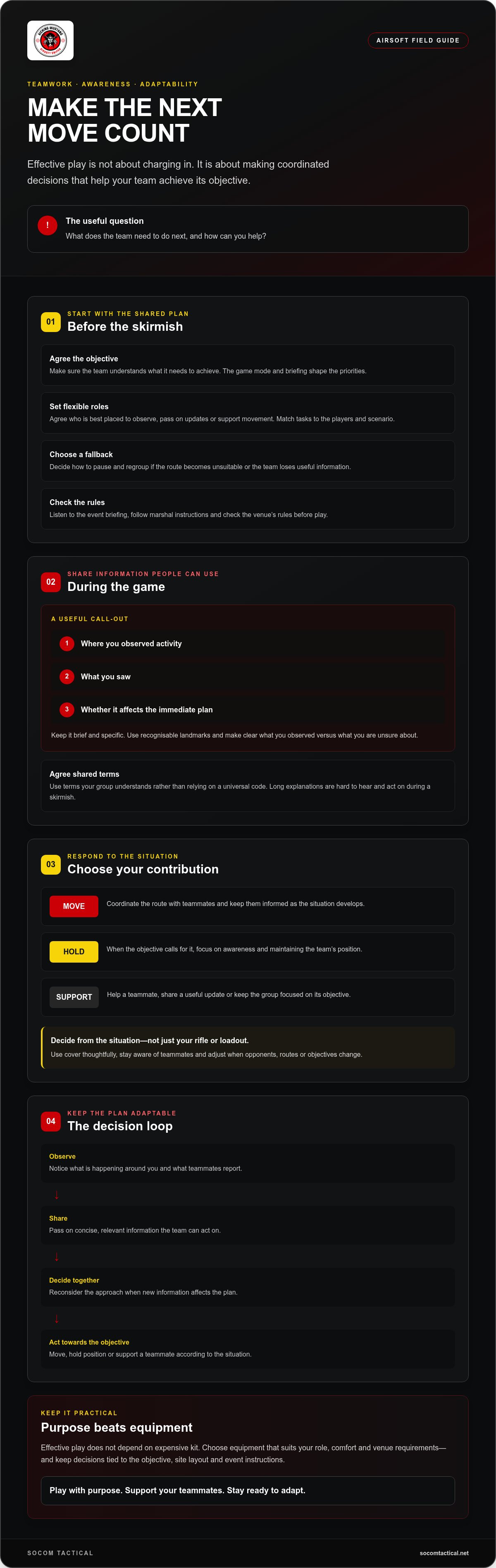
A practical airsoft gameplay checklist for before, during and after a skirmish
A repeatable routine helps you stay focused without locking the team into a plan that no longer fits. Adapt these steps to the event, and follow the briefing and marshal instructions throughout.
- Before play, listen and confirm. Make sure you understand the objective, boundaries and applicable site rules. If anything is unclear, ask before the game begins rather than relying on assumptions.
- Check your equipment. Confirm your protective equipment is suitable for the venue and correctly in place before entering play. Check that your kit feels comfortable and won’t distract you from moving or communicating.
- Agree a simple team plan. Decide how you’ll share relevant updates and where or how you’ll regroup if the team becomes separated or needs to reconsider its approach. Keep the plan flexible.
- During play, reassess. Pause when there’s a useful opportunity to check the objective, your position and information from teammates. If circumstances have changed, communicate and adjust in line with the event rules.
- After the game, review. Name one decision that helped the team and one you’d handle differently next time. Keep feedback specific and constructive, so the whole group can learn without turning the discussion into blame.
The reassessment doesn’t need to be lengthy. If a teammate shares information that changes your understanding of the objective, check whether the current plan still makes sense. When the game ends, compare what the team expected with what actually happened. That turns a single skirmish into useful experience for the next one.
Preparation, clear communication and honest review make play more deliberate, one decision at a time. These Tactical Gameplay Tips & Strategy are most useful when they support the event’s instructions, not replace them.
For kit that supports comfort and movement, browse tactical clothing and gear and check that your choices suit the venue’s guidance.
Turn tactical gameplay tips into a field-ready setup and next steps
Good decisions come first; equipment should make them easier to carry out. Use what you’ve learnt about your role and the event to build a setup that feels comfortable, works with the kit you already own and meets the venue’s requirements. No single loadout suits every player or game, and extra equipment won’t replace practice or teamwork.
Choose equipment that supports your way of playing
Think about what you need to carry, how you move and whether your equipment stays comfortable throughout play. Check fit and compatibility with your existing setup, and follow the venue’s guidance for permitted equipment. A useful setup is one you can manage without distraction, not one that dictates how you should move or play.
If you’re considering a different platform, compare options against your role and the event requirements rather than assuming a particular style guarantees better results. You can explore the airsoft guns range as one step in that decision, then check the relevant site guidance before choosing equipment.
When to seek equipment advice or technical support
If a fault, fit issue or maintenance question is affecting your readiness, get the equipment checked before relying on it in a game. Socom Tactical Airsoft offers technical maintenance, fault diagnosis and performance upgrades. These services can help address equipment concerns, but they’re separate from learning the venue’s rules and developing your skills with your team.
Build on your Tactical Gameplay Tips & Strategy by keeping your choices practical: match your kit to your role, comfort and venue, then focus on communication and sound decisions. If you have an equipment question, contact Socom Tactical Airsoft for guidance, or explore suitable kit at your own pace.
Take your next game plan onto the field
Better airsoft play comes from deliberate choices: keep the objective in view, share useful information and adjust your position as the situation changes. You don’t need to be the most experienced player or carry the most advanced kit to help your team. Apply these Tactical Gameplay Tips & Strategy one decision at a time, always following the event briefing and venue rules.
Choose equipment that suits your role, feels comfortable and meets your venue’s requirements. It can support your preparation, but practice, communication and teamwork remain central to effective play.
Socom Tactical Airsoft is a UK specialist airsoft retailer founded in 2009, with technical maintenance, fault diagnosis and performance upgrades available for equipment questions. Explore suitable kit for your next game, or seek guidance if a fault or maintenance concern is affecting your readiness.
Explore airsoft equipment and get ready for your next game. Take the plan, work with your team and enjoy the next skirmish.
Frequently Asked Questions
How can I improve my airsoft tactics as a beginner?
Start by learning the objective and venue instructions, then focus on staying aware and sharing useful information with your team. You don’t need to lead or make complicated plans to contribute. Pick one habit to practise, such as checking where your teammates are before changing position. These Tactical Gameplay Tips & Strategy work best when you review what happened afterwards and choose one decision to improve next time.
What is the most important tactic in airsoft?
The most important tactic is working together towards the objective. A team that shares relevant observations and adjusts its approach can make better decisions than players acting separately. Keep your choices tied to the game mode and briefing: the priorities for holding an objective may differ from those for reaching one. There isn’t a single tactic that suits every situation, so communicate, stay aware and follow the venue’s rules.
How do you communicate with teammates during an airsoft game?
Use short, clear call-outs that give teammates information they can act on. Share what you observed, where you saw it using a recognisable landmark, and whether it affects the team’s immediate plan. Agree any shared terms before play rather than assuming there’s a universal vocabulary. Listen as well as speak, avoid unnecessary chatter and use only communication methods permitted by the venue. Keep messages relevant and follow marshal instructions.
Is positioning more important than having a better airsoft gun?
A suitable rifle can support your role, but it can’t replace sound positioning or teamwork. Consider the objective, available cover, visibility and where your teammates are before deciding whether to move, hold or support someone. The best position depends on the situation and venue rules, not simply on the equipment you carry. A familiar, appropriate setup can help you stay focused, but it won’t make every position or decision effective.
How do I know when to move or hold position in airsoft?
Check whether your current position still supports the objective and your team’s plan. Moving may make sense if the team needs support elsewhere and the route is appropriate under the venue’s rules. Holding may be more useful if you can maintain awareness or share relevant information from where you are. Listen to teammates, consider available cover and visibility, and follow the briefing rather than moving automatically.
What should I do if my team’s airsoft plan stops working?
Pause when practical, share what has changed and reassess the objective with your teammates. Check whether the plan still fits the information available, then agree a simple adjustment or regroup if needed. Don’t keep following an approach just because it was the original plan, and don’t improvise in a way that conflicts with marshal instructions or site rules. After the game, discuss what you learnt constructively, without blaming individuals.
Do I need expensive tactical gear to play airsoft effectively?
No. Effective play depends more on awareness, communication and decisions than on the price or complexity of your kit. Prioritise suitable protective equipment and gear that feels comfortable, works with your existing setup and meets the venue’s requirements. Learn to use what you have before adding more. Equipment can support your role, but it can’t replace practice, teamwork or following the event briefing and site instructions.