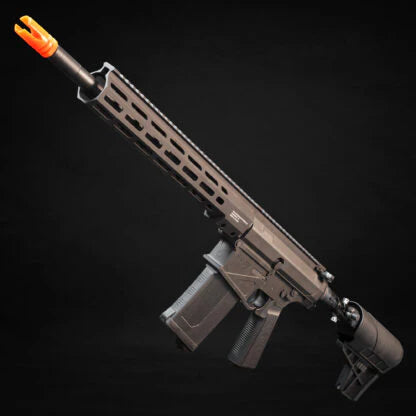
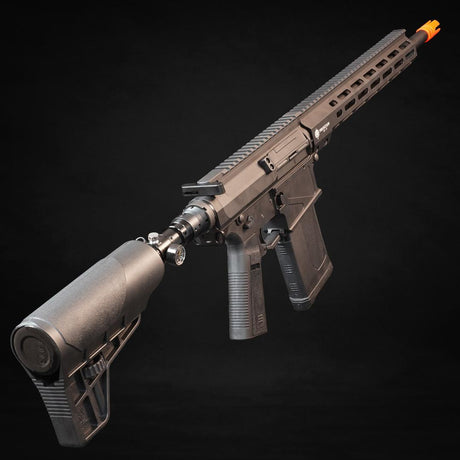
Fitment, not the carbon finish, should guide your choice of Strike carbon airsoft accessories. A barrel nut provides the mounting interface for a compatible carbon handguard, while a carbon-fibre suppressor is a separate accessory fitted at the muzzle. They have different roles, so each part must suit the replica and its attachment points.
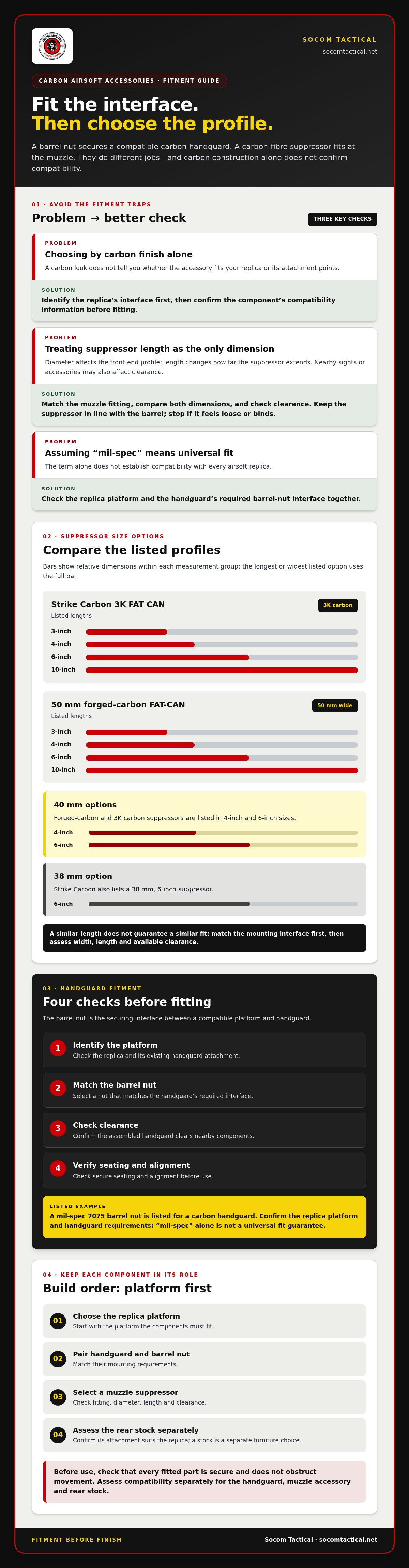
That distinction matters when planning an external build: the handguard’s mounting arrangement and the suppressor’s muzzle interface both determine whether the setup fits. Carbon construction alone doesn’t establish compatibility. This guide explains the role of barrel nuts, what to consider when choosing a carbon-fibre suppressor, and which fitment details matter. Understanding how each accessory contributes to the build helps you choose the right parts and avoid treating two different components as interchangeable.
Key Takeaways
- Choose a carbon-fibre suppressor by matching its attachment interface and dimensions to your replica, not by appearance alone.
- Understand how a barrel nut secures a compatible carbon handguard and why the mounting system matters to your build.
- Separate UK legal requirements from individual site rules when planning accessory changes for skirmish use.
- Review the suppressor size options in the guide to narrow down a setup that suits your replica’s configuration.
- Explore Socom Tactical Airsoft’s AEG Airsoft Rifles if you’re considering a platform to build around.
Carbon-fibre airsoft suppressors
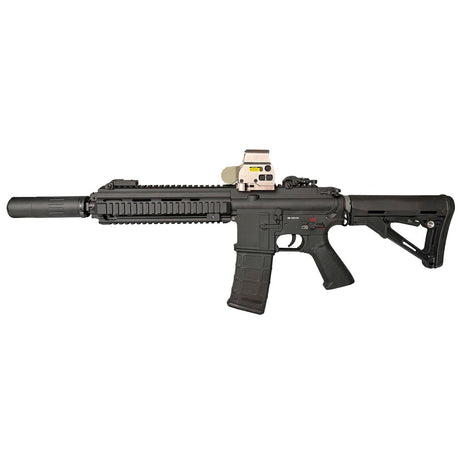
Carbon-fibre suppressors add a distinctive profile to an airsoft replica. Their dimensions shape the front-end appearance and affect how the replica handles in close spaces. Strike Carbon examples include 3K carbon and forged-carbon designs. The range includes different diameters and lengths, so compare the dimensions before choosing. A larger can may change the replica’s balance and obscure nearby accessories. A longer can extends the muzzle profile. Neither feature makes every model suitable for every replica.
Start by identifying the attachment interface. Check the replica’s muzzle fitting, then match it to the suppressor’s fitting and confirm compatibility information before installation. A mismatch can prevent secure attachment or leave the suppressor misaligned. Check for nearby front sights, muzzle devices or other accessories that could affect clearance. Keep the suppressor aligned with the barrel, and stop if it feels loose or binds during fitting.
Strike Carbon’s 3K FAT CAN is offered in 3-inch, 4-inch, 6-inch and 10-inch sizes. Its size options provide different visual proportions, rather than a single fixed profile. The 50 mm-wide forged-carbon FAT-CAN is also offered in 3-inch, 4-inch, 6-inch and 10-inch sizes. That 50 mm width creates a visibly broader front end than a slimmer profile. A 6-inch FAT-CAN, for example, extends further than its 3-inch counterpart. Compare both diameter and length against your intended setup.
Other options include 40 mm forged and 3K carbon suppressors, offered in 4-inch and 6-inch sizes. Strike Carbon also lists a 38 mm, 6-inch suppressor. These measurements describe different profiles, so don't assume that a similar length means a similar fit. First match the mounting interface. Then assess the replica’s available clearance and preferred proportions. The 40 mm and 50 mm options differ in width, while length changes how far the accessory projects forward.
Handguards, barrel nuts and rear stocks
A carbon-fibre handguard changes the replica’s fore-end, but its mounting system determines compatibility. The Strike Carbon 50 mm-wide forged-carbon/3K handguard is one example. Its barrel nut is the interface securing the handguard to a compatible platform. A mil-spec 7075 barrel nut is listed for a carbon handguard. The term “mil-spec” alone doesn't establish fitment with every airsoft replica. Check the platform and handguard requirements together before selecting the nut. For related component categories, browse the airsoft RIF accessories page.
Use this fitting sequence to reduce compatibility mistakes:
- Identify the replica platform and existing handguard attachment.
- Match the barrel nut to the handguard’s required interface.
- Confirm that the assembled handguard clears nearby components.
- Check alignment and secure seating before use.
A carbon-fibre rear stock is a separate furniture choice, not part of the handguard. Strike Carbon lists a carbon-fibre rear stock, but its name alone doesn’t specify the attachment system. Compare the replica’s stock interface with the stock’s intended fitment before choosing. Consider how its shape sits against your shoulder and supports your usual position. A suppressor, handguard and rear stock each change a different part of the replica, so assess compatibility separately before considering the completed build.
For a coherent setup, choose the replica platform first. Then match the handguard with its barrel nut, select a suppressor by fitting, diameter and length, and finish with a compatible rear stock. This order gives each component a clear role and prevents the muzzle accessory from dictating the handguard interface. Before using the replica at a game, check that every fitted part is secure and doesn’t obstruct movement.
You can assess related components alongside your front-end choices, but each needs its own fitment check. Before choosing a stock, confirm that its attachment suits the replica and consider how the change works with the rest of the setup. A listed price alone doesn’t establish compatibility or explain how the stock fits.
Compare this option with the suppressors described above by checking its dimensions and mounting interface against your replica, rather than choosing by appearance or price alone. Check clearance around nearby parts and confirm that the suppressor sits securely and in line with the barrel. If fitment is uncertain, review the product’s compatibility information before installation.
Are there UK laws or site rules affecting Strike Carbon airsoft accessories?
Consider two separate questions before changing a replica: the legal context surrounding it and its use, and the individual airsoft site’s equipment rules. A carbon-fibre finish doesn’t answer either question, and a suppressor’s appearance doesn’t establish how a site will treat it. Keep these decisions distinct and assess the complete setup, not just one component.
For UK players, start with the replica, not the accessory label. A handguard, barrel nut or rear stock forms part of a broader configuration. A suppressor attaches at the muzzle and changes the replica’s external profile. None of these components provides a complete legal assessment. Don’t treat “airsoft accessory” as a universal legal category; the circumstances and the complete replica remain relevant.
This distinction also prevents a common mix-up: site permission isn’t the same as a legal rule. A game site sets conditions for play at its venue, which may cover equipment, safe handling and how replicas are presented. Requirements vary between sites, so an accessory accepted at one venue isn’t automatically accepted at another. Read the rules for the specific game and venue rather than relying on another player’s experience.
Check the venue’s equipment rules
Use this sequence before packing a modified replica:
- Find the rules for the exact site and game session.
- Look for wording about replica attachments and external modifications.
- Compare that wording with your fitted suppressor or handguard.
- Keep the site’s instructions with your equipment preparations.
For example, a long muzzle attachment changes the replica’s overall profile, while a broad handguard changes its fore-end shape. Neither determines what a venue will allow. Check the site’s own written conditions before playing there. If the wording is unclear, resolve the question with the site before travelling. That can help prevent an equipment dispute from disrupting your game day.
Keep legal questions separate from practical site checks. Don’t infer a legal outcome from carbon construction, a product name or an accessory’s dimensions. These details describe the component, not every circumstance related to its ownership or use. Likewise, a site rule doesn’t establish a general rule for the whole UK. Assess each question on its own terms and don’t repeat unsourced legal claims as settled fact.
Before fitting accessories, record the setup clearly. Note the replica model, the attachment fitted and any changes made. Keep the product descriptions or fitting instructions with your notes. If a site’s rules mention muzzle devices, compare them with the part actually fitted. If they refer to the replica’s configuration, assess the complete build. This preparation gives you specific details to discuss instead of relying on assumptions.
A field-ready check should cover fit and venue requirements. Confirm that the accessory sits securely and doesn’t obstruct normal handling, then check the site’s published conditions for the replica and its attachments. These are separate checks, not substitutes for each other. Secure fit doesn’t guarantee site acceptance, and site acceptance doesn’t establish legal suitability in every context. Keep that distinction clear when planning changes.
When planning a build, use accessory descriptions to identify components, not to settle legal questions. The airsoft RIF accessories page can help you explore related equipment categories. For a particular UK game, let the venue’s own rules guide what you bring. For legal decisions, rely on appropriately qualified advice and the applicable law, not assumptions drawn from a product’s carbon-fibre construction.
Socom Tactical Airsoft: AEG Airsoft Rifles
Socom Tactical offers AEG airsoft rifles for players choosing a platform before planning further upgrades. Start with the role you want your replica to fill, then consider how its existing configuration affects accessory choices. AEGs provide an electric platform; gas blowback pistols, spring sniper rifles and airsoft shotguns offer different formats to consider.
Once you’ve settled on a platform, matching compatible components becomes more straightforward. Review the airsoft gun range to explore the available replica categories and compare them with your build plans.
Explore Socom Tactical’s range of airsoft platforms at socomtactical.net to choose a suitable starting point for your build.
Build towards your next game
Make your next upgrade part of a considered build, not a standalone change. Treat Strike carbon airsoft accessories as components of a wider setup, choosing each part to support the role you want your replica to fill. As you refine your plans, consider how Strike carbon airsoft accessories suit your play style and overall configuration.
If you’re still choosing a platform, Socom Tactical offers AEG airsoft rifles, gas blowback pistols and spring sniper rifles. Decide which format suits your approach before planning the rest of your setup. A clear starting point makes later equipment decisions easier to assess.
Ready to take the next step? Contact Socom Tactical Airsoft and move your build forward with confidence.
Frequently Asked Questions
Where can I buy Strike Carbon airsoft accessories in the UK?
Socom Tactical Airsoft is the retailer referenced for related airsoft accessories. Free UK shipping is offered on orders over £75.
How much do Strike Carbon airsoft accessories cost in the UK?
Which Strike Carbon accessories fit common airsoft guns and platforms?
Compatibility depends on the replica platform and attachment interfaces, not just the accessory type. Match the barrel nut to the handguard’s required interface and the suppressor fitting to the replica’s muzzle fitting. Check the manufacturer’s compatibility information before fitting either part.
How do Strike Carbon accessories compare with similar airsoft accessories?
The guide describes Strike Carbon accessories by their carbon-fibre construction and available profiles, including suppressors with different widths and lengths. It doesn’t directly compare their performance or quality with similar accessories.