What if your replica is within the legal energy threshold but still fails the site chrono? It’s a common source of confusion. A standard AEG site limit is often around 350 FPS with a 0.20g BB, but that isn’t a universal UK legal limit. So, what FPS limits apply in the UK? The answer depends on the replica’s firing capability, its muzzle energy and the rules of the site you’re playing at.
It’s easy to focus on the FPS figure, especially when limits vary between standard rifles, DMRs and bolt-action snipers. But FPS measures velocity, while joules account for the BB’s weight as well. A reading that looks acceptable with one BB weight may not tell the whole story.
This guide explains how legal thresholds differ from individual site limits, how FPS and joules relate, and why higher-powered setups can come with extra restrictions, such as a minimum engagement distance. You’ll also learn what to expect at a chrono check and how to prepare your replica for a safe, consistent reading.
Key Takeaways
- What FPS limits apply in the UK? The answer depends on legal classification as well as the rules of the site you’re attending.
- BB weight affects how a chrono reading relates to energy, so FPS alone doesn’t tell the full performance story.
- Sites may set different limits for replica categories, firing modes and gameplay roles. Check the rules for your setup.
- Prepare for a chrono check by confirming your replica category, the BB weight and the site’s stated test procedure before game day.
- Choose and maintain a replica for consistent, repeatable readings rather than chasing a headline FPS figure.
What FPS limits apply in the UK: law or airsoft site rules?
There isn’t one FPS figure that applies as the game limit at every UK airsoft site. The important distinction is between legal energy thresholds, which help define whether a replica falls within the statutory airsoft-gun category, and a site’s own rules for play. They answer different questions. A replica may sit below a legal threshold but still exceed the limit or fail the chrono procedure at the venue you’re attending.
What does FPS mean for an airsoft replica?
FPS means feet per second, a measure of how quickly a BB travels as it leaves the barrel. A chronograph records that velocity, and some devices can also calculate muzzle energy when you enter the BB weight. FPS tells you a projectile’s speed, not the complete muzzle energy of the shot. Joules are the unit of energy used in legal definitions and many site rules, so read the unit and test conditions alongside any reported figure.
Is there one UK-wide airsoft site limit?
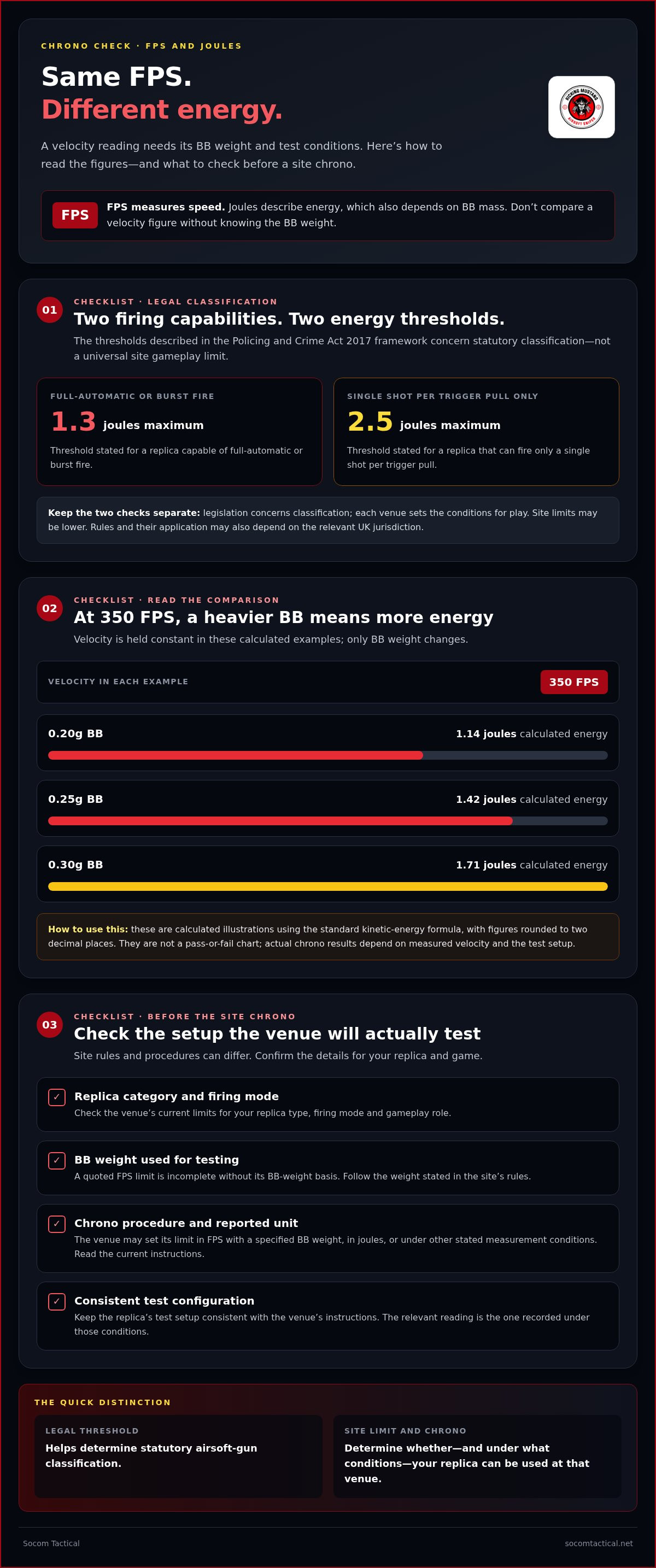
No. Legislation and field rules aren’t interchangeable: the legal threshold concerns classification, while a site’s limit governs whether and how a replica can be used during its games. Under the thresholds described in the Policing and Crime Act 2017 framework, the maximum muzzle energy for an airsoft replica capable of full-automatic or burst fire is 1.3 joules. For a replica that can fire only a single shot per trigger pull, the threshold is 2.5 joules. These are energy figures, not universal FPS allowances.
Exceeding the relevant threshold can mean the device no longer falls within the statutory airsoft-gun definition. That’s separate from passing a site’s chrono: a venue may set a lower gameplay limit and specify the BB weight, firing mode or measurement method it uses. Passing one test therefore doesn’t automatically settle the other.
Legal scope also matters. Rules and their application may depend on the relevant UK jurisdiction, so don’t assume a general summary covers every circumstance. Check current legislation and official guidance for the part of the UK relevant to possession or use. For broader background, Airsoft Legal Restrictions in the UK summarises the topic, but it isn’t a substitute for the legislation itself.
Before travelling to a game, read the venue’s current limits and chrono instructions, including any rules for replica category or firing mode. The site’s stated procedure determines whether your setup is ready for play. Keep the distinction clear: the law sets a classification boundary; the site sets the conditions for its games.
How joules, FPS, and BB weight affect an airsoft reading
A chrono reading needs context. FPS records how fast a BB leaves the barrel, but the BB’s mass also affects its kinetic energy. That’s why the same FPS reading can correspond to different joule figures with different BB weights. You can’t compare FPS and joules meaningfully without knowing the BB weight and the conditions used for the measurement.
Why BB weight changes the meaning of an FPS figure
At a fixed velocity, a heavier BB carries more energy than a lighter one. For example, using the standard kinetic-energy calculation, a BB travelling at 350 FPS produces approximately 1.14 joules at 0.20g, but approximately 1.42 joules at 0.25g. These are calculated examples, not claims about a particular replica. For practical BB selection, browse the range of airsoft BBs and match your choice to your replica and the site rules.
How to read an FPS-to-joule comparison
The table holds velocity constant to show how changing BB mass affects calculated energy. It assumes the BB travels at 350 FPS, uses the listed mass and applies the standard kinetic-energy formula. Figures are rounded to two decimal places. Actual chrono results depend on the measured velocity and test setup.
| BB weight | Velocity | Calculated energy |
|---|---|---|
| 0.20g | 350 FPS | 1.14 joules |
| 0.25g | 350 FPS | 1.42 joules |
| 0.30g | 350 FPS | 1.71 joules |
Use this as an illustration, not a pass-or-fail chart. If the BB weight changes, the same displayed FPS doesn’t mean the same energy. A calculation can’t replace a site’s chrono check, which may specify the BB weight and procedure to use. Follow those instructions rather than treating a conversion table as your final result.
A quoted FPS limit is incomplete unless its BB weight is stated. You may see figures paired with 0.20g BBs, but don’t assume that basis applies to every rule or test. Check the exact wording: a site may set its limit in FPS with a specified BB weight, in joules, or under conditions described in its chrono policy. That context helps answer “What FPS limits apply in the UK?” without mistaking one conversion for a universal allowance.
Keep your replica’s test configuration consistent with the venue’s instructions, including the BB weight used for testing. The relevant result is the one recorded under the site’s stated conditions, not a headline velocity from a different setup.
Why airsoft FPS limits vary between sites and replica types
Two players can arrive with different replicas and face different site conditions, even if both have checked their equipment against the relevant legal framework. A game venue sets rules for the replicas and play styles it allows. Those rules may distinguish by replica category, firing mode or role on the field, so a limit quoted by another site or player isn’t a reliable guide to your booking.
That’s why “What FPS limits apply in the UK?” doesn’t have one site-wide answer. The practical answer depends on the venue, the replica category and the current rules for that game. Treat examples you hear elsewhere as context, not permission to use the same setup at your next event.
Do AEGs, pistols, and sniper replicas follow the same site rules?
Not necessarily. A site may set different conditions for an AEG, a gas blowback pistol or a spring sniper rifle, based on how each is used in its games. It may also classify replicas by gameplay role rather than appearance alone. These are examples of categories a site could use, not a promise that every venue separates them in the same way.
Check how the venue defines each class. A rifle’s appearance or your preferred play style may not be enough to qualify it for a particular category. Look for requirements about firing mode, configuration or permitted role, and use the site’s own wording when deciding which rules apply.
What role do firing mode and engagement rules play?
Firing mode can matter because a site may impose separate conditions on replicas that can fire automatically and those restricted to single shots. Gameplay rules may also set a minimum engagement distance for certain setups, or describe what players should use at closer range. These are venue policies for safe, fair play, distinct from legal classification and energy thresholds.
Before your game, read the specific site’s current rules and booking information. Look for details such as:
- How the venue defines replica categories and gameplay roles.
- Whether it sets different conditions for automatic, burst or single-shot firing.
- Any minimum engagement distance or close-range requirements.
- The stated chrono method, including BB weight and the configuration to be tested.
Check the site rule for your game separately, even if you already know the replica’s energy reading. Don’t rely on an old screenshot, a rule from a different venue or a general FPS chart. Site policies can differ and may be updated, so use the latest published instructions for your booking. If a category or condition is unclear, resolve it before arriving with the replica you intend to use.
Preparing in advance can prevent a frustrating surprise at check-in. Match the replica to the site’s stated category, bring it in the configuration you plan to use and follow the venue’s chrono process. That makes the check more straightforward and clarifies what’s permitted on that field.
How to prepare for an airsoft chrono check safely
A smooth chrono check starts before you reach the site. Bring the replica in a safe condition, know which category it falls under and be ready to follow the venue’s process. The check establishes whether your setup meets that game’s rules, so an accurate, honest test configuration matters more than a figure recorded at home.
What should you check before travelling to a game?
Use this checklist to prepare:
- Read the current site rules. Find the limits for your replica category and note the venue’s stated chronograph procedure.
- Confirm the category. Check how the site classifies your replica and whether firing mode or gameplay role affects its requirements.
- Check the BB weight. Use the weight specified for the test. If the rules name a particular BB weight or require testing with your intended game weight, follow that instruction.
- Keep the setup honest. Bring the replica in its normal operating configuration. Don’t fit a velocity reducer, switch BB weights or otherwise alter the setup to disguise its output or evade a limit.
- Make it safe to handle. Before approaching the chrono station, remove the magazine, clear the chamber and engage the safety. Keep your eye protection on and follow staff directions throughout.
These checks help avoid confusion, but they don’t replace the site’s test. Chronographs, test conditions and handling instructions can differ, so let staff direct the game-day process. Don’t fire or handle the replica at the station until instructed.
What happens if a replica exceeds the site’s limit?
The venue applies its published procedures and decides whether the replica can be used in that game. The outcome depends on that site’s rules, so don’t assume there will be a retest, an adjustment opportunity or permission to use it in another role. Listen to staff and follow their instructions.
Never try to bypass the check or misrepresent the BB weight or configuration being tested. That undermines the reading and can create a safety issue. If a result surprises you, keep the replica safe and speak with the staff member running the check rather than attempting a quick alteration at the chrono station.
For broader context on responsible play and legal restrictions, the Airsoft overview includes a section on UK legal considerations. For replica maintenance or upgrades that support dependable performance, explore airsoft parts and upgrades.
Choosing and maintaining an airsoft replica within the rules
A replica that suits your play style still needs to fit the rules of the games you intend to attend. Before choosing, check the applicable legal requirements and the current rules of your preferred site. These are separate considerations: a replica’s legality doesn’t guarantee it meets a venue’s gameplay limits or category conditions.
Don’t choose by headline FPS alone. A reliable, repeatable reading under the site’s stated test conditions is more useful than a high velocity figure recorded with different BBs or in a different setup. Consistency helps you understand how your replica performs and gives you a sound basis for checking it against the rules.
How to match a replica to the games you play
Start with the site’s replica categories, firing-mode requirements and engagement rules. Then consider your intended role: an AEG may suit one style of play, while a gas blowback pistol or spring sniper rifle may suit another, subject to that venue’s conditions. Compare categories and intended use in this guide to airsoft guns, then make sure your choice fits the games you plan to attend.
Rules first, kit second. This keeps your decision grounded in how you’ll play, rather than an assumed universal FPS allowance.
When should a replica be checked or serviced?
Arrange a fresh check after repairs or internal changes, and investigate inconsistent readings before taking the replica to a game. Upgrades can affect performance, so make changes responsibly and test the setup in line with the venue’s procedure. Explore airsoft parts and upgrades with compatibility and rule compliance in mind. No change should be treated as proof that a setup will pass a site chrono.
Routine maintenance also supports dependable use. Keep a note of relevant changes and test results, including the BB weight and conditions used, so you can spot variation rather than relying on memory. If readings shift unexpectedly, avoid guessing at the cause or making a last-minute adjustment to chase a particular number. Have the replica checked appropriately, then follow the specific site’s test requirements before play.
Keep the decision process simple: check the legal framework, read your chosen site’s current rules, select a replica that fits your intended games, and maintain it for consistent performance. Socom Tactical Airsoft sells AEG airsoft rifles and other airsoft guns, and provides maintenance and upgrade services to help you choose and maintain your setup.
Make your next replica choice field-ready
Turn the rules into a practical decision before you buy or modify a replica. Think about the games you want to play and the setup you can keep consistent within their requirements. A dependable configuration gives you a clearer starting point for maintenance, future upgrades and site checks, without making headline FPS the goal.
Socom Tactical is an independent specialist retailer offering airsoft guns, tactical gear and accessories, alongside technical maintenance and upgrade services. Browse the range and choose a replica that fits your plans: explore airsoft guns.
Still asking, “What FPS limits apply in the UK?” Match your chosen replica to the rules for your intended game, then keep its performance consistent. Prepare before your next session and follow the site’s chrono procedure.
Frequently Asked Questions
What is the legal FPS limit for airsoft guns in the UK?
There isn’t one legal FPS figure: statutory thresholds are expressed in muzzle energy and depend on firing capability. Under the relevant UK legal framework, the threshold is 1.3 joules for a replica capable of full-automatic or burst fire, and 2.5 joules for one that can only fire a single shot per trigger pull. What FPS limits apply in the UK? For your circumstances, check current legislation and authoritative guidance for the relevant jurisdiction.
Is there a difference between an FPS limit and a joule limit?
Yes. FPS limits state a BB’s velocity in feet per second, while joule limits specify its kinetic energy. A site may express its rule using either unit, but an FPS figure only has meaning alongside the BB weight and test conditions. If a rule gives both units, treat them as linked values for its stated test setup, not interchangeable numbers that apply to every BB or replica.
Can two airsoft guns with the same FPS have different joule readings?
Yes. At the same velocity, a heavier BB represents more kinetic energy than a lighter one. For example, at 300 FPS, a 0.20g BB has approximately 0.84 joules, while a 0.30g BB has approximately 1.25 joules, using the standard kinetic-energy calculation. These are calculated examples, not chrono results. Actual readings depend on measured velocity and the test setup, so use the venue’s stated procedure.
Do airsoft sites in the UK all use the same FPS limits?
No. Each venue publishes its own gameplay limits and testing policy, and rules can differ by replica category, firing mode or game format. Before booking, look for the current rules covering your replica, the BB weight used for testing and any additional conditions for its use. Don’t rely on another site’s chart or a friend’s previous visit, even if you plan to use similar equipment.
What happens if my airsoft gun fails a chrono check?
The site will apply its own published procedure and decide whether the replica can be used in that game. Follow the chrono staff’s instructions and keep the replica safe. Don’t attempt an unapproved adjustment, swap BBs to influence the result or misstate its configuration. Avoid assuming there will be a retest or permission to use the replica in another role, and plan around the site’s rules.
Does BB weight affect an airsoft chrono test?
Yes. BB weight affects the energy represented by a velocity reading, and sites may specify the weight to use during testing. Some may require the BB weight you intend to play with, so check the written instructions before packing your ammunition. Bring the correct BBs and tell staff what you’re using. A result taken with a different weight may not reflect the setup the site wants to assess.
Are FPS limits different for AEGs and sniper rifles?
They can be, but there’s no single rule shared by all venues. A site may set separate conditions for AEGs and spring sniper rifles, or distinguish replicas by firing mode and gameplay role. Sniper-style use may also involve engagement-distance rules. Read the specific venue’s definitions and requirements before selecting your replica; don’t assume its appearance alone determines the category or the limit that applies.
Can I increase my airsoft gun's FPS to meet a site's limit?
Only consider a performance change if it’s genuinely needed to meet the site’s rules, and don’t assume increasing FPS is the right adjustment. A higher velocity could take the replica further beyond its permitted limit. Any internal change can affect the measured output, so have the setup assessed responsibly and tested under the site’s conditions before play. Never alter a replica to evade a limit or misrepresent its test configuration.