What if the best airsoft sniper on your team is the player who takes fewer shots? Sniper Role & Techniques are about more than range: patient observation, well-timed movement and clear communication can help your team read the field and act on useful information.
If you’re unsure how to contribute without playing alone, or when to hold position and when to move, you’re not the only one. A sniper role has limits, and a rifle’s reach matters less if you miss the chance to support your team or overlook a safe engagement.
This guide explains where the role fits in a skirmish and how to build practical habits for observing, communicating and deciding when to engage. It also covers preparation, teamwork and why following your site’s rules is essential for a safe, enjoyable game.
Key Takeaways
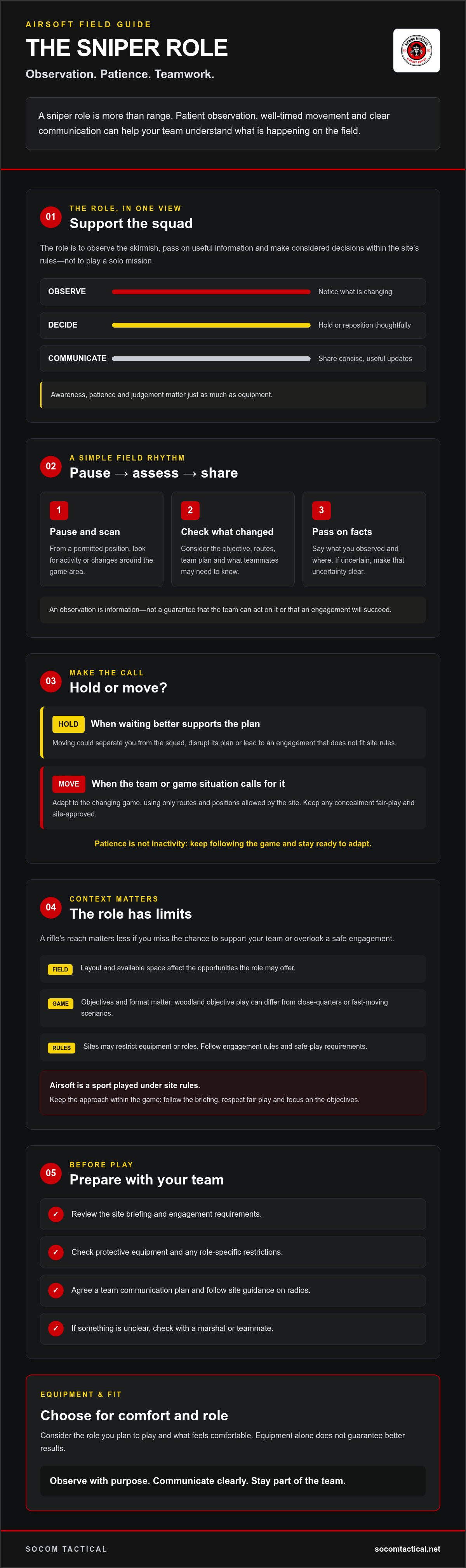
- Approach Sniper Role & Techniques as a way to support your team, not as a solo mission.
- Observe what is changing, decide whether to hold or reposition, and share concise updates.
- Consider how site layout, objectives and engagement rules affect the role’s benefits and limitations.
- Before play, review the site briefing, protective equipment and team communication plan.
- Choose equipment for comfort and the role you plan to play. No item guarantees better results.
What the Airsoft Sniper Role Actually Involves
An airsoft sniper supports their team by observing the skirmish, communicating useful information and making considered decisions within the site’s rules. The role is not simply about using a rifle with an optic or trying to engage opponents from further away. Awareness, patience and good judgement count just as much as equipment.
Airsoft is a sport played under site rules, not a simulation of military or law-enforcement duties. Although people may read about real-world sniper techniques, airsoft players should keep their approach within the game: follow the briefing, respect engagement rules and focus on the objectives. Sniper Role & Techniques are best understood as a way to contribute to a squad, not an invitation to imitate real-world operations.
How an airsoft sniper supports the team
A useful contribution might be noticing activity near an objective and passing a clear update to teammates. Keep it specific: say what you observed and where, then let the team decide how to respond. An observation is information, not a guarantee that the team can act on it or that an engagement will succeed.
Patience can help you avoid rushing into an unhelpful position or taking a shot that doesn’t fit the site’s rules. Wait, keep track of what’s happening and move when the team’s plan or the game situation calls for it. That measured approach still depends on coordination: agree how to communicate with your squad, and stay responsive to their needs. A sniper remains part of the team, even when playing at a different pace.
Is the sniper role right for every player?
Not necessarily. The role may suit players who enjoy observing, communicating and waiting for a useful moment. A slower, more measured style can feel frustrating if you prefer constant movement and frequent engagements. Be honest about what you enjoy, and adapt to your team and the game.
Field layout and game format matter, too. A woodland objective game may create different opportunities from a close-quarters or fast-moving scenario, and some sites may restrict which equipment or roles can be used. Before choosing the role, consider the objectives, the available space and the rules for that game.
If you’re new to the role, ask site staff about the rules before play, including any role-specific restrictions and safe engagement requirements. Then check in with your team about the plan. The right starting point isn’t range alone; it’s knowing how you can contribute safely and communicate well.
Sniper Role & Techniques: Observation, Patience and Communication
Effective airsoft play starts with reading the game, not rushing to take a shot. Notice where activity is building, whether an objective or route has changed hands, and what your teammates may need to know. These are adaptable habits, not guaranteed ways to gain an advantage: field layout, game format and other players’ decisions all affect what happens next.
Information is useful only when it reaches teammates clearly and helps them make their own decisions. Agree how your team will communicate before play, whether by radio or another site-approved method. Keep updates brief and specific: share what you observed and where, rather than filling the channel with guesses. Follow the site briefing on radios and in-game communication, and don’t transmit information the rules prohibit.
Observe the game and communicate clearly
Build a simple rhythm: pause, scan the game area from your permitted position, then check whether anything has changed. For example, you might notice teammates approaching an objective or activity shifting to another part of the field. Pass on only relevant observations using your agreed method. If you’re unsure what you saw, say so; clear uncertainty is more useful than presenting a guess as fact.
Keep observation within supervised airsoft play. The U.S. Army field manual concerns a real-world military context, not instructions for an airsoft skirmish. Here, your reference points are the site briefing, game objectives and fair-play rules.
Use patience and movement thoughtfully
Waiting can be the better choice if moving would separate you from the squad, disrupt its plan or lead to an engagement that doesn’t comply with site rules. Patience isn’t inactivity: keep following the game, listen for updates and be ready to adapt. A shot isn’t automatically worthwhile just because an opportunity appears.
Move when doing so supports the team or the changing game, and use only routes and positions allowed by the site. Any concealment should be fair-play and site-approved. Don’t interfere with field boundaries, structures or other players’ safe movement. If the situation is unclear, check with a marshal or teammate rather than improvising.
That’s the heart of Sniper Role & Techniques: stay observant, communicate with purpose and make decisions that fit the game. If you’re considering what equipment suits this measured style, browse airsoft rifles from Socom Tactical Airsoft, keeping your site’s rules and your own comfort in mind.
Airsoft Sniping Myths: Range Is Not the Whole Role
A rifle’s potential range can sound like the defining measure of an airsoft sniper. It isn’t. An opportunity only matters if it fits the site’s rules, the game situation and your team’s plan. A player who notices a change around an objective and passes on a useful update may contribute more than one who focuses solely on taking a long shot.
The role has possible benefits: a measured pace can leave more room to watch the game and share observations. But it also has limits. Field layout, visibility, engagement rules and the way each game unfolds all affect what’s practical. There’s no universal distance or performance benchmark that makes someone a successful sniper.
Does a longer-range rifle automatically make a better sniper?
No. Equipment capability and player contribution are different things. A rifle may suit a particular style of play, but it can’t decide whether an engagement is safe or permitted, communicate with teammates, or judge when it’s better to hold position. Those decisions rest with the player and take practice.
Before play, check the site’s rules for permitted equipment and engagement conditions. Then consider whether the game’s layout and objectives give the role a useful place. If you’re comparing rifle types or features, a dedicated airsoft sniper rifle buying guide is a better place to explore those choices; this guide focuses on playing the role well.
Why playing alone can limit your contribution
Going off on your own may feel part of the image, but isolation can cut you off from squad updates and make it harder to coordinate around changing objectives. You might observe something useful and still lose its value if teammates don’t receive the information in time to consider it.
Stay connected to your team through the communication method and plan agreed before the game. That doesn’t mean moving as a group at every moment; it means remaining responsive and sharing relevant information. Teamwork is a strength of the role, not a compromise.
There’s a similar distinction between equipment and consistency: neither a longer-range rifle nor a single adjustment guarantees accurate play. For a closer look at repeatable shot placement in supervised airsoft, a separate guide to airsoft sniper accuracy can cover that topic without confusing it with role selection.
The takeaway: range may shape your options, but judgement, practice, safe play and coordination shape how you use them. Sniper Role & Techniques are most useful when they support the game your team is actually playing.
How to Prepare for an Airsoft Sniper Game
Good preparation starts before you reach your position. A quick check of the site briefing, protective equipment and team plan helps you arrive ready to play safely and contribute from the outset. Use this checklist before each game, since site rules and objectives can vary.
- Confirm the briefing and role rules. Ask site staff about current equipment limits, engagement conditions and any restrictions for sniper roles. Don’t rely on assumptions from another site or a previous visit.
- Check your eye protection. Make sure it’s clean, undamaged, secure and suitable for the site’s requirements. Wear it as instructed, and don’t remove it in play areas.
- Review other protective equipment. Check what the site requires, such as face protection, and make sure it fits securely. Prioritise protection and comfort over carrying unnecessary kit.
- Check your equipment before play. Make sure your rifle and any permitted supporting equipment are secure and functioning as intended. Pack suitable airsoft BBs and confirm your kit complies with the briefing.
- Agree the team plan. Confirm your role, the game objective and how you’ll communicate. Keep the plan simple enough to adapt if the situation changes.
- Review the game afterwards. Share what worked and what you’d change next time. Keep the discussion constructive, without blaming teammates.
Check site rules, protective equipment and kit
Site staff are the source for the rules that apply on the day. If anything is unclear, ask before entering play rather than trying to resolve it during an engagement. Check protective equipment before each game, not just when you first pack it; damage, dirt or a poor fit can affect whether it’s ready to use. If you spot a problem, address it before play and follow staff guidance.
Keep your loadout practical. Tactical gloves, boots, a chest rig or a belt and pouches may help you carry equipment comfortably, but each item should suit the site and your needs. More kit isn’t automatically better. For broader equipment ideas, explore tactical clothing and gear.
Agree a simple team plan before play
Before the game starts, decide who is doing what and which communication method the team will use. Agree how to share a brief observation or flag a change, and keep messages within the site’s rules. Treat the objective as a guide, not a rigid script: adapt with your teammates if the game develops differently.
Preparation turns Sniper Role & Techniques into a practical plan for the day: know the rules, check your protection and kit, then stay connected to your squad. Ready your equipment, listen to the briefing and play the game in front of you.
Build Your Airsoft Sniper Setup Around the Role
Your loadout should support how you play, what the site allows and what you can comfortably carry throughout a game. A spring sniper rifle is one equipment category to consider, but choosing a rifle doesn’t define the role or guarantee a particular result. Prioritise safe, comfortable play and a setup you can manage while staying connected to your team.
Prioritise a balanced, field-appropriate loadout
Start with the essentials. Use suitable ballistic eye protection and any additional protective equipment required by the site. Practical clothing, gloves and boots can help you feel prepared for the field, whilst a chest rig, plate carrier or tactical belt may provide a way to carry the kit you actually need. Check fit and comfort before game day, and avoid adding equipment simply because it looks the part.
Think about the game format, field conditions and site rules. If you’ll be moving with teammates, consider whether your loadout lets you move comfortably and communicate without distraction. Carry only what suits your needs and is permitted. A lighter, simpler setup may be more practical for one player, whilst another may prefer different options. Neither configuration is automatically right for every site or skirmish.
Choose equipment with advice, not assumptions
Before changing parts or combining accessories, check compatibility with your rifle and confirm that any changes are allowed under the site’s rules. Don’t assume an accessory or modification will improve your gameplay; equipment choices should be based on your needs, the platform and the conditions in which you’ll use it. If you’re new to spring-powered platforms, a dedicated spring airsoft gun guide can help with the basics. A separate sniper rifle guide is the better place for model-by-model comparisons.
Keep the role at the centre of each decision. Ask yourself whether an item supports comfort, safe handling or a practical need during play. If the answer isn’t clear, leave it out until you’ve had more experience. Check your equipment before each game and ask site staff about restrictions when you’re unsure.
Sniper Role & Techniques are built on observation, judgement and teamwork, so set up around those demands rather than chasing a particular look or presumed advantage. If you’re ready to compare platforms, explore Socom Tactical Airsoft’s airsoft rifles and consider which category fits your play style and site requirements.
Take These Habits Into Your Next Skirmish
The strongest contribution in the sniper role isn’t measured by range alone. It comes from noticing what’s happening, sharing useful information and making decisions that fit the team’s plan and the site’s rules. Build your Sniper Role & Techniques around those habits, then choose a setup that feels comfortable and appropriate for the game.
Preparation matters, too. Check the briefing, make sure your protective equipment is ready and agree how you’ll communicate before play begins. Afterwards, reflect on what helped the team and what you might adjust next time. Small lessons from each game can help you become a more confident, dependable squad member.
If you’re considering equipment for your role, Socom Tactical Airsoft offers spring sniper rifles and protective equipment among its airsoft product categories. Explore Socom Tactical Airsoft’s airsoft rifles and consider what suits your needs and site requirements. Go into your next game ready to observe, communicate and play as part of the team.
Frequently Asked Questions
What does an airsoft sniper do?
An airsoft sniper contributes to a team during a skirmish by observing play, sharing relevant information and exercising patience and judgement. Their responsibilities depend on the site rules, field layout and game format. The role is part of sporting airsoft, not a real-world military equivalent. Follow the briefing, respect engagement procedures and coordinate with teammates so observations support the agreed objective.
Is airsoft sniping suitable for beginners?
Beginners can explore the role if they understand the game rules, communicate with teammates and enjoy a patient style of play. Not every format or field suits the same approach, so ask site staff whether the role is appropriate for the game. First, get comfortable with core safety requirements and the basics of skirmish play. That foundation helps you make informed decisions as you try a more specialised role.
How can I improve as an airsoft sniper?
Practise noticing changes in the game, sharing clear updates with your team and waiting for decisions that fit the situation. After each game, reflect on what helped and what you might approach differently next time. Sniper Role & Techniques depend on field layout, site rules and teamwork, so results vary. Build experience through supervised play, follow the site briefing and ask staff when you’re unsure about a procedure.
Do airsoft snipers always play alone?
No. Playing alone isn’t a requirement; an airsoft sniper can support teammates by sharing observations and working towards agreed objectives. How close you stay to the squad or how you move around the field depends on the game format and site rules. Agree a communication method before play, keep teammates updated and don’t act outside the briefing. The role is one way to contribute to the team, not a separate game.
Does a longer-range airsoft rifle make a better sniper?
No. Range alone doesn’t determine whether you contribute effectively. Site rules and field conditions shape what equipment is appropriate, whilst judgement, communication and awareness of the wider game shape how you use it. A rifle’s capabilities can’t replace practice or teamwork, and no particular performance should be assumed. Consider rifle selection separately from learning the role, and check that any equipment you use is permitted at your site.
What should I wear for an airsoft sniper role?
Choose protective equipment that meets the site’s requirements, alongside comfortable clothing suited to the conditions and your planned role. Check ballistic eye protection carefully before play, and confirm whether the site also requires face protection or other kit. Keep your loadout practical, secure and manageable. Requirements can vary, so follow the briefing and check that your equipment fits properly and is ready to use.
What rules should airsoft snipers check before a game?
Read the site briefing and ask staff to clarify any current rules that apply to your role. Check for role-specific equipment limits, engagement procedures and any instructions about communication or movement. These can vary between sites and game formats, so don’t assume rules from a previous skirmish still apply. Follow the site’s directions throughout play, and pause to ask a marshal if you’re uncertain about a situation.